The Threat against Man's Transgression for the sake of Wealth
Allah informs that man is very pleased, most evil, scornful and transgressive when he considers himself self-sufficient and having an abundance of wealth. Then Allah threatens, warns and admonishes him in His saying,
إِنَّ إِلَى رَبِّكَ الرُّجْعَى
(Surely, unto your Lord is the return.) meaning, `unto Allah is the final destination and return, and He will hold you accountable for your wealth, as to where you obtained it from and how did you spend it.'
Scolding of Abu Jahl and the Threat of seizing Him
Then Allah says,
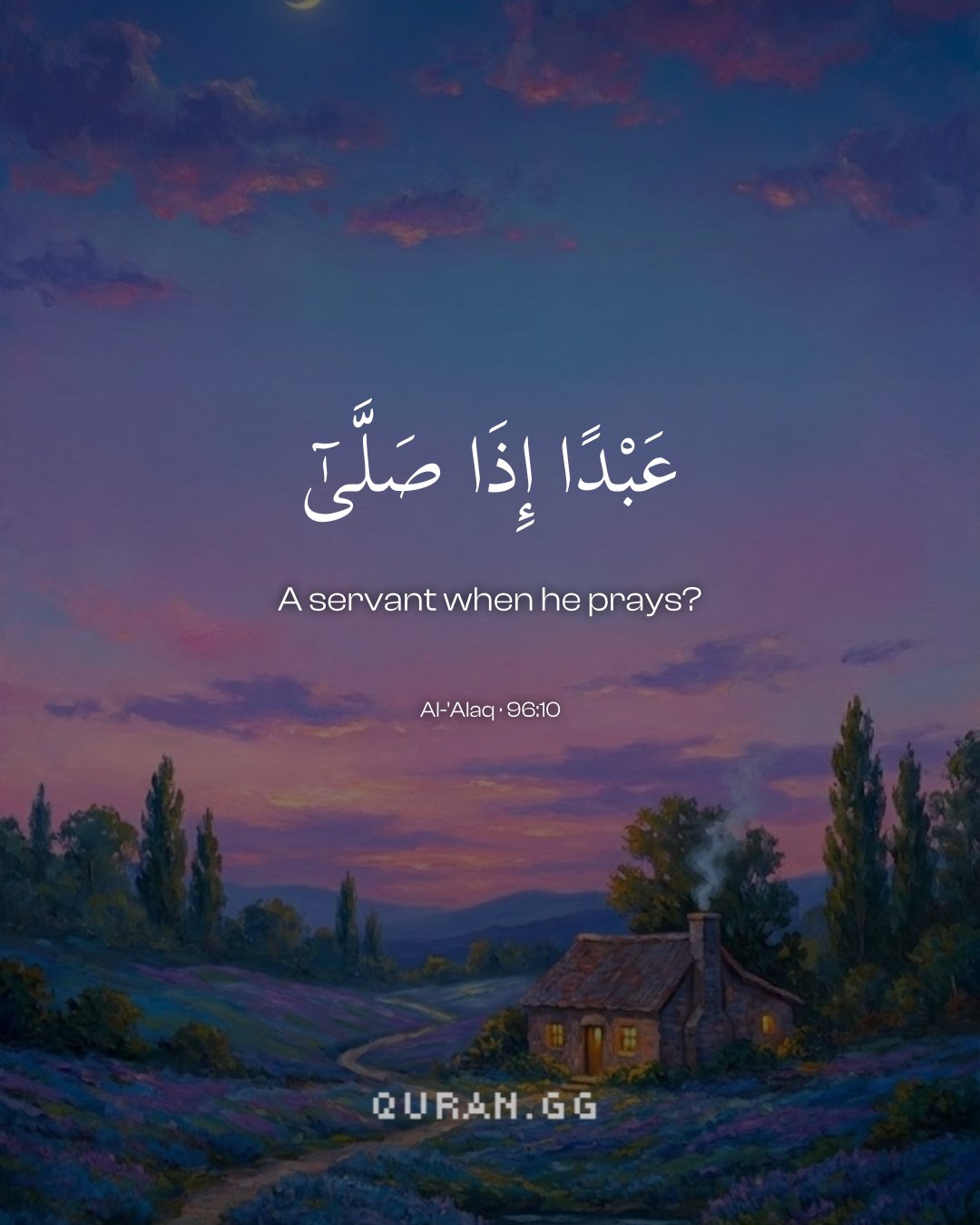
أَرَأَيْتَ الَّذِى يَنْهَى - عَبْداً إِذَا صَلَّى
(Have you seen him who prevents. A servant when he prays) This was revealed about Abu Jahl, may Allah curse him. He threatened the Prophet for performing Salah at the Ka`bah. Thus, Allah firstly admonished him with that which was better by saying,
Verses [ 9-10] أَرَأَيْتَ الَّذِي يَنْهَىٰ عَبْدًا إِذَا صَلَّىٰ أَرَأَيْتَ الَّذِي يَنْهَىٰ (Have you seen him who forbids a slave of Allah when he prays?) From here to the end of the Surah, the verses allude to an incident. When the Holy Prophet was enjoined to perform the salah, he started performing it at first privately, later in public in the Sacred Mosque. Abu Jahl stopped him from performing salah and threatened him that if he were to perform salah and prostrate, he would [ God forbid!] trample his neck. Verse [ 14] أَلَمْ يَعْلَم بِأَنَّ اللَّـهَ يَرَىٰ (Does he not know that Allah is watching?) is in response to the threat made by Abu Jahl, and the verse does not mention whom He is watching. It is of general application - He is watching the pious personality who is performing the salah, as well as the wretched, miserable person who is obstructing the performance of the salah. Here the statement merely asserts that Allah is watching everything and everyone. It does not specify what will happen at Resurrection, because the horrible, terrible and dreadful scenes of that are unimaginable.
Tazkirul Quran
Maulana Wahiduddin KhanOn ayahs 5–18
The first five verses of this chapter were the very first verses which were revealed to the Prophet Muhammad. Almighty God created man out of ordinary material elements. Then He blessed him with the rare capacity to read and to understand the import of what he read. Then, man was given the additional capacity to use the pen and thus systematise and preserve his knowledge. While the capacity to read enables a man to acquire knowledge, the pen makes him capable of spreading this knowledge to others on a large scale. The ‘pen’ is a symbol of knowledge. In other words, through written words the believers are enjoined to acquire and spread the knowledge of the truth, wisdom and beauty of Islam. Today, spreading the word of God will be done by means of printed material and through other means of communication which includes the internet and the multimedia. Translations of the Quran in various languages, Islamic books and other printed material on Islam should be distributed as a part of dawah work on a large scale, so that the word of God reaches each and every home—big or small as predicted in a hadith (Musnad Ahmed). Thousands of men and women are dying every day without having had the message of God conveyed to them; without having had the opportunity to accept it, they have missed their chance of improving their lives in the Hereafter. In such a situation it is the solemn responsibility of the believers to desist from making excuses and seriously take up the mission of proclaiming the divine truth. The conveying of the message of Truth to everyone, the responsibility for which has been placed on the Muslims, is not like an optional subject, which you may either take up or leave off on some pretext. This is a responsibility of such a nature that it has to be discharged at all costs. Dawah, which in the Quran is called ‘warning and giving glad tidings’, is directly the mission of God. So that men might have no argument with God on the plea that they were unaware, this task was passed on to the believers themselves after the preservation of the Quran. This exigency has opened up the opportunity for man to perform this great divine task. Those who come forward to carry out this divine mission of dawah will receive special succour in this life and will be held deserving of great honour in the life Hereafter.