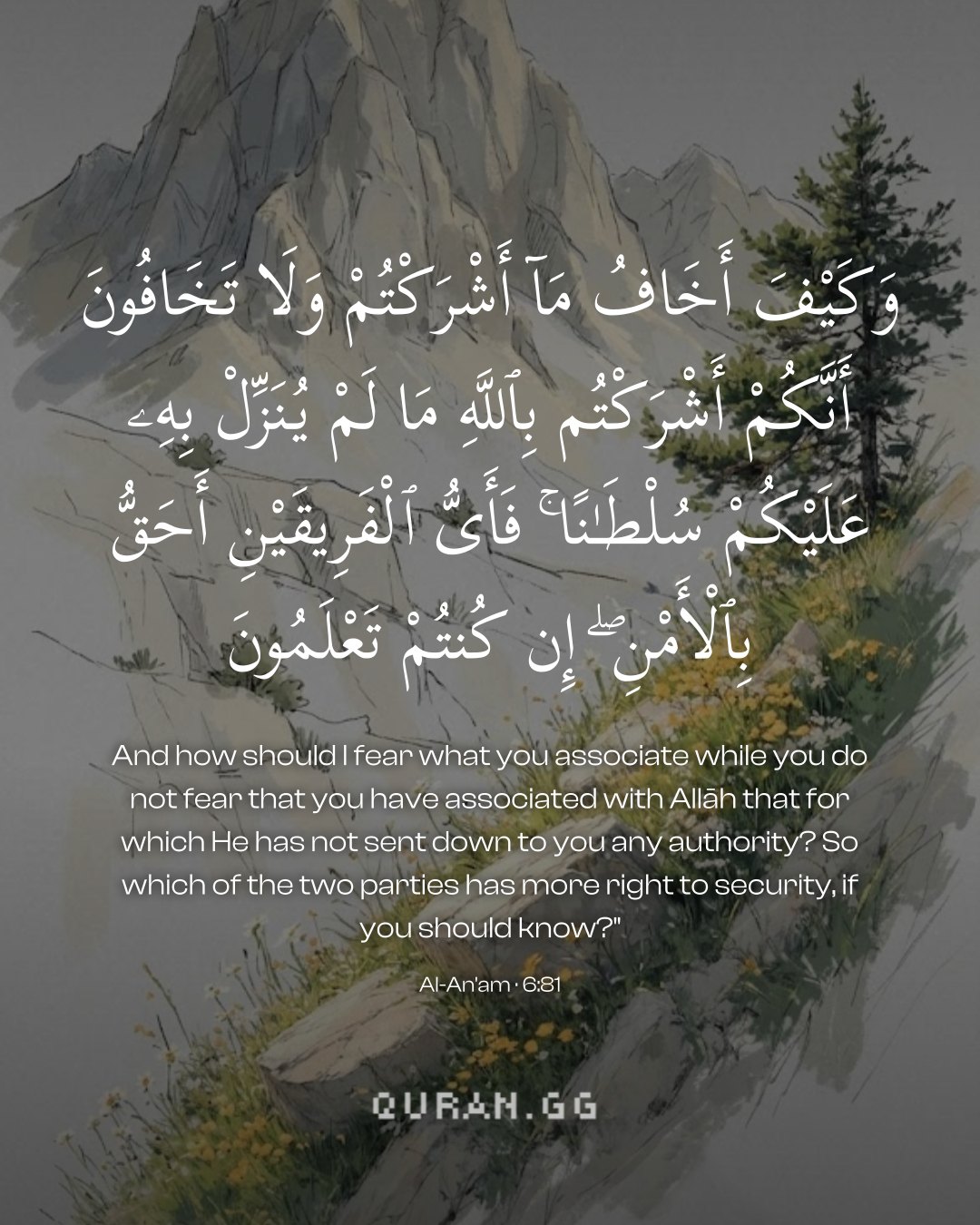
And how should I fear what you associate while you do not fear that you have associated with Allāh that for which He has not sent down to you any authority? So which of the two parties has more right to security, if you should know?"
(Do you dispute with me about Allah while He has guided me). The Ayah means, do you argue with me about Allah, other than Whom there is no god worthy of worship, while He has guided me to the Truth and made me aware of it Therefore, how can I ever consider your misguided statements and false doubts Ibrahim said next,
(and I fear not those whom you associate with Allah in worship. (Nothing can happen to me) except when my Lord wills something.) Ibrahim said, among the proofs to the falsehood of your creed, is that these false gods that you worship do not bring about any effect, and I do not fear them or care about them. Therefore, if these gods are able to cause harm, then use them against me and do not give me respite. Ibrahim's statement,
Using Wisdom and Strategy in Tabligh and Da'wah is the Way of Prophets
Let us begin with verse 76 which opens with the words: رَأَىٰ كَوْكَبًا So, when the night enveloped him, he saw a star. Then, beaming at his people, he said: This is my Lord. The sense in which he said it was: Is it not, as you think and believe, my Lord and your Lord, the Rabb of both of us who nurtures, nourishes and sustains us? In a little while you will find out how real that is. Then, after some time, the star vanished. This gave Sayyidna Ibrahim (علیہ السلام) a good occasion to drive his argument home against his disbelieving people. He said: لَا أُحِبُّ الْآفِلِينَ (I do not like those who vanish). The word: آفِلِين (` afulin' ) is from: افول ('afulin) which means to set.
The story of Abraham narrated here is not the story of his search for Truth but that of his observation of Truth. Abraham was born in Iraq four thousand years ago in an environment in which the sun, moon and stars were worshipped. However, Nature’s guidance and God’s special help kept Abraham away from polytheism. His keen vigilant eyes observed signs in the phenomena spread throughout the universe which supported the idea of the oneness of God (tawhid). Everywhere in the mirror of the universe, the face of the one God would appear before him. Feeling sorry for his community, he used to ask them why they were blind to reality, in spite of the facts revealed before them. Whenever a thing or person is given the status of the worshipped one (ma‘bud), it naturally follows that the concepts of mysterious pre-eminence and greatness become attached to that thing or person. People start thinking that, in the scheme of the universe, this being has a high status such as is not enjoyed by anybody else. Pleasing him brings good fortune, while displeasing him does the reverse. Accordingly, when Abraham said that his community’s deities were valueless and that in this world of God they had absolutely no powers, people were afraid that, as a result of this ‘insolence’, they might be subjected to some suffering and they started arguing with Abraham. They warned him against such talk and said that the vengeance of these deities would be wreaked upon him—he would become blind, go mad, would face destruction, etc.
Uthmani text of the Madinah mushaf (King Fahd Complex). Translation: Saheeh International. Tafsir via Quran.com.