أَتُحَاجُّونِّى فِى اللَّهِ وَقَدْ هَدَانِى
(Do you dispute with me about Allah while He has guided me). The Ayah means, do you argue with me about Allah, other than Whom there is no god worthy of worship, while He has guided me to the Truth and made me aware of it Therefore, how can I ever consider your misguided statements and false doubts Ibrahim said next,
وَلاَ أَخَافُ مَا تُشْرِكُونَ بِهِ إِلاَّ أَن يَشَآءَ رَبِّى شَيْئاً
(and I fear not those whom you associate with Allah in worship. (Nothing can happen to me) except when my Lord wills something.) Ibrahim said, among the proofs to the falsehood of your creed, is that these false gods that you worship do not bring about any effect, and I do not fear them or care about them. Therefore, if these gods are able to cause harm, then use them against me and do not give me respite. Ibrahim's statement,
Continue reading the tafsir of ayahs 80–83Ma'arif al-Qur'an
Mufti Muhammad Shafi
Commentary
Mentioned in the previous verses was the debate Sayyidna Ibrahim (علیہ السلام) had held with his father, 'Azar, and with his entire Nimrudic people. There, after having conclusively refuted their worship of idols and stars, he had addressed his people by telling them in effect: You threaten me that your idols will destroy me if I refuse to accept their authority, although these idols do not have the power to do so, nor have I done anything as a result of which I may be hit by some hardship. In fact, it is you who should be trembling in fear for you have committed a crime as terrible as equating with Him the creations of Allah, rather the objects made and prepared by His creation even giving them a share in His divinity. Then, the fact that Allah Ta` ala is All-Knowing, All-Aware and All-Powerful is not hidden from any sensible person. This calls for some thinking on your part. So, think and say who deserves to be in peace and who it is who should be fearing?
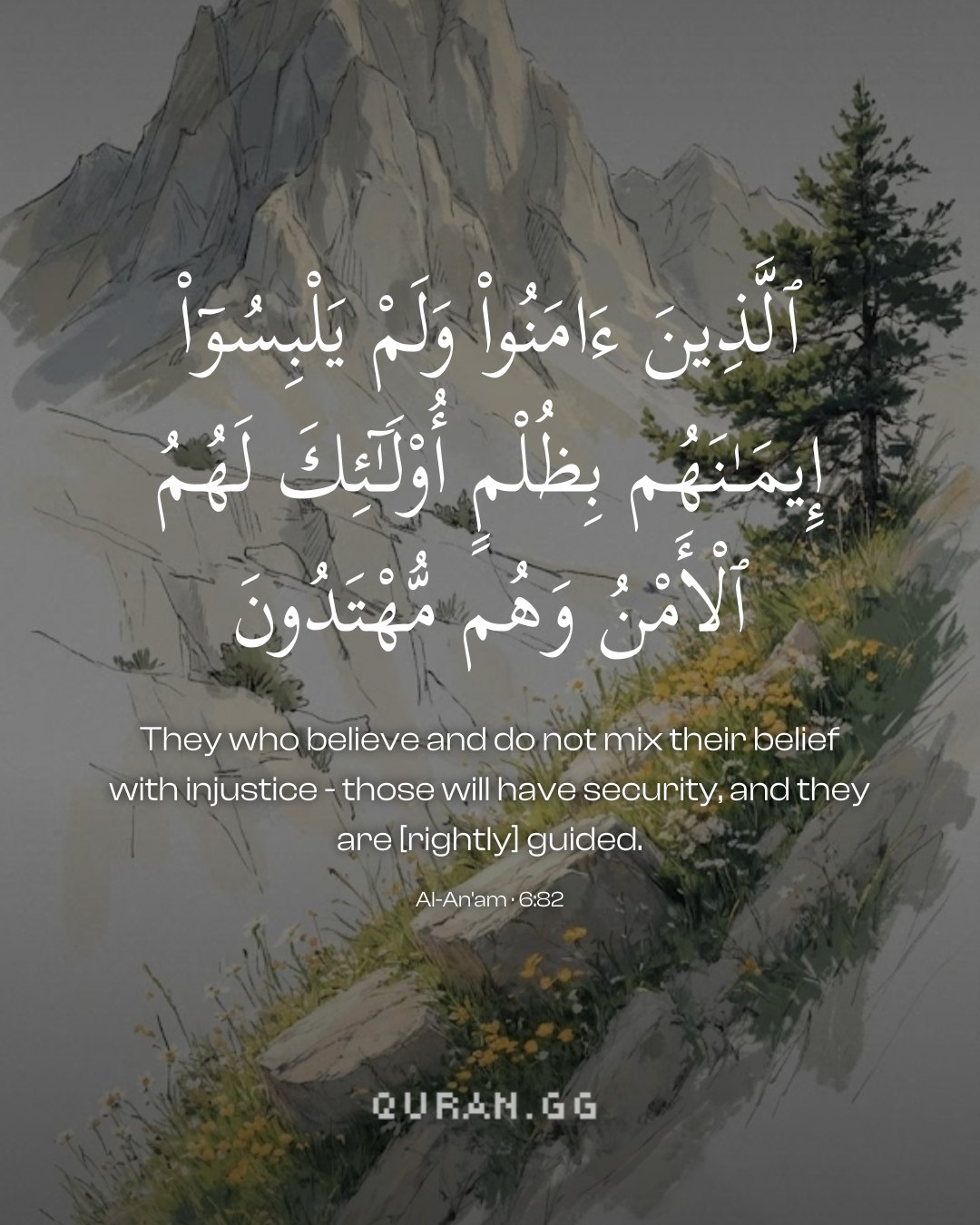
In the first (82) of the present verses, it was said that only those who believe in Allah and then do not go on to mix up their faith with injustice shall be the people who can hope to be safe against punishment. It appears in Hadith, when this verse was revealed, the noble Sahabah were frightened. They said: Ya Rasul Allah, who among us has not been unjust to himself by committing one or the other sin? Now, in this verse, the only condition of remaining safe from punishment is that one should have done no injustice to himself while in the state of Im an. If so, how can we ever achieve salvation? The Holy Prophet ﷺ said: You have not understood the correct meaning of the verse. Here, ` Zulm' (injustice) means ` Shirk' (ascribing of partners to Allah) as said in another verse: إِنَّ الشِّرْكَ لَظُلْمٌ عَظِيمٌ (Joining others in the worship of Allah is a great injustice - 31:13). Therefore, the sense of the verse is that one, who enters (the bliss of) Iman and then does not associate anyone with the Being and the Attributes of Allah Ta` ala, shall remain safe from punishment, and considered well guided.
In brief, those who worship idols, rocks, trees, rivers and stars do so because they, out of bland simplicity, take them to be the holders and wielders of power. So, they are scared of the idea of forsaking their worship lest these objects were to hurt them in some way. Sayy-idna Ibrahim (علیہ السلام) gave such people a smart key to their problem when he asked them to fear Almighty Allah who knew all they do and had power over whatever good or bad reaches them - and not commit the folly of fearing things which have neither knowledge nor power. This fear is absolutely unreasonable. One must fear Allah alone - and whoever believes in it is out of all danger.
Said in this verse وَلَمْ يَلْبِسُوا إِيمَانَهُم بِظُلْمٍ (And those who have not mixed their faith with injustice). Here, ` Zulm' as explained by the Holy Prophet ﷺ means Shirk (ascribing partners in the divinity of Allah) - not sin in an ordinary sense. But, by bringing in: بِظُلم (bi zulmin) as indefinite noun (Nakirah), a device supported by the rules of the Arabic grammar, the sense was made general which includes all kinds of Shirk. As for the word: لَمْ يَلْبِسُوا (lam yalbisu), it has been de-rived from: لَبَسَ (labasa) which means to wear, cover or mix. Thus, the verse comes to mean that a person who mixes some sort of Shirk in his or her Iman, that is, one who, despite believing in Allah Ta` ala along with all His attributes of perfection, takes non-Allah too as bearing some of those attributes, shall be considered excluded from the guarantee of peace and faith given here.
We also come to know from this verse that Shirk is not restricted to becoming a Mushrik or idolater. In fact, also Mushrik is a person who does not worship idols in the customary sense, but recites the Kalimah of Islam, yet takes some angel or messenger or waliy or ‘saint’ of Allah as partners or sharers in some exclusive attributes of Allah. This verse carries a stern warning for those who take the Aulia' of Allah (The Men of Allah) and their Mazars (resting places, tombs) as capable of answering their prayers and granting their needs, and go as far as believing practically as if the Divine powers have been delegated to them. Refuge with Allah!
The story of Abraham narrated here is not the story of his search for Truth but that of his observation of Truth. Abraham was born in Iraq four thousand years ago in an environment in which the sun, moon and stars were worshipped. However, Nature’s guidance and God’s special help kept Abraham away from polytheism. His keen vigilant eyes observed signs in the phenomena spread throughout the universe which supported the idea of the oneness of God (tawhid). Everywhere in the mirror of the universe, the face of the one God would appear before him. Feeling sorry for his community, he used to ask them why they were blind to reality, in spite of the facts revealed before them. Whenever a thing or person is given the status of the worshipped one (ma‘bud), it naturally follows that the concepts of mysterious pre-eminence and greatness become attached to that thing or person. People start thinking that, in the scheme of the universe, this being has a high status such as is not enjoyed by anybody else. Pleasing him brings good fortune, while displeasing him does the reverse. Accordingly, when Abraham said that his community’s deities were valueless and that in this world of God they had absolutely no powers, people were afraid that, as a result of this ‘insolence’, they might be subjected to some suffering and they started arguing with Abraham. They warned him against such talk and said that the vengeance of these deities would be wreaked upon him—he would become blind, go mad, would face destruction, etc.
Uthmani text of the Madinah mushaf (King Fahd Complex). Translation: Saheeh International. Tafsir via Quran.com.