The Idolators leave Makkah, heading for Badr
After Allah commanded the believers to fight in His cause sincerely and to be mindful of Him, He commanded not to imitate the idolators, who went out of their homes
بَطَراً
(boastfully) to suppress the truth,
وَرِئَآءَ النَّاسِ
(and to be seen of men), boasting arrogantly with people. When Abu Jahl was told that the caravan escaped safely, so they should return to Makkah, he commented, "No, by Allah! We will not go back until we proceed to the well of Badr, slaughter camels, drink alcohol and female singers sing to us. This way, the Arabs will always talk about our stance and what we did on that day." However, all of this came back to haunt Abu Jahl, because when they proceeded to the well of Badr, they brought themselves to death; and in the aftermath of Badr, they were thrown in the well of Badr, dead, disgraced, humiliated, despised and miserable in an everlasting, eternal torment. This is why Allah said here,
Continue reading the tafsir of ayahs 47–49Ma'arif al-Qur'an
Mufti Muhammad Shafi
Commentary
Since its beginning, Surah al-Anfal has been dealing with the actual events and attending circumstances of the battle of Badr along with subsequent lessons learnt and related injunctions given.
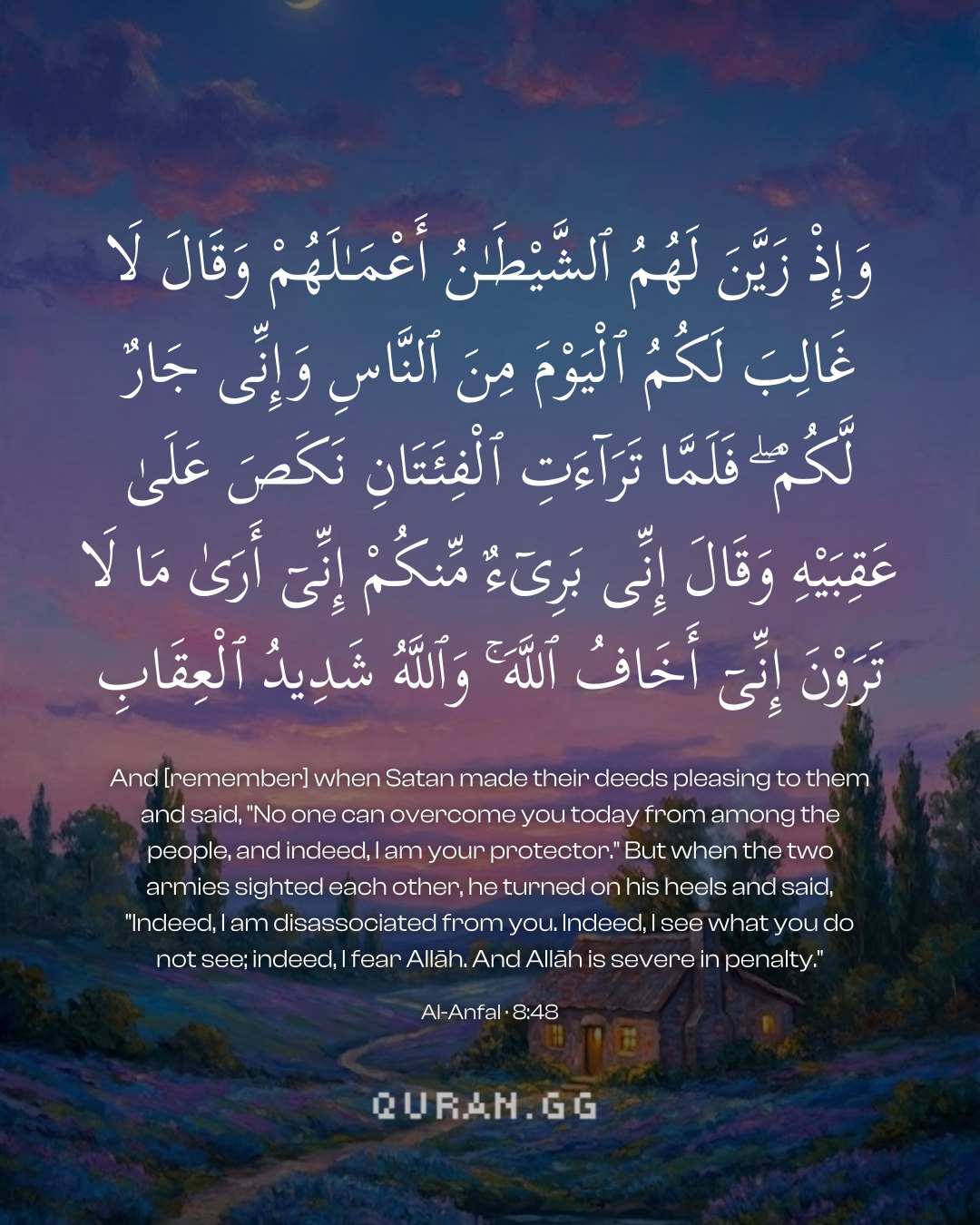
One such event from here relates to the Shaitan who misled the disbelievers of Makkah, exhorted them to go to battle against Muslims and then he disengaged, and left them all by themselves right there in the middle of the battlefield. This event has been mentioned at the beginning of verse 48.
Did this deception of the Shaitan take the form of scruples put into the hearts of the Quraysh? Or, did the Shaitan come to them in human form and talked to the Quraysh face to face? Both probabilities exist here. But, the words of the Qur'an seem to support the second eventuality - that the Shaitan misled them by appearing in a human form before them.
According to a narration of Sayyidna ` Abdullah ibn ` Abbas ؓ reported by Imam ibn Jarir, when the army of the Quraysh of Makkah marched out from the city, they were terribly worried about a possible danger from their neighbouring tribe of Banu Bakr, also an enemy. They apprehended that once they went out to confront Muslims, this tribe hostile to them may find an opportunity to attack their homes and hurt their women and children there. No doubt, they had demonstrated their readiness to respond to the plaintive appeal for help made by Aba Sufyan, the leader of their trade caravan, but they were dragging their feet because of this danger. In this perplexing situation, all of a sudden, the Shaitan appeared in the form and guise of Suraqah ibn Malik holding a flag in his hand and flanked by a regiment of tough fighting men. Suraqah ibn Malik was a big chief who controlled the tribal area from where that danger of attack was expected. He stepped forward and addressed the army of Quraysh young men through which he misled them in two ways. First, he said: لَا غَالِبَ لَكُمُ الْيَوْمَ مِنَ النَّاسِ (None of the people is to overpower you today - 48). By this, he meant that he had a good idea of the strength of their adversary and he could also see their own physical and numerical superiority, there-fore, he assured them that they should stop worrying, march ahead and prevail, for no one is going to prevail against them.
Then, he said: إِنِّي جَارٌ لَّكُمْ (I am a protector for you - 48). By saying this, he was referring to their apprehensions against the tribe of Banu Bakr who might attack their homes and families in Makkah during their absence. Here, he was taking the responsibility that nothing of this sort was going to happen as he was their supporter and caretaker. The Quraysh of Makkah already knew about Suraqah ibn Malik being a known and influential personality of the area. Hearing this assurance from him, they became emotionally stable. They dismissed the threat from the tribe of Banu Bakr from their hearts and became all set to go and confront Muslims.
Thus, by employing this dual deception, the Shaitan drove these people to their killing field and what he did for himself is described by the Holy Qur'an in the following words: فَلَمَّا تَرَاءَتِ الْفِئَتَانِ نَكَصَ عَلَىٰ عَقِبَيْهِ (So, when the two groups [ the disbelievers of Makkah and Muslims ] saw each other [ at Badr ], he turned back on his heels - 48).
Since a force of Shaitans had also assembled in support of the disbelievers of Makkah at the battle of Badr, therefore, Allah Ta` ala sent a force of angels under the command of Jibra'il and Mika'il (علیہما السلام) to meet their challenge. According to a narration of Sayyidna ` Abdullah ibn ` Abbas ؓ reported by Imam Ibn Jarir and others, when the Shaitan who was commanding his force in the human guise of Suraqah ibn Malik at that time saw Arch angel Jibra'il (علیہ السلام) and the force of angels with him, he lost his nerves. At that time, he was standing hand in hand with a Qurayshi warrior, Harith ibn Hisham. All of a sudden, he tried to free his hand clasped into the hand of Harith. When Harith asked him as to why he was doing that, he whacked his chest with a blow and threw him down. Now unchecked, he bolted out from the battlefield. Harith - under the impression that he was Suraqah - shouted at him: 0 Suraqah, chief of Arabia, you had said that you will support us and here you are doing this to us in the middle of a battle! The Shaitan - in the guise of Suraqah - replied: إِنِّي بَرِيءٌ مِّنكُمْ إِنِّي أَرَىٰ مَا لَا تَرَوْنَ إِنِّي أَخَافُ اللَّـهَ (I have nothing to do with you. I am seeing what you do not see. I am scared of Allah - 48). Thus, he disengaged himself from the earlier compact because he was seeing a force of angels and parted ways with the disbelievers on the plea that he feared Allah.
When the Shaitan saw the force of angels, he virtually saw trouble for him as he knew their power. As for his statement that he was scared of Allah, says Tafsir authority Qatadah, this was a lie forged by him. Had he feared Allah, why would he disobey Him? But, other Commentators have suggested that his fear is justified in its own place because he is fully aware of the perfect power of Allah Ta` ala and that He is severe at punishment. Therefore, there is no reason for not fearing. However, bland fear without faith and obedience is useless.
Abu Jahl, when he noticed signs of weakness showing up in his army because of the withdrawal of Suraqah and his force, he tried to avert the awkward situation by appealing that they should not feel being affected by the sudden retreat of Suraqah for he had a secret understanding with Muhammad to do that. In short, after the retreat of the Shaitan, what was due to happen to them did. It was on their return to Makkah that one of them met Suraqah ibn Malik. This person scolded Suraqah telling him that he was responsible for their defeat in the battle of Badr and certainly for all the losses that followed in its wake because he had broken the backs of their fighting men by retreating from the action on the battlefield. Suraqah said: I never went with you, nor did I ever take part in anything you were doing there. In fact, I heard of your defeat only after you had reached Makkah.
After having reported all these narrations in his Tafsir, Imam Ibn Kathir said: It is the customary practice of Shaitan, the accursed, that he would cause man to become involved with evil and then leave him off in the middle of it. The Qur'an has mentioned this habit of the Shaitan repeatedly. One such verse says:
كَمَثَلِ الشَّيْطَانِ إِذْ قَالَ لِلْإِنسَانِ اكْفُرْ فَلَمَّا كَفَرَ قَالَ إِنِّي بَرِيءٌ مِّنكَ إِنِّي أَخَافُ اللَّـهَ رَبَّ الْعَالَمِينَ ﴿16﴾
It is like the Shaitan when he tells man: "Disbelieve." Then, after he becomes a disbeliever, he says: "I have nothing to do with you. I am scared of Allah, the Lord of all the worlds". (59:16)
Success ensues with the help of God. But God’s help always arrives in this world in the garb of the cause and effect process, and not otherwise. If Muslims prepare themselves as far as possible, fulfilling all the conditions laid down by God for success, then God grants them success after compensating for any shortcomings that they might have. But if they do not exert themselves to the full as commanded by God, He never sends His help in such circumstances. What are these factors which will lead to success? Firstly Muslims should not initiate aggression. Then they should set about strengthening their roots until the enemy comes to attack them. When things reach the stage of a clash, they should prove to be staunch and unflinching, keeping in mind the remembrance of God—in other words, the real goal,—so that their morale may remain intact; they should keep themselves fully organised under the command of their chief, ignoring mutual differences instead of enlarging upon them and becoming divided; they should impress the enemy with their unity; they should exercise patience, i.e., they should adopt a sensible approach instead of being emotional; they should not take any immature step in the hope of quick success; their eyes should be on the final goal and not on immediate gain. Receiving God’s succour is thus a matter of cause and effect. If we are willing to surrender our will wholeheartedly to the will of God, then alone are we held deserving to receive divine succour. The present world is one of trial. Here, God achieves His will from behind the veil of the ‘unseen.’ That is why when He helps the believers, it is done from behind the screen of ‘cause and effect.’ If the Muslims go on taking steps without making preliminary preparations and suffer from differences and dissension, they should never hope that God will appear all of a sudden and solve all their problems on the spot. Even if the Muslims find themselves in better conditions than those of their opponents, it should not happen that, like those who deny the truth they become boastful of their power; fall a prey to haughtiness and ostentation and, in claiming superiority, go to the extent of opposing the call of Truth because it does not suit their whims and fancies.
Continue reading the tafsir of ayahs 47–48 Uthmani text of the Madinah mushaf (King Fahd Complex). Translation: Saheeh International. Tafsir via Quran.com.