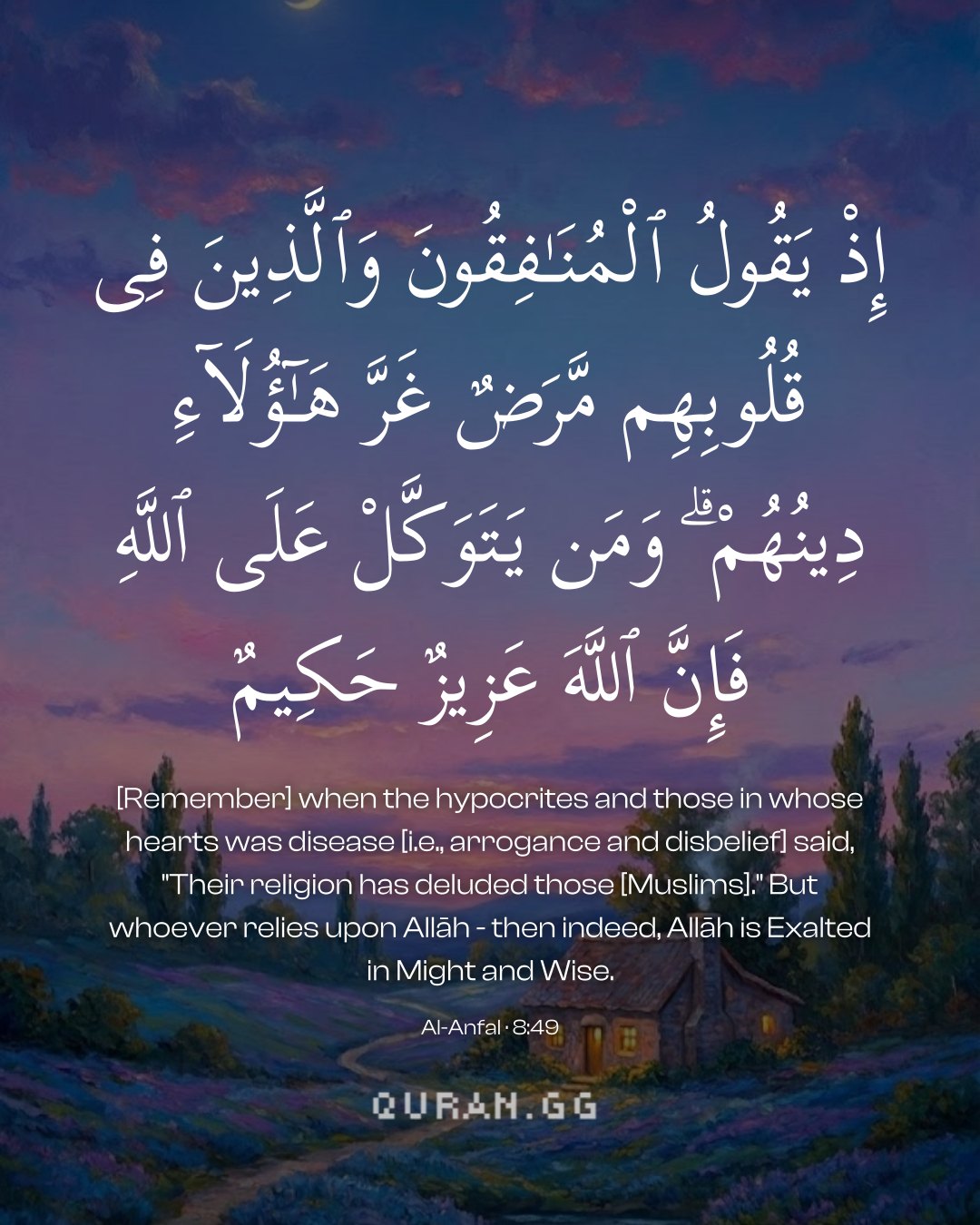
[Remember] when the hypocrites and those in whose hearts was disease [i.e., arrogance and disbelief] said, "Their religion has deluded those [Muslims]." But whoever relies upon Allāh - then indeed, Allāh is Exalted in Might and Wise.
After Allah commanded the believers to fight in His cause sincerely and to be mindful of Him, He commanded not to imitate the idolators, who went out of their homes
بَطَراً
(boastfully) to suppress the truth,
وَرِئَآءَ النَّاسِ
(and to be seen of men), boasting arrogantly with people. When Abu Jahl was told that the caravan escaped safely, so they should return to Makkah, he commented, "No, by Allah! We will not go back until we proceed to the well of Badr, slaughter camels, drink alcohol and female singers sing to us. This way, the Arabs will always talk about our stance and what we did on that day." However, all of this came back to haunt Abu Jahl, because when they proceeded to the well of Badr, they brought themselves to death; and in the aftermath of Badr, they were thrown in the well of Badr, dead, disgraced, humiliated, despised and miserable in an everlasting, eternal torment. This is why Allah said here,
The Anatomy of Shaitanic Deception and Personal Defence
There are some elements of guidance we receive from what has been mentioned in this verse:
(1) That the 'Shaitan' is man's enemy who employs all sorts of tricks, guises and stratagems to bring loss to him. There are occasions when he would simply inject a scruple in the heart and harass his victim and there are times when he would deceive man by appearing before him.
(2) That Allah Ta` ala has given him the ability to appear before man in various guises. There is a well-known book of Hanaf'i jurisprudence called آکام المرجان فی أحکام الجان : 'Akam al-Marjan fi Ahkam al-Jann where it has been proved in detail. Therefore, authorities among mystic scholars who are recognized as masters in illumination کَشف (kashf) and eye-witness شُہُود (shuhud) have warned people that it is dangerous to start following a person simply by seeing him or hearing him say something without taking the trouble of finding out his antecedents and circumstantial conditions. There could be couched Shaitanic inputs even in what is known as illumination کَشف (kashf) and inspiration اِلھام (ilham). So, the ideal method of remaining safe against Shaitanic deceptions is to follow Divine Revelation faithfully.
Success Comes By Actually Being on the Straight Path and Not By Simply Having Sincere Intentions
(3) That the most frequent reason why people get involved in disbelief, polytheism or other impermissible doings is no other but that the Shaitan, by making their evil deeds appear handsome, desirable and beneficial, turns their hearts away from truth, as it is, and its consequences, as they would be. Once so brain-washed, they would start taking their false as the epitome of truth and their loss as the ultimate gain, so much so that, very much like the votaries of truth, they would be all set to lay down even their lives for the sake of their false notions. It was for this reason that the army and the chiefs of Quraysh, when they were departing from the Baytullah بَیتُ اللہ ، had already supplicated before it by saying: اللھم انصر اھدی الطایٔفتین (0 Allah, help the better-guided group between the two of us) (See pages 183-184). Such was the level of their unawareness that they simply walked into the snare of the Shaitan and started taking themselves to be the ones better-guided and truth-oriented and, unbelievably enough, they would go to the outer limits of sacrificing their lives and possessions in support of their false stand - and that too with all 'sincerity' at their command!
From here we find out that bland sincerity is never sufficient unless the direction of deeds is correct.
In the verse which follows (49), mentioned there is a common saying of the hypocrites of Madinah and the polytheists of Makkah. It was almost in a strain of combined sympathy and contempt that it was said about Muslims: غَرَّ هَـٰؤُلَاءِ دِينُهُمْ (The belief of these people has deluded them). It means that those handful of Muslims had come all the way to the battlefield of Badr to challenge an army so powerful and well-equipped as if those poor people have been deluded by their faith which seems to have thrown them into the jaws of death. Responding to them, Allah Ta` ala said: وَمَن يَتَوَكَّلْ عَلَى اللَّـهِ فَإِنَّ اللَّـهَ عَزِيزٌ حَكِيمٌ (And whoever places his trust in Allah, then, Allah is Mighty, Wise). The sense of the statement is that one who places his total trust in Allah never runs into disgrace because Allah is all-dominating and when it comes to wisdom, there is no plan or intelligence or insight into the future which can hold before it. In other words, those who know no more than what is material would only place their trust in nothing but the material. How would they know the secret power which lies in the treasures of the One who has created everything material. This power accompanies those who believe in Allah Ta` ala and place their total trust in Him.
Even in our day, there are those religiously observing and innocent-looking Muslims who would become ready targets for those who claim to have advanced rationally and intellectually and who would benignly dismiss them as old-timers who might as well be left alone. But, should such people be armed with perfect faith and trust in Allah, no harm can touch them - even if intended and tried.
Tazkirul Quran
Maulana Wahiduddin KhanOn ayahs 49–52
The Quraysh of Makkah considered themselves adherents of the Truth and the companions of the Prophet adherents of falsehood. They were so certain about this, that they prayed standing before the Kabah, ‘O God! Give success to the one of these two parties which is in the right and destroy the party which is in the wrong.’ However this faith of theirs was false. This type of faith always develops due to glorification (taz’in) of wrong action. Satan taught the people of Makkah that they were the followers of the recognised, well-known prophets, Abraham and Ishmael, while the Muslims were the followers of a person whose very claim to being a prophet was controversial; they were the inheritors of the Ka‘bah, while the Muslims had been banished from the land of the Ka‘bah. Satan having created such ideas in the hearts of the Makkans, infused false faith in them. They thought that whatever they were doing was done rightly and that, at all events, God would come to their assistance. On the one hand, the Makkan opponents considered their false conviction to be true on the basis of the above-mentioned factors. On the other hand, when they saw that the Prophet’s companions had engaged themselves on the Islamic front with stronger conviction and the will to self-sacrifice, they set about trying to show that their true faith was unreliable by saying that it was merely religious fanaticism; that they were going mad under the influence of the eloquent utterances of the Prophet. But, when there was a clash between the two groups and God’s succour came down in favour of the Muslims, Satan fled, abandoning the opponents of Islam. By the Grace of God, the Muslims’ hearts became strengthened. God certainly helps those who rely on Him. But, God’s help appears only when believers prove their faith in God to such a great extent that those who deny the truth feel justified in saying that they (the Faithful) have gone mad.
Uthmani text of the Madinah mushaf (King Fahd Complex). Translation: Saheeh International. Tafsir via Quran.com.