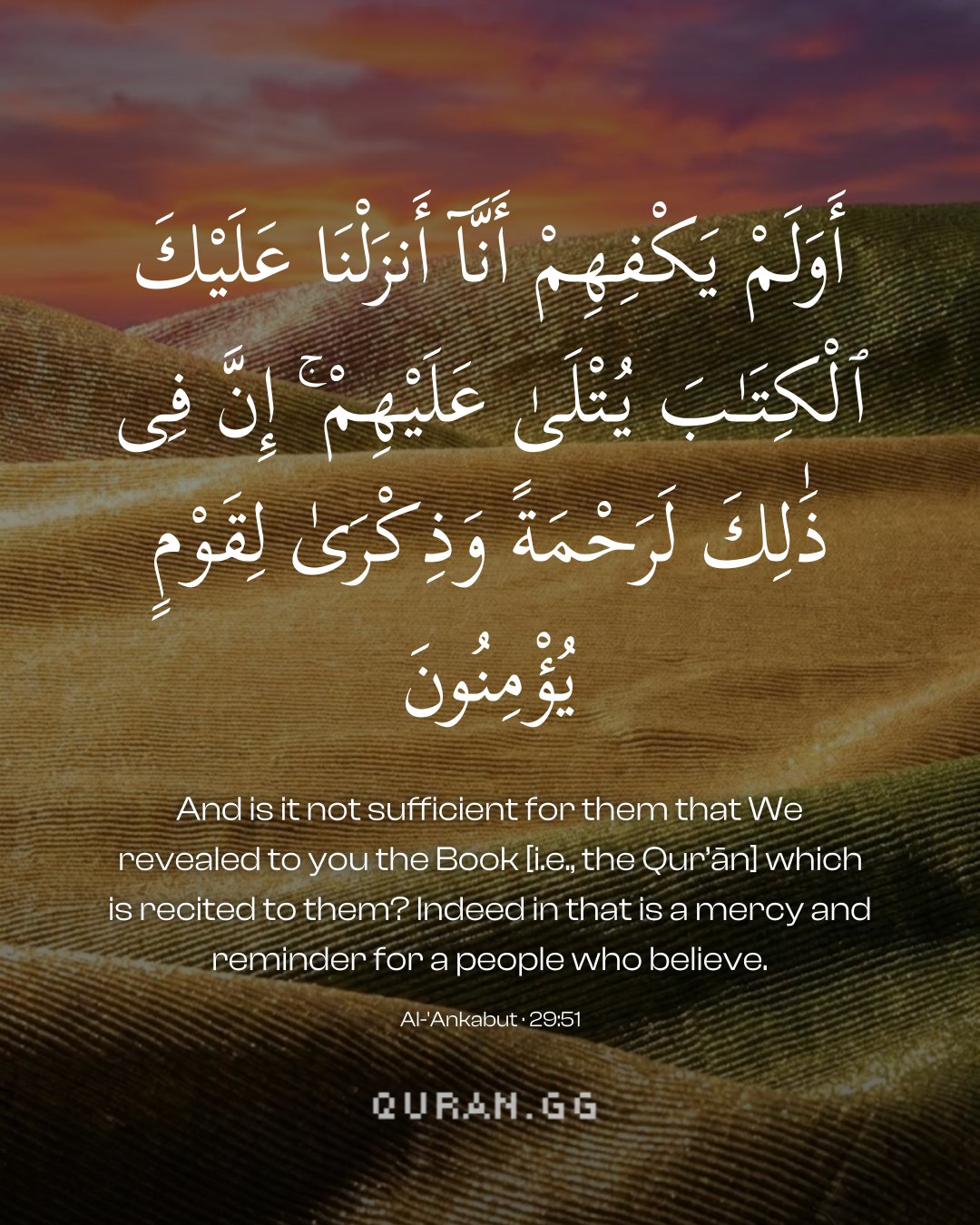
And is it not sufficient for them that We revealed to you the Book [i.e., the Qur’ān] which is recited to them? Indeed in that is a mercy and reminder for a people who believe.
Allah tells us how the idolators stubbornly demanded signs, meaning that they wanted signs to show them that Muhammad was indeed the Messenger of Allah ﷺ, just as Salih was given the sign of the she-camel. Allah says:
قُلْ
(Say) -- `O Muhammad' --
إِنَّمَا الاٌّيَـتُ عِندَ اللَّهِ
(The signs are only with Allah) meaning, `the matter rests with Allah, and if He knew that you would be guided, He would respond to your request, because it is very easy for Him to do that. Yet He knows that you are merely being stubborn and putting me to the test, so He will not respond to you.' This is like the Ayah,
The status of the narrations of the People of the Book quoted by the commentators in their commentaries is also the same. The object of their reproduction in the commentaries is meant to highlight their historical position. They cannot be used for determining what is permitted (halal) and what is not permitted حَرَام (haram).
مَا كُنتَ تَتْلُو مِن قَبْلِهِ مِن كِتَابٍ وَلَا تَخُطُّهُ بِيَمِينِكَ إِذًا لَّارْتَابَ الْمُبْطِلُونَ (And you have never been reciting any book before this, nor have you been writing it with your right hand, had it been so, the people of falsehood would have raised doubts. - 29:48). That is Before the revelation of the Qur'an you could neither read nor write, rather you were unlettered (اُمِّی). If it was not so, and you were literate, then there could have been a possibility of doubt for the infidels to put the blame that you were repeating what you had read in, the earlier books, Torah and Injil, and it was not a new revelation sent down on you by way of prophethood.'
There are two types of individuals—one who already possesses a knowledge of the Truth and the other who apparently does not. However, the second type also are acquainted with the Truth at the level of their inherent nature. The former are the bearers of the book, while the latter draw on the resources of their own nature. If people are really sincere and serious, they recognize the Truth immediately. One group might recognize it as a Divine Book from heaven, while the other might recognize it as a Book of Nature. To each one, the Truth will manifest itself as a matter after his own heart. But, people often become enmeshed in a variety of psychological problems, due to which they adopt a rigid attitude of denial. They go on denying the Truth, even though there may be many factors in its support, and even if many arguments are advanced in its favour.
Uthmani text of the Madinah mushaf (King Fahd Complex). Translation: Saheeh International. Tafsir via Quran.com.