Fir`awn vows to kill the Children of Israel, Who complain to Musa; Allah promises Them Victory
Allah mentions the conspiracy of Fir`awn and his people, their ill intentions and their hatred for Musa and his people.
وَقَالَ الْمَلأ مِن قَوْمِ فِرْعَونَ
(The chiefs of Fir`awn's people said), to Fir`awn,
أَتَذَرُ مُوسَى وَقَوْمَهُ
("Will you leave Musa and his people"), will you let them be free,
لِيُفْسِدُواْ فِى الاٌّرْضِ
("to spread mischief in the land"), spreading unrest among your subjects and calling them to worship their Lord instead of you Amazingly, these people were worried that Musa and his people would cause mischief! Rather, Fir`awn and his people are the mischief-makers, but they did not realize it. They said,
Continue reading the tafsir of ayahs 127–129Ma'arif al-Qur'an
Mufti Muhammad Shafi
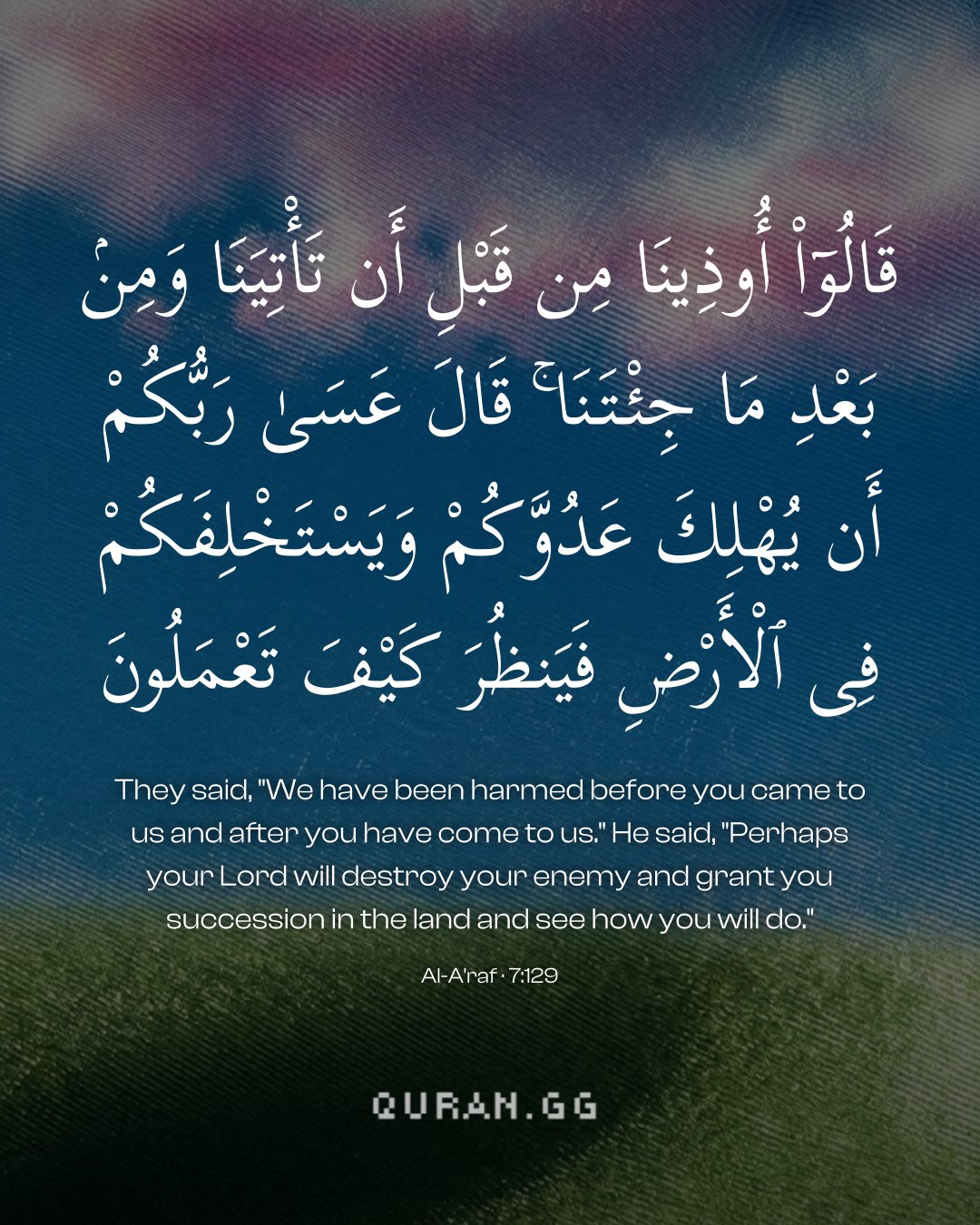
The Israelites who seemed to have no conception of such matters could not understand how patience alone could free them from Pharaoh's punishment and bring them success against him. They blamed the prophet Musa (علیہ السلام) saying:
قَالُوا أُوذِينَا مِن قَبْلِ أَن تَأْتِيَنَا وَمِن بَعْدِ مَا جِئْتَنَا
We have been persecuted before you came to us as well as after you came to us."
What they meant, perhaps, was that they were looking for a prophet to deliver them from the oppression of the Pharaoh, but their fate remained unchanged even after he came to them. The prophet Musa answered to them:
عَسَىٰ رَبُّكُمْ أَن يُهْلِكَ عَدُوَّكُمْ وَيَسْتَخْلِفَكُمْ فِي الْأَرْضِ فَيَنظُرَ كَيْفَ تَعْمَلُونَ
'It is likely that your Lord will destroy your enemy and make you successors in the earth that He may see how then, you act.'
Sovereignty is a test
The last phrase of the verse has provided with a wise observation that sovereignty or dominion is not in itself an aim or objective but a means to achieve the objective of making peace and justice prevail in the land. Sovereignty or dominion is a sacred trust bestowed upon by Allah for making good prevail over evil. The verse has warned them that, in case they are bestowed this trust, they should not forget the ill fate of those who were before them.
Though the direct addressee of the verse are the Israelites, but indirectly the verse has thrown a warning to all those trusted with rule or dominion. Sovereignty or power, in fact, belongs to Allah alone. Allah has made man his deputy on the earth. He is the One who designates man with power and takes it away when He so wills. This is what the following verse means:
تُؤْتِي الْمُلْكَ مَن تَشَاءُ وَتَنزِعُ الْمُلْكَ مِمَّن تَشَاءُ
You give power to whom You please, and You strip off power from whom You please." (3:26)
The power and rule, therefore, is a test for the rulers to see how far they have fulfilled their duty of establishing peace and justice and making good prevail over evil.
Abu Hayyan in his Tafsir Al-Bahr-al Muhit has included the following event under the comments on this verse: ` Amr ibn ` Ubaid once visited Mansur, the second caliph of the Abbaside dynasty, prior to his designation to caliphate and recited this verse: 'It is likely that Allah will destroy your enemy and make you successor in the earth.' This was a sort of prediction by ` Amr ibn ` Ubaid of his succession to the throne. Soon after Mansur succeeded to the throne and became the Caliph. ` Amr ibn ` Ubaid came to the Caliph again. Mansur reminded him of the prediction made by him. Amr ibn ` Ubaid instantly answered, "Well, the first part of the prediction has come true and you have become the Caliph, but the second part of it still remains unfulfilled. The verse also contains this phrase, فَیَنظُرَ کَیفَ تَعمَلُون "Then, He will see how you act." Amr ibn ` Ubaid suggested that gaining power is not a matter of pride because thereafter, Allah judges the acts of those in authority and sees how they make use of this trust.
Then the prophet also explained why he was presenting a solution which was against the general way of thinking of the community; though these problems apparently stemmed from the ruling authority and were resolvable only by that ruling authority, the more important point for consideration was how power and authority came to be wielded. Nobody wields power simply as a result of strategies; power is bestowed or taken away directly by God. This being so, it follows that the solution to the problem also lies in God. Then, this power, regardless of whoever it is bestowed upon, is in fact a test for the recipient. In this world, being powerful is as much of a test as being powerless. Today, if one has received power, it is because he is being tested on whether he will become haughty and tyrannical, or will behave with justice and modesty. If empowerment is conferred upon others, even then the purpose will be to test others. If, due to its incompetence, one group has power taken away from it and handed over to another group, and if this other group also proves incompetent, power will likewise be taken away from it and given to yet another group. The prosperity and power for which a man pines in this world are in fact, assets that are attainable in the real sense only in the Hereafter: thus in the world these things are conferred on human beings solely to put them to the test, while in the Hereafter they will be given to the righteous people as rewards.
Uthmani text of the Madinah mushaf (King Fahd Complex). Translation: Saheeh International. Tafsir via Quran.com.