Fir`awn and His People suffer Years of Drought
Allah said,
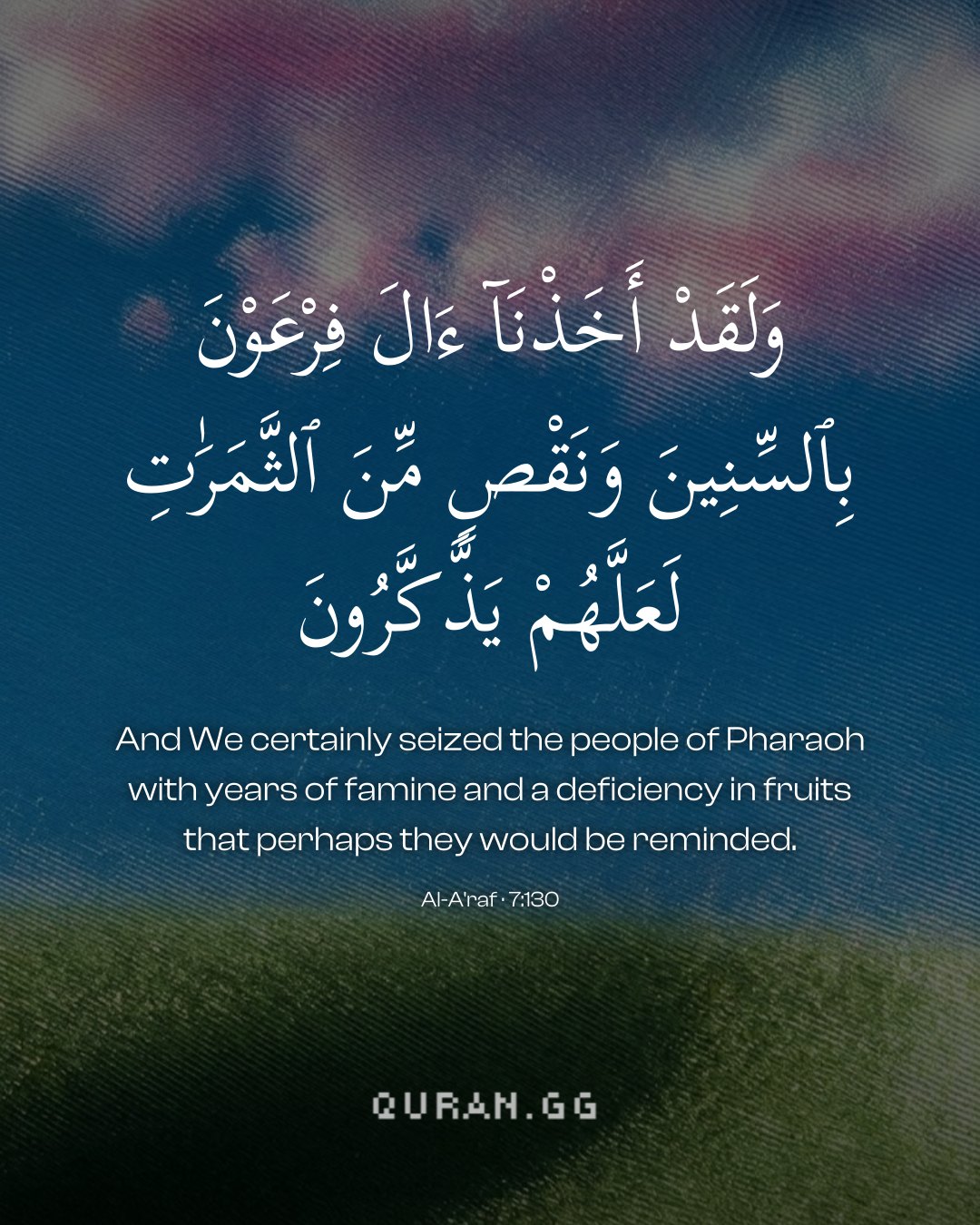
وَلَقَدْ أَخَذْنَآ ءالَ فِرْعَوْنَ
(And indeed We punished the people of Fir`awn) We tested and tried them,
بِالسِّنِينَ
(with years of drought) of famine due to little produce,
وَنَقْصٍ مِّن الثَّمَرَاتِ
(and lack of fruits), which is less severe, according to Mujahid. Abu Ishaq narrated that Raja' bin Haywah said, "The date tree used to produce only one date!"
لَعَلَّهُمْ يَذَّكَّرُونَفَإِذَا جَآءَتْهُمُ الْحَسَنَةُ
(That they might remember (take heed). But whenever good came to them) such as a fertile season and provisions,
قَالُواْ لَنَا هَـذِهِ
(they said, "This is for us."), because we deserve it,
وَإِن تُصِبْهُمْ سَيِّئَةٌ
(and if evil afflicted them) drought and famine,
يَطَّيَّرُواْ بِمُوسَى وَمَن مَّعَهُ
(they considered it an omen Musa and those with him. ) saying that this hardship is because of them and what they have done.
أَلاَ إِنَّمَا طَائِرُهُمْ عِندَ اللَّهِ
(Verily, their omens are with Allah) `Ali bin Abi Talhah reported that Ibn `Abbas commented on the Ayah,
أَلاَ إِنَّمَا طَائِرُهُمْ عِندَ اللَّهِ
(Verily, their omens are with Allah) "Allah says that their afflictions are with and from Him,
وَلَـكِنَّ أَكْثَرَهُمْ لاَ يَعْلَمُونَ
(but most of them know not.)"
Ma'arif al-Qur'an
Mufti Muhammad Shafi
The next verses speak of the events that led Pharaoh and his people to a number of calamities sent to them as punishment and finally led them to their death. The first heavenly punishment came to them in the form of famine. According to historical reports this famine lasted for seven years.
"And We seized the people of the Pharaoh with years of famine and loss of fruits, so that they may take lesson. So when something good came to them they said, 'This is our right.' And if they suffered from something evil, they ascribed it as an ill omen to Musa and those with him. Listen, their omen lies with Allah only, but most of them do not know."
The first verse has described the famine with two phrases: 'years of famine' and 'loss of fruits.' The respected Companion ` Abdullah ibn ` Abbas ؓ and the commentator Qatadah have said that the punishment of drought was for the people of the rural areas, while people living in cities and towns were punished by the loss of fruits.
Then the prophet also explained why he was presenting a solution which was against the general way of thinking of the community; though these problems apparently stemmed from the ruling authority and were resolvable only by that ruling authority, the more important point for consideration was how power and authority came to be wielded. Nobody wields power simply as a result of strategies; power is bestowed or taken away directly by God. This being so, it follows that the solution to the problem also lies in God. Then, this power, regardless of whoever it is bestowed upon, is in fact a test for the recipient. In this world, being powerful is as much of a test as being powerless. Today, if one has received power, it is because he is being tested on whether he will become haughty and tyrannical, or will behave with justice and modesty. If empowerment is conferred upon others, even then the purpose will be to test others. If, due to its incompetence, one group has power taken away from it and handed over to another group, and if this other group also proves incompetent, power will likewise be taken away from it and given to yet another group. The prosperity and power for which a man pines in this world are in fact, assets that are attainable in the real sense only in the Hereafter: thus in the world these things are conferred on human beings solely to put them to the test, while in the Hereafter they will be given to the righteous people as rewards.
Uthmani text of the Madinah mushaf (King Fahd Complex). Translation: Saheeh International. Tafsir via Quran.com.