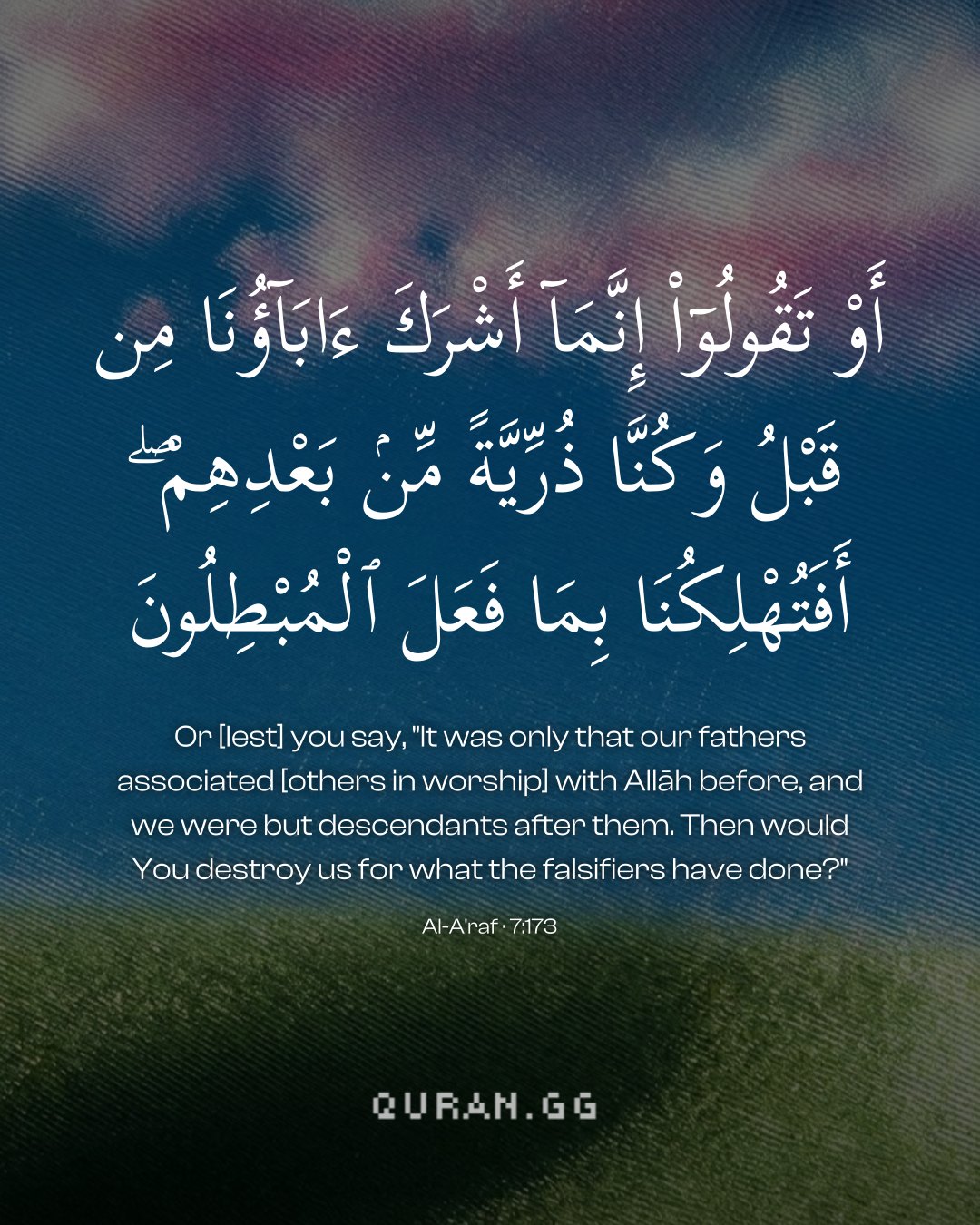
Or [lest] you say, "It was only that our fathers associated [others in worship] with Allāh before, and we were but descendants after them. Then would You destroy us for what the falsifiers have done?"
Allah stated that He brought the descendants of Adam out of their fathers' loins, and they testified against themselves that Allah is their Lord and King and that there is no deity worthy of worship except Him. Allah created them on this Fitrah, or way, just as He said,
(So set you (O Muhammad) your face truly towards the religion, Hanifan. Allah's Fitrah with which He has created mankind. No change let there be in Khalqillah.) 30:30 And it is recorded in the Two Sahihs from Abu Hurayrah who said that the Messenger of Allah ﷺ said,
"Or you should say, "It was our forefathers who associated partners with Allah and we were (only) a progeny after them. So, would you destroy us on account of what the false ones did?"
The verse precludes them from seeking refuge in saying that they were unaware of the Truth. Being a progeny of their forefathers they only followed their path. Therefore they should not be punished for the error of their forefathers. The verse has said that they shall not be punished for the acts of their forefather. It was their own fault and their apathetic attitude that led them to this disaster. It is because the covenant had sown the seed of Truth in their heart and it was not difficult for them to decide that the stones, shaped by themselves into idols, or the fire, the trees and other created beings could, in no way, be considered as being their creator or possessing powers of helping them in their need.
Tazkirul Quran
Maulana Wahiduddin KhanOn ayahs 172–173
This happens in the case of every prophet’s community. In the beginning, its individuals are God-fearing and pious. But in later generations, this spirit vanishes. They become just like other worldly people. Religion is still amongst them. The Holy Book is still read and taught. But all this is done in the context of a national heritage and not as a real fulfilment of a pledge to God. They proceed in the way of the world and in practice forget the Hereafter. Being completely unmindful of right or wrong, they make their desire their religion. At the same time they are proud of being the best of all communities. They are the members of the community of one who is God’s favourite; they are the inheritors of the Holy Book; by the grace of the belief in monotheism they shall certainly be granted salvation. But the truth is that man should hold fast to God’s Word; he should regularly say his prayers. And the sign of holding fast God’s Book and of having said his prayers sincerely is that he should have become a maintainer of peace and harmony (muslihun). Communion with God’s Book and God’s worship are what makes a man opposed to one who disturbs the peace.
Uthmani text of the Madinah mushaf (King Fahd Complex). Translation: Saheeh International. Tafsir via Quran.com.