Allah stated that He brought the descendants of Adam out of their fathers' loins, and they testified against themselves that Allah is their Lord and King and that there is no deity worthy of worship except Him. Allah created them on this Fitrah, or way, just as He said,
(So set you (O Muhammad) your face truly towards the religion, Hanifan. Allah's Fitrah with which He has created mankind. No change let there be in Khalqillah.) 30:30 And it is recorded in the Two Sahihs from Abu Hurayrah who said that the Messenger of Allah ﷺ said,
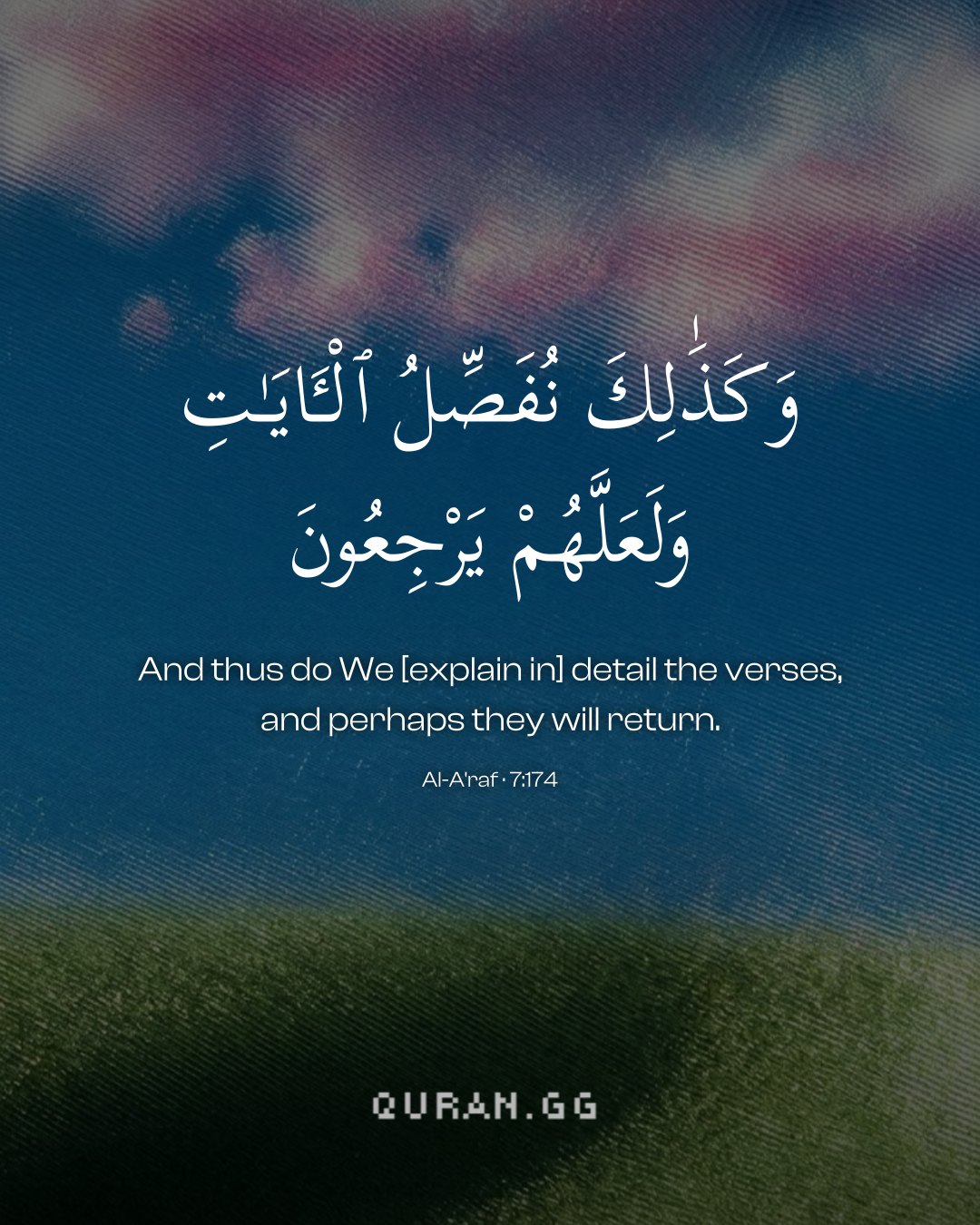
"And this is how we elaborate the verses, so that they may return."
That is, Allah has made His signs clear through His elaborate verses to facilitate people to turn back to their pledge and acknowledge Him as their Lord. Any one applying his reason can find the Truth and save himself from everlasting punishment.
Tazkirul Quran
Maulana Wahiduddin KhanOn ayahs 174–177
If an animal is separated from its father and mother and it is brought up in a strange atmosphere, even after growing up it retains the characteristics of its species. The way it behaves in all its dealings is rooted in its instinct. The same is true of the human being as regards his ‘God-consciousness’. In the soul of a human being the consciousness of a Creator and Lord has been instilled so deeply that he never loses it. However, there is one difference between animals and human beings. Animals are not capable of going against their nature. They are compelled to do whatever their inner nature urges them to do. But the case of a human being is different. This awareness is embedded in his nature, but he is completely free in the matter of action, even although his mind and his conscience start pointing out to him what is right and what is wrong. A human being has, therefore, the power and the option either to follow his inner voice, or to ignore it and start doing whatever he likes. It is on such occasions of moral choice that man is on trial and on the basis of its result, decisions regarding heaven or hell are taken. The one who lends his ears to the voice of God and does whatever He tells him to do through the silent language of ‘Nature’, passes the test. The doors of heaven (Paradise) will be thrown open for him after death, whereas one who ignores the voice of God speaking at Nature’s level, will be held guilty in the eyes of God and he will be ignored by God, just as he ignored God’s voice. This voice of inner nature is, in itself, evidence of the existence of God. Now, nobody has the excuse of ignorance and nobody can say that he is just doing whatever has been done since ancient times. Man brings the consciousness of God along with him from his birth. This consciousness remains preserved even with changes in his circumstances. In view of this, what excuse has anyone to follow the path of misguidance?
Uthmani text of the Madinah mushaf (King Fahd Complex). Translation: Saheeh International. Tafsir via Quran.com.