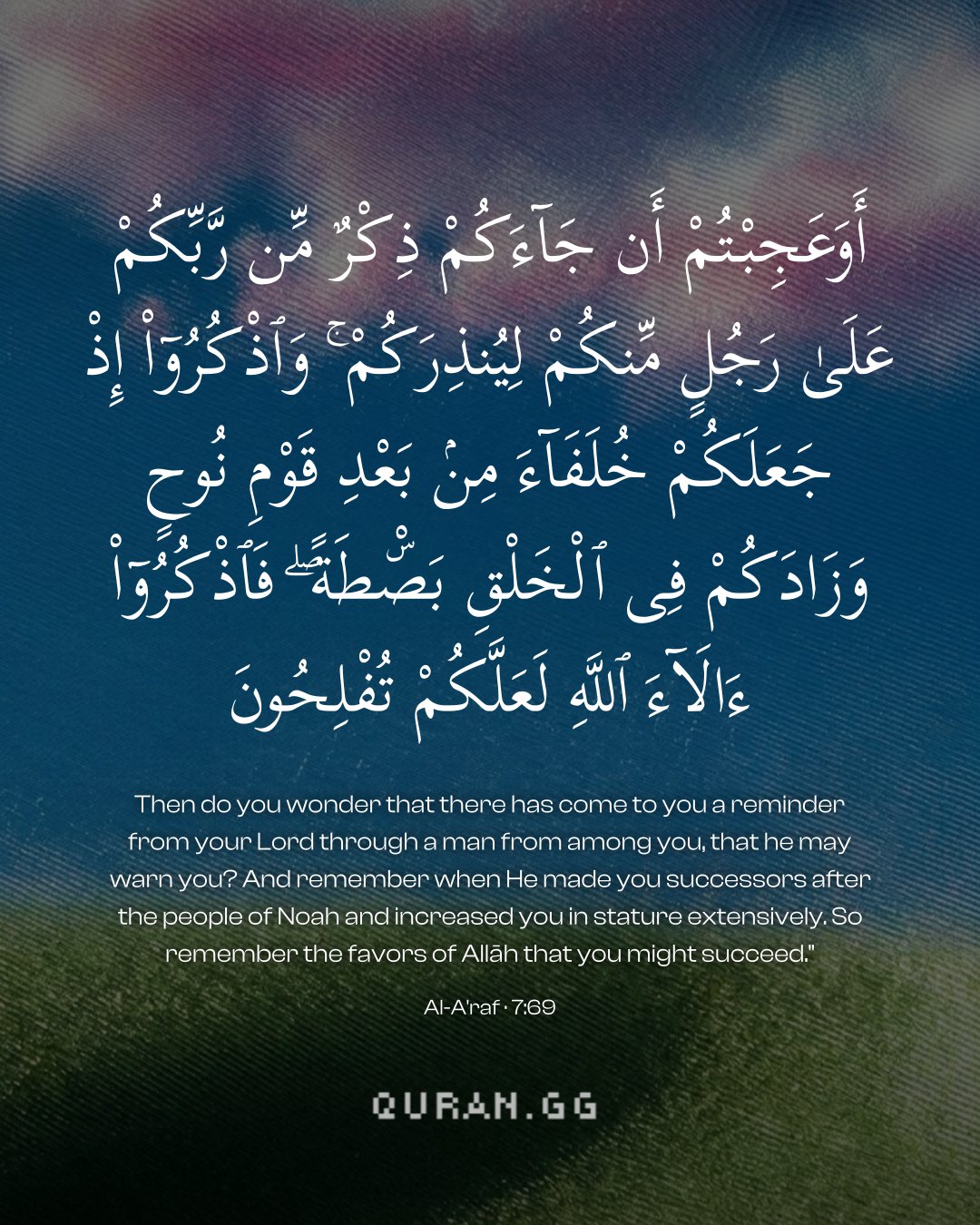
Then do you wonder that there has come to you a reminder from your Lord through a man from among you, that he may warn you? And remember when He made you successors after the people of Noah and increased you in stature extensively. So remember the favors of Allāh that you might succeed."
The Story of Hud, Peace be upon Him, and the Lineage of the People of `Ad
Allah says, just as We sent Nuh to his people, similarly, to the `Ad people, We sent Hud one of their own brethren. Muhammad bin Ishaq said that the tribe of `Ad were the descendants of `Ad, son of Iram, son of `Aws, son of Sam, son of Nuh. I say, these are indeed the ancient people of `Ad whom Allah mentioned, the children of `Ad, son of Iram who were living in the deserts with lofty pillars or statues. Allah said,
(Have you not seen how your Lord dealt with `Ad (people). Of Iram like (lofty) pillars. The like of which were not created in the land) 89:6-8 because of their might and strength. Allah said in another instance,
(3)-Once again, the objection of the people of ` Ad mentioned in the fifth verse (69) is the same as raised by the people of Sayyidna Nuh (علیہ السلام) before them - that is, how can we take a human being like us as our superior? Had it been an angel, maybe we would have done that.' In answer to this what the Qur'an has mentioned is the reply given by Sayyidna Nuh (علیہ السلام) to his people - where he had said that there was nothing to be surprised about the fact that a human being comes to people as the prophet or messenger of Allah to put His fear in their hearts, because it is a human being who can convince other human beings effectively.
After that they were reminded of the blessings Allah Ta` ala had bestowed upon them. It was said: وَاذْكُرُوا إِذْ جَعَلَكُمْ خُلَفَاءَ مِن بَعْدِ قَوْمِ نُوحٍ وَزَادَكُمْ فِي الْخَلْقِ بَسْطَةً ۖ فَاذْكُرُوا آلَاءَ اللَّـهِ لَعَلَّكُمْ تُفْلِحُونَ (And remember when He made you successors after the people of Nuh and gave you increased strength in physique).
Remembering these blessings would have been for their own good, but wicked and intoxicated with power and wealth as they were, they paid no heed and gave a reply which was no different from what is generally given by people who have gone astray. They said that if Sayyidna Hud (علیہ السلام) was trying to wean them away from the faith of their ancestors and hoping that they would abandon their idols and come around to believing in just one God, then, this they would never be able to do. As for the warning of punishment he was giving to them, they would say: go ahead and bring it upon us, if you are telling the truth.
Tazkirul Quran
Maulana Wahiduddin KhanOn ayahs 68–69
Literally ‘I am your well-wisher.’ This utterance of the prophet shows that the relationship between the call-giver and his addressees is not that of a rival or a competitor. It is a relationship of well-wishing and trust. The call-giver should be such that he should have nothing in his heart except good wishes for his addressees. Howsoever rude and unpleasant the behaviour that he comes across in his addressees may be, the call-giver should remain their well-wisher till the last moment. Then, while delivering his message, he should not have the feeling that he is bestowing upon another something which belongs to him. He should feel rather that it belongs to others and that he is holding it in trust for them, and that, by delivering it, he is relieving himself of a great responsibility.
Uthmani text of the Madinah mushaf (King Fahd Complex). Translation: Saheeh International. Tafsir via Quran.com.