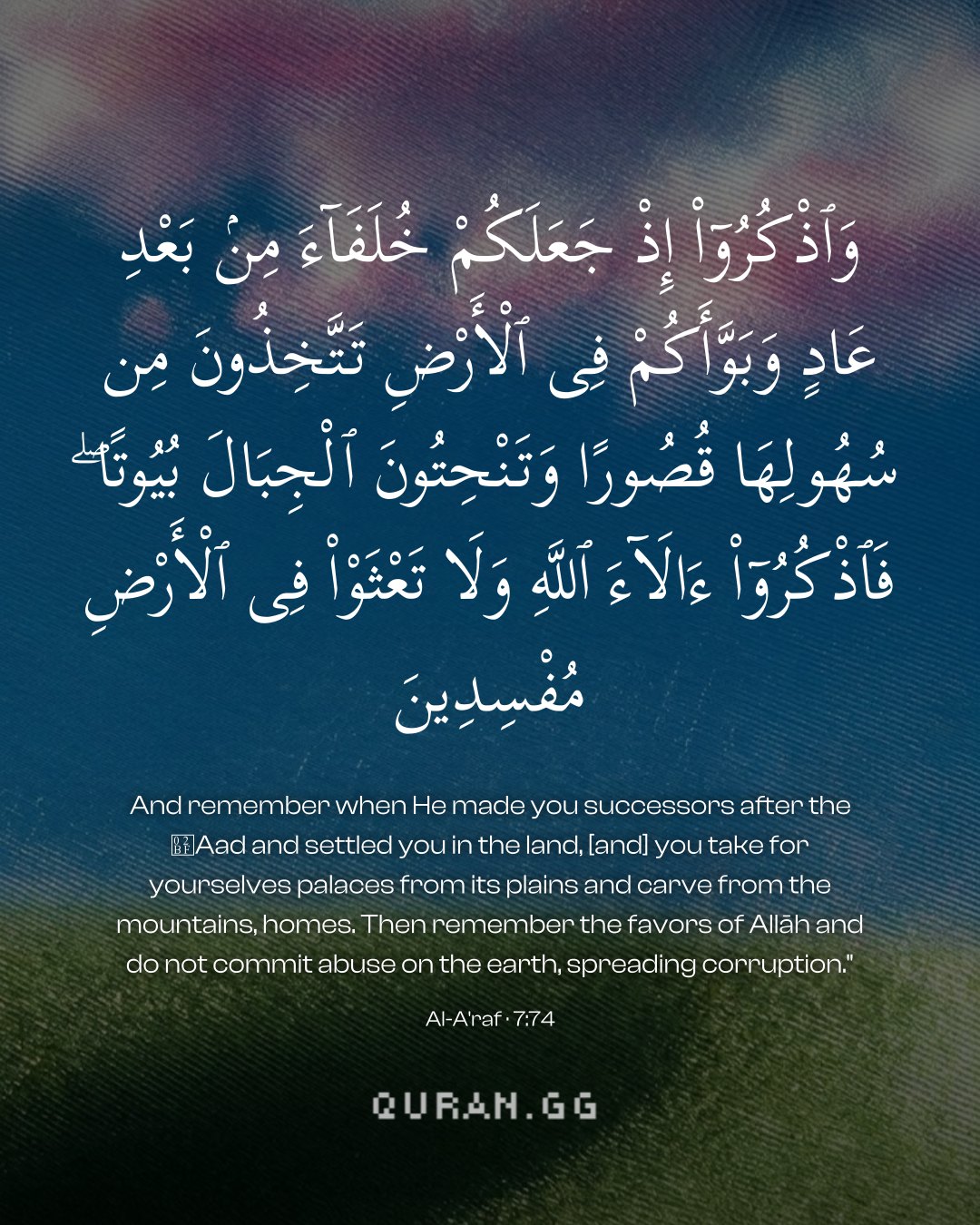
And remember when He made you successors after the ʿAad and settled you in the land, [and] you take for yourselves palaces from its plains and carve from the mountains, homes. Then remember the favors of Allāh and do not commit abuse on the earth, spreading corruption."
Scholars of Tafsir and genealogy say that (the tribe of Thamud descended from) Thamud bin `Athir bin Iram bin Sam bin Nuh, and he is brother of Jadis son of `Athir, similarly the tribe of Tasm, and they were from the ancient Arabs, Al-`Aribah, before the time of Ibrahim, Thamud came after `Ad. They dwelled between the area of the Hijaz (Western Arabia) and Ash-Sham (Greater Syria). The Messenger of Allah ﷺ passed by the area and ruins of Thamud when he went to Tabuk (in northern Arabia) during the ninth year of Hijrah. Imam Ahmad recorded that Ibn `Umar said, "When the Messenger of Allah ﷺ went to the area of Al-Hijr in Tabuk with the people, he camped near the homes of Thamud, in Al-Hijr and the people brought water from the wells that Thamud used before. They used that water to make dough and placed the pots (on fire) for cooking. However, the Prophet commanded them to spill the contents of the pots and to give the dough to their camels. He then marched forth with them from that area to another area, near the well that the camel (as will follow) used to drink from. He forbade the Companions from entering the area where people were tormented, saying,
In the second verse (74), concern has been shown for these pledge-breaking and contumacious people lest they find themselves subjected to Divine punishment. For this purpose they have been reminded of the favours and blessings of Allah Ta` ala upon them in the hope that they would alter their uncompromising stance and abandon their doggedness and rebellion. It was said: وَاذْكُرُوا إِذْ جَعَلَكُمْ خُلَفَاءَ مِن بَعْدِ عَادٍ وَبَوَّأَكُمْ فِي الْأَرْضِ تَتَّخِذُونَ مِن سُهُولِهَا قُصُورًا وَتَنْحِتُونَ الْجِبَالَ بُيُوتًا (And remember when He made you successors after ` Ad and lodged you on earth [ whereby ] you make castles in its plains and hew out the mountains into houses). Here, the word: خُلَفَاءَ (khulafa' ) is the plural of khalifah which means deputy or vice-regent and: قُصُور (qusur) is the plural of قَصر qasr which means a palace or palatial building. The word: تَتَّخِذُونَ (tanhituna) is a derivation from naht which means sculpture or stone-carving. جِبَال ` Jibal' is the plural of jabal meaning a mountain. ` Buyut' is the plural of bayt which denotes a house or rooms in it. The sense of the verse is that they should remember the blessing of Allah Ta` ala that He, after the destruction of the people of ` Ad, brought them to settle in their place, gave their lands and homes to them as the new owners, and bestowed on them the skill with which they could raise big palaces on open surfaces and hew out mountains to make rooms and apartments inside them. Then, at the end of the verse, it was said فَاذْكُرُوا آلَاءَ اللَّـهِ وَلَا تَعْثَوْا فِي الْأَرْضِ مُفْسِدِينَ (So be mindful of the bounties of Allah, and do not go about the earth spreading disorder).
Injunctions and Rulings
Some fundamental and subsidiary rulings emerge from the cited verse. These are as follows:
(1) There is a unanimous agreement of all prophets, may peace be upon them all, on fundamental articles of faith and, similarly, united stand their religious codes or Shari'ahs. All of them invite towards Tauhid or absolutely pure monotheism as the basis of worshiping Allah, and they all warn against contravention of this concept which brings punishment in this world and in the Hereafter.
(2) It has happened in past communities too that the wealthy and the traditional holders of social prestige have not said yes to the call of prophets as a result of which they were disgraced and destroyed in this world and became deserving of punishment in the Hereafter as well.
(3) According to Tafsir al-Qurtubi, this verse tells us that the blessings of Allah in this world are directed to and shared by disbelievers as well - as was the case with the people of ` Ad and Thamud to whom Allah Ta` ala had given great wealth and power.
(4) According to Tafsir al-Qurtubi, once again, this verse tells us that palaces and mansions are blessings of Allah Ta` ala and their making is permissible.
However, this is an entirely different matter that the noble prophets and the men of Allah have not favoured them as they make people heedless. The sayings of the Holy Prophet ﷺ about high rising buildings are of this nature.
Tazkirul Quran
Maulana Wahiduddin KhanOn ayahs 73–75
After the destruction of the ‘Ad community, certain righteous people redeemed by God settled in the Hajr, the area in the north west of Arabia. Their race increased and they made immense progress in the fields of agriculture and construction. They constructed palaces in the plains and by chiselling the hills, made stone houses. But later on they fell victim to the evils that generally follow a community’s material development and worldly well-being, i.e. debauchery, obliviousness of the Hereafter, heedlessness about the limits laid down by God, self-conceit and disregard for the greatness of God. At this juncture God raised Salih so that he might warn them of the chastisement of God. But they did not accept the admonition. They were not willing to mend their ways. In the universe, where all things are living in complete obedience to God, they opted to live in arrogance and disobey God: where everything strictly observed the limits set by God, man wanted to lead his life by transgressing His limits. Their transgression created disturbances in the reformed world. Therefore, they were held unfit to inhabit the world. For the purpose of testing the community of Thamud, God assigned a she-camel to them and commanded them not to harm her, or else they would be destroyed. It would have been quite possible for God to appoint a terrifying lion for this purpose. But God appointed a she-camel instead of a lion. The reason for this is that the test of a man’s fear of God is always taken at the level of a ‘she camel’ and not at the level of a ‘lion’. In society there are always some people who are like the camel of God. These are the weak individuals who do not have the material strength which could act as a deterrent to oppression. Through these people, God tests the true faith of His people. And the certificates of Heaven and Hell are given on the basis of the results of these tests.