Surah Al-Baqarah Ayah 118 (2:118) — Meaning & Tafsir | Quran.GG

Surah Al-Baqarah, Ayah 118

2:118 · Meaning and tafsir

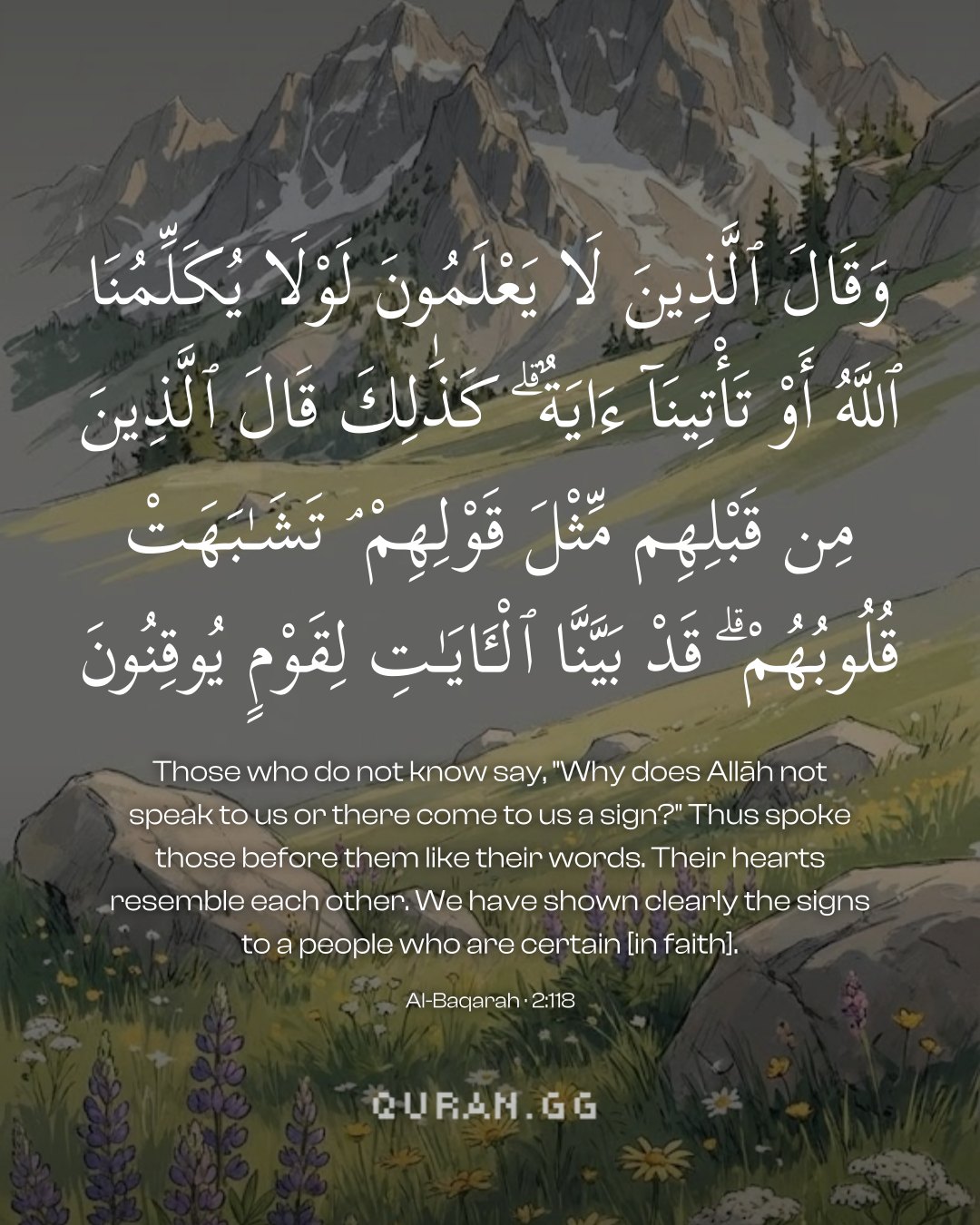
وَقَالَ ٱلَّذِينَ لَا يَعْلَمُونَ لَوْلَا يُكَلِّمُنَا ٱللَّهُ أَوْ تَأْتِينَآ ءَايَةٌ ۗ كَذَٰلِكَ قَالَ ٱلَّذِينَ مِن قَبْلِهِم مِّثْلَ قَوْلِهِمْ ۘ تَشَـٰبَهَتْ قُلُوبُهُمْ ۗ قَدْ بَيَّنَّا ٱلْـَٔايَـٰتِ لِقَوْمٍ يُوقِنُونَ ١١٨

Those who do not know say, "Why does Allāh not speak to us or there come to us a sign?" Thus spoke those before them like their words. Their hearts resemble each other. We have shown clearly the signs to a people who are certain [in faith].

Surah Al-Baqarah 2:118 in Arabic with its translation: “Those who do not know say, "Why does Allāh not speak to us or there come to us a sign?" Thus spoke those…”

Make something with this ayah

Turn it into a video for Stories, Reels or TikTok, recited by the reciter you pick, or an image on a background you choose. Free, in your browser.

Download this image

Tafsir Ibn Kathir (abridged)

Muhammad bin Ishaq reported that Ibn `Abbas said that Rafi` bin Huraymilah said to the Messenger of Allah ﷺ , "O Muhammad! If you were truly a Messenger from Allah, as you claim, then ask Allah to speak to us directly, so that we hear His Speech." So Allah revealed,

وَقَالَ الَّذِينَ لاَ يَعْلَمُونَ لَوْلاَ يُكَلِّمُنَا اللَّهُ أَوْ تَأْتِينَآ ءَايَةٌ

(And those who have no knowledge say: "Why does not Allah speak to us (face to face) or why does not a sign come to us")

Abu Al-`Aliyah, Ar-Rabi` bin Anas, Qatadah and As-Suddi said that it was actually the statement of the Arab disbelievers:

كَذَلِكَ قَالَ الَّذِينَ مِن قَبْلِهِم مِّثْلَ قَوْلِهِمْ

(So said the people before them words of similar import. ) He said, "These are the Jews and the Christians."

What further proves that the Arab idolators said the statement mentioned in the Ayah is that Allah said,

وَإِذَا جَآءَتْهُمْ ءَايَةٌ قَالُواْ لَن نُّؤْمِنَ حَتَّى نُؤْتَى مِثْلَ مَآ أُوتِىَ رُسُلُ اللَّهِ اللَّهُ أَعْلَمُ حَيْثُ يَجْعَلُ رِسَالَتَهُ سَيُصِيبُ الَّذِينَ أَجْرَمُواْ صَغَارٌ عِندَ اللَّهِ وَعَذَابٌ شَدِيدٌ بِمَا كَانُواْ يَمْكُرُونَ

(And when there comes to them a sign (from Allah) they say: "We shall not believe until we receive the like of that which the Messengers of Allah ﷺ had received." Allah knows best with whom to place His Message. Humiliation and disgrace from Allah and a severe torment will overtake the criminals (polytheists and sinners) for that which they used to plot.) (6:124) and

وَقَالُواْ لَن نُّؤْمِنَ لَكَ حَتَّى تَفْجُرَ لَنَا مِنَ الاٌّرْضِ يَنْبُوعًا

(And they say: "We shall not believe in you (O Muhammad ), until you cause a spring to gush forth from the earth for us) until,

قُلْ سُبْحَـنَ رَبِّى هَلْ كُنتُ إَلاَّ بَشَرًا رَّسُولاً

(Say (O Muhammad ): "Glorified (and Exalted) be my Lord (Allah) above all that evil they (polytheists) associate with Him! Am I anything but a man, sent as a Messenger") (17:90-93) and,

وَقَالَ الَّذِينَ لاَ يَرْجُونَ لِقَآءَنَا لَوْلاَ أُنزِلَ عَلَيْنَا الْمَلَـئِكَةُ أَوْ نَرَى رَبَّنَا

(And those who expect not a meeting with Us (i. e. those who deny the Day of Resurrection and the life of the Hereafter) said: "Why are not the angels sent down to us, or why do we not see our Lord") (25:21) and,

بَلْ يُرِيدُ كُلُّ امْرِىءٍ مِّنْهُمْ أَن يُؤْتَى صُحُفاً مُّنَشَّرَةً

(Nay, everyone of them desires that he should be given pages spread out) (74:52).

There are many other Ayat that testify to the disbelief of the Arab idolators, their transgression, stubbornness, and that they asked unnecessary questions out of disbelief and arrogance. The statements of the Arab idolators followed the statements of the nations of the People of the Two Scriptures and other religions before them. Allah said,

يَسْأَلُكَ أَهْلُ الْكِتَـبِ أَن تُنَزِّلَ عَلَيْهِمْ كِتَـباً مِّنَ السَّمَآءِ فَقَدْ سَأَلُواْ مُوسَى أَكْبَرَ مِن ذلِكَ فَقَالُواْ أَرِنَا اللَّهِ جَهْرَةً

(The People of the Scripture (Jews) ask you to cause a book to descend upon them from heaven. Indeed, they asked Musa (Moses) for even greater than that, when they said: "Show us Allah in public,") (4:153) and,

وَإِذْ قُلْتُمْ يَـمُوسَى لَن نُّؤْمِنَ لَكَ حَتَّى نَرَى اللَّهَ جَهْرَةً

(And (remember) when you said: "O Musa! We shall never believe in you until we see Allah plainly.") (2:55).

Allah's statement,

تَشَـبَهَتْ قُلُوبُهُمْ

(Their hearts are alike. ) means, the hearts of the Arab idolators are just like the hearts of those before them, containing disbelief, stubbornness and injustice. Similarly, Allah said,

كَذَلِكَ مَآ أَتَى الَّذِينَ مِن قَبْلِهِمْ مِّن رَّسُولٍ إِلاَّ قَالُواْ سَـحِرٌ أَوْ مَجْنُونٌ أَتَوَاصَوْاْ بِهِ

(Likewise, no Messenger came to those before them but they said: "A sorcerer or a madman!" Have they (the people of the past) transmitted this saying to these (Quraysh pagans)) (51:52-53).

Allah said next,

قَدْ بَيَّنَّا الآيَـتِ لِقَوْمٍ يُوقِنُونَ

(We have indeed made plain the signs for people who believe with certainty.) meaning, We made the arguments clear, prooving the truth of the Messengers, with no need of more questions or proofs for those who believe, follow the Messengers and comprehend what Allah sent them with. As for those whose hearts and hearing Allah has stamped and whose eyes have been sealed, Allah described them:

إِنَّ الَّذِينَ حَقَّتْ عَلَيْهِمْ كَلِمَةُ رَبِّكَ لاَ يُؤْمِنُونَ - وَلَوْ جَآءَتْهُمْ كُلُّ ءايَةٍ حَتَّى يَرَوُاْ الْعَذَابَ الاٌّلِيمَ

(Truly, those, against whom the Word (wrath) of your Lord has been justified, will not believe. Even if every sign should come to them, until they see the painful torment) (10:96-97).

Ma'arif al-Qur'an

The Jews, the Christians and the mushrikin used to deny the prophethood of Sayyidna Muhammad ﷺ and some of them did so out of sheer malevolence. In order to feel triumphant in this obstinacy, they would make absurd and impossible demands, two of which have been mentioned here. To begin with, they insisted that Allah Himself should speak to them, either directly as He speaks to the angels, or through the angels as He speaks to the prophets, and that He should Himself proclaim his injunctions to them so as to make the intervention of a new prophet unnecessary, or should at least announce that He had sent Sayyidna Muhammad ﷺ as a prophet, thus making it easy for them to have faith in him and to follow his guidance. Should Allah choose not to accept this demand, they were ready with another -- that is, Allah should send them a sign or proof in confirmation of his prophethood.

In reply to them, Allah puts this demand down as being no more than a foolish custom which has all along been unthinkingly practised by ignorant people even in the earlier ages. Then, the verse traces the origin of this demand to a distortion of the heart, in respect of which all the ignorant people, past or present, are alike, hence the parrot-like repetition of the same demand throughout the ages.

The first of these demands was, on the face of it, silly enough, for, with all the grossness of their minds and hearts, they had the audacity to place themselves on the level of angels and prophets. So, the Holy Qur'an dismisses it as being unworthy of a reply. But in answer to the other demand, Allah reminds them that He has sent, not one, but a number of clear signs and proofs to confirm and establish the prophethood of Sayyidna Muhammad ﷺ . But these signs and proofs can be of help only to those who sincerely wish to know the truth and to attain certitude. As for those who are not in search of the truth, but enjoy being stuck in their malice and obstinacy, there is no help for them.

At this point, we had better say a word to resolve a difficulty that is likely to arise. The Jews and the Christians were the People of the Book", and some of them were men of learning, and yet Allah calls them ignorant. Why? The reason is that although Allah had sent such a large number of clear signs and definite proofs to establish the prophethood of Sayyidna Muhammad .i" , yet they persisted in their denial. This is the mentality and the conduct of the ignorant.

Tazkirul Quran

To the Israelites the criterion of truth was their association with the prophets and saints. That was why they believed that their community was in the right while other communities were in the wrong. As for the Christians, they considered themselves unique in that God’s ‘beloved son’ had been sent to them. Even the polytheists of Makkah thought of themselves as superior to others, basing their claim on the fact that they were the guardians of God’s Sacred House. Thus every nation had set its own self-styled religious standards, according to which they themselves inevitably appeared to be in the right, and everyone else in the wrong. Their actions, however, did not substantiate their claims. For one thing, they had become divided into sects, though all of them swore allegiance to the divine scriptures. They took every opportunity to deny others the right to enter places of worship, though they would say that they were doing this to protect the sanctity of these places. In fact they were ruining them, for places of worship become derelict when people are denied the right of worship there. If a worshipper has the correct attitude, he will never deny the right to worship to those who come to do so; he will never persecute those who come to serve the Lord. When one is truly conscious of God’s greatness and one’s own helplessness before Him, one’s humility will show in one’s dealings with others: one will not seek to harm one’s fellow men in any way, let alone deny them their fundamental right to worship God.

Uthmani text of the Madinah mushaf (King Fahd Complex). Translation: Saheeh International. Tafsir via Quran.com.