Surah Al-Baqarah Ayah 119 (2:119) — Meaning & Tafsir | Quran.GG

Surah Al-Baqarah, Ayah 119

2:119 · Meaning and tafsir

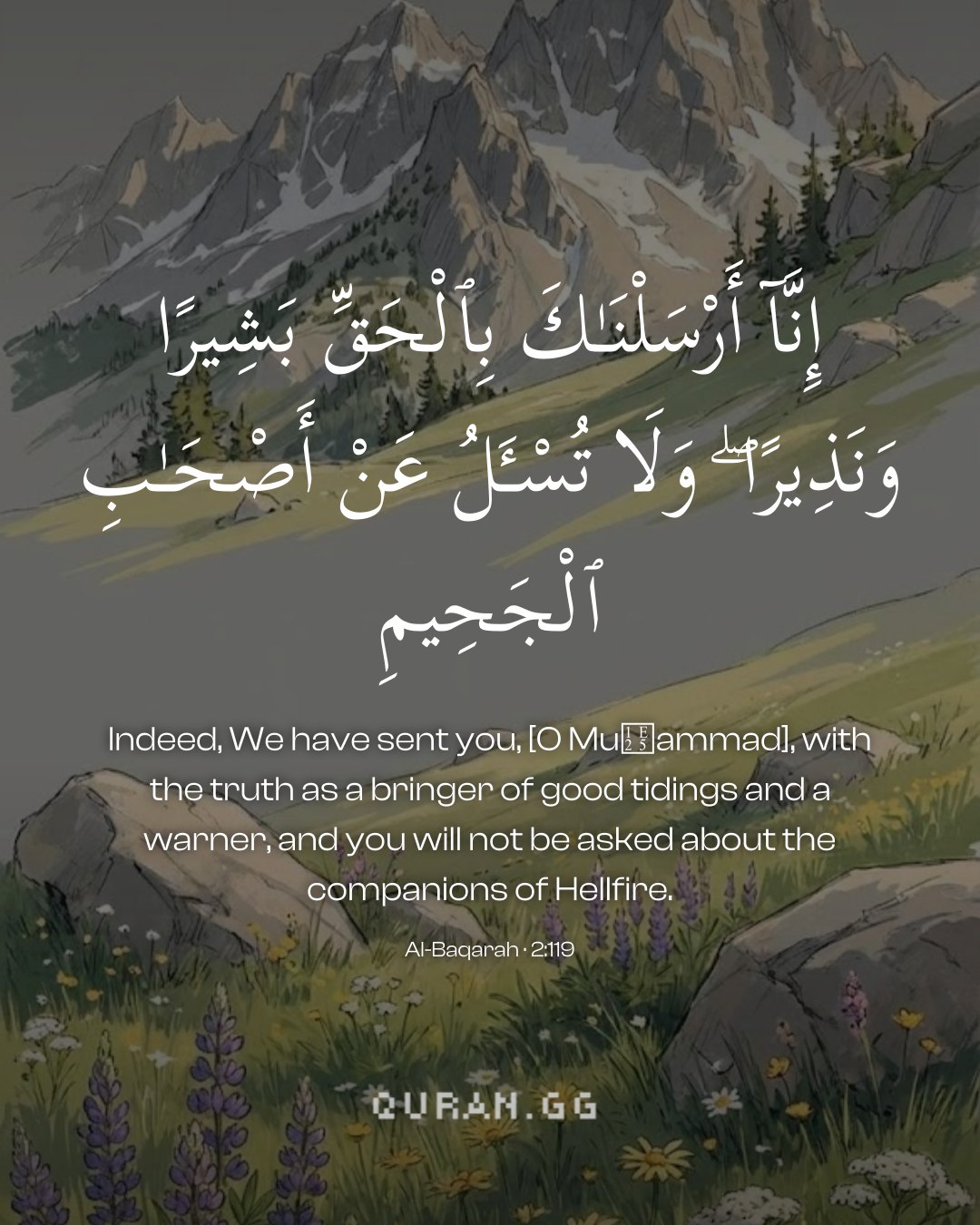
إِنَّآ أَرْسَلْنَـٰكَ بِٱلْحَقِّ بَشِيرًا وَنَذِيرًا ۖ وَلَا تُسْـَٔلُ عَنْ أَصْحَـٰبِ ٱلْجَحِيمِ ١١٩

Indeed, We have sent you, [O Muḥammad], with the truth as a bringer of good tidings and a warner, and you will not be asked about the companions of Hellfire.

Surah Al-Baqarah 2:119 in Arabic with its translation: “Indeed, We have sent you, [O Muḥammad], with the truth as a bringer of good tidings and a warner, and you…”

Make something with this ayah

Turn it into a video for Stories, Reels or TikTok, recited by the reciter you pick, or an image on a background you choose. Free, in your browser.

Download this image

Tafsir Ibn Kathir (abridged)

Allah's statement;

وَلاَ تُسْـَلُ عَنْ أَصْحَـبِ الْجَحِيمِ

(And you will not be asked about the dwellers of the blazing Fire.) means, "We shall not ask you about the disbelief of those who rejected you." Similarly, Allah said,

فَإِنَّمَا عَلَيْكَ الْبَلَـغُ وَعَلَيْنَا الْحِسَابُ

(Your duty is only to convey (the Message) and on Us is the reckoning.) (13:40)

فَذَكِّرْ إِنَّمَآ أَنتَ مُذَكِّرٌ - لَّسْتَ عَلَيْهِم بِمُسَيْطِرٍ

(So remind them (O Muhammad ) ـ you are only one who reminds. You are not a dictator over them.)(88:21-22) and,

نَّحْنُ أَعْلَمُ بِمَا يَقُولُونَ وَمَآ أَنتَ عَلَيْهِمْ بِجَبَّارٍ فَذَكِّرْ بِالْقُرْءَانِ مَن يَخَافُ وَعِيدِ

(We know best what they say. And you (O Muhammad ) are not the one to force them (to belief). But warn by the Qur'an; him who fears My threat) (50:45).

There are many other similar Ayat.

The Description of the Prophet in the Tawrah

Imam Ahmad recorded `Ata' bin Yasar saying that he met `Abdullah bin `Amr bin Al-`As and said to him, "Tell me about the description of the Messenger of Allah ﷺ in the Torah." He said, "Yes, by Allah, he is described by the Torah with the same characteristics that he is described with in the Qur'an with: `O Prophet! We have sent you as a witness, a bringer of good news, a warner, and as safe refuge for the unlettered people. You are My servant and Messenger. I have called you the Mutawakkil (who depends and relies on Allah for each and everything). You are not harsh, nor hard, nor obnoxious in the bazaars. He does not reward the evil deed with an evil deed. Rather, he forgives and pardons. Allah will not bring his life to an end, until he straightens the wicked's religion by his hands so that the people proclaim: There is no deity worthy of worship except Allah. By his hands, Allah will open blind eyes, deaf ears and sealed hearts."' This was recorded by Al-Bukhari only.

Ma'arif al-Qur'an

The implication of Verse 118 was that those who persisted in their denial of the Holy Prophet ﷺ did so out of sheer malice and ignorance, and could not be expected to reform themselves. Since he has been sent as the mercy for all the worlds", the thought of their being incorrigible was likely to make him sad on their account. So, in this verse Allah offers him a consolation. He has been sent down to men, bearing the truth and the genuine faith. His function is twofold -- to give glad tidings to those who accept the truth, and warnings of dire punishment to those who deny. Allah assures him that he will not be held responsible or taken to account for those who willingly pursue the way to Hell. All that he is required to do is to keep performing his own function, and not to worry as to who accepts the truth and who does not.

Tazkirul Quran

Another error into which they fell was to liken God to man. A human being, for instance, cannot be in two places at the same time, and, in consequence, people think that God is also to be found only in some particular place. But God is everywhere. True, He has prescribed a direction for us to face when we worship, but this is a purely organizational requirement for prayer; it does not mean that God is to be found in only one direction and not in any other. Another outcome of this basic misconception of God’s nature is people’s attributing a son to Him. But only those who have needs beget sons, and God is above all such imperfections and limitations. He is complete in Himself. Such beliefs do not stem from God; man has invented them himself.

Uthmani text of the Madinah mushaf (King Fahd Complex). Translation: Saheeh International. Tafsir via Quran.com.