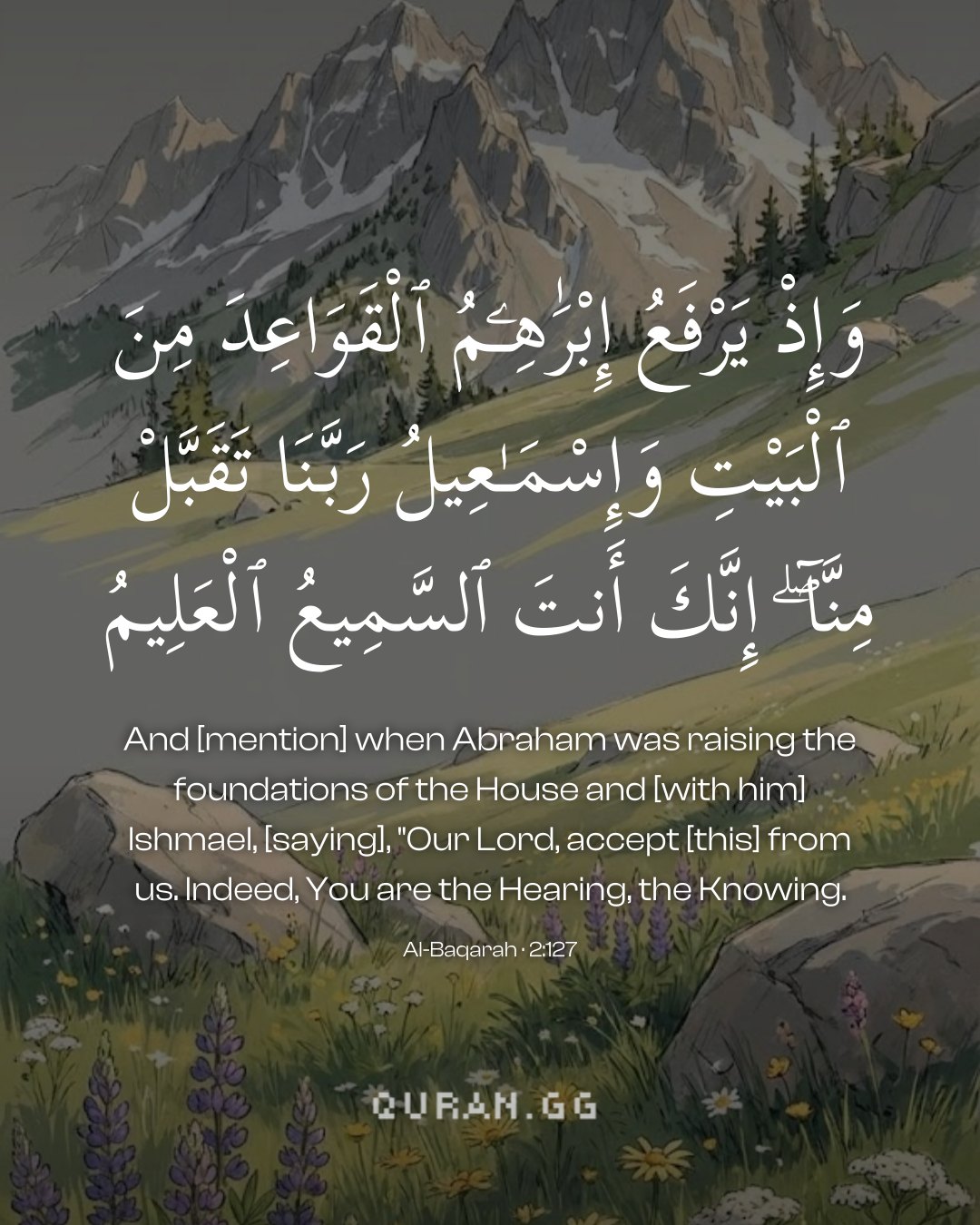
And [mention] when Abraham was raising the foundations of the House and [with him] Ishmael, [saying], "Our Lord, accept [this] from us. Indeed, You are the Hearing, the Knowing.
(And We gave Our 'Ahd (command) to Ibrahim and Isma`il) means, "Allah ordered them to purify it from all filth and impurities, of which none should ever touch it." Also, Ibn Jurayj said, "I said to `Ata', `What is Allah's `Ahd' He said, `His command."' Also, Sa`id bin Jubayr said that Ibn `Abbas commented on the Ayah,
(that they should purify My House (the Ka`bah) for those who are circumambulating it, or staying (I`tikaf)) "Purify it from the idols." Further, Mujahid and Sa`id bin Jubayr said that,
Verse 127 shows another essential quality of this great prophet. In obedience to Allah, he had left the fertile land of Syria and made his wife and child to settle in the barren desert, and now he was taking up the labour of building "the House of Allah." This was a moment when a man who had been bearing such hardships in the way of Allah could normally be expected to feel satisfied with himself and relax in a mood of self-congratulation. But "the Friend of Allah" recognized the Majesty of Allah, and knew that no creature can possibly worship or obey his Creator as is His due, but within his own limited powers. Consequently, he also knew that in performing the hardest or the greatest tasks one should not be proud of one's attainment, but should, in all humility, pray to Allah to accept the little effort one has been capable of making - and that, too, with the grace of Allah Himself. That is exactly what Sayyidna Ibrahim did when he started, along with his young son, to build the Ka'bah. That is to say, he prayed to Allah to accept this deed, for Allah hears all prayers, and knows the intentions of His creatures.
Tazkirul Quran
Maulana Wahiduddin KhanOn ayahs 126–127
In ancient times Arabia was the most arid land on earth: its sandy surfaces and barren rocks were totally unsuitable for any kind of cultivation. Worse, it was totally exposed to attacks from the outside world. Four thousand years ago Abraham was commanded to take his family into an ‘uncultivable valley’, in that part of Arabia known as Hijaz, and settle them there. Abraham bowed to the will of God without slightest hesitation. When he had taken his family to that ‘uncultivable and inhospitable valley’ he prayed to God, ‘O my God, I have done as was commanded. Now listen to the call of your servant and make this town a place of peace, and make special provision for the material needs of its citizens; for the land that they inhabit is uncultivable.’ Abraham’s prayer was answered: the land of Hijaz has remained an abode of peace and plenty up to the present day. The believer’s whole life should be an act of worship. In whatever far-off corner of the world he lives, he should at all times remember that, one day, he shall have to return to the Lord. He should cause no harm to his fellow men, and as for the earth he lives on, it should be thought of as a place of worship, and kept free of all pollution. Although physically in this world, his heart and mind should always be focused on God—his life should revolve around Him alone; his whole life should be that of submission to Him. True religion makes certain demands on everyone, sometimes even requires that his children be taken to a place as arid and uncultivable as Abraham’s valley. Whatever is entailed, he should faithfully carry out God’s commandments and only then pray to God that He should make his efforts successful. It may well be that God will make fountains gush forth from a dry desert, and lush crops spring forth from a barren land. Whatever splendour and glory one is accorded in this life, these things in themselves do not signify that one is considered fit by God for the leadership of mankind. Everything given to man is a means of testing him and there is no one who is exempt from God’s trial. Leadership indicates that one has been selected by God to represent Him in the nations of the world, and it is only for those who have been found fit by God to represent His divine religion on earth.