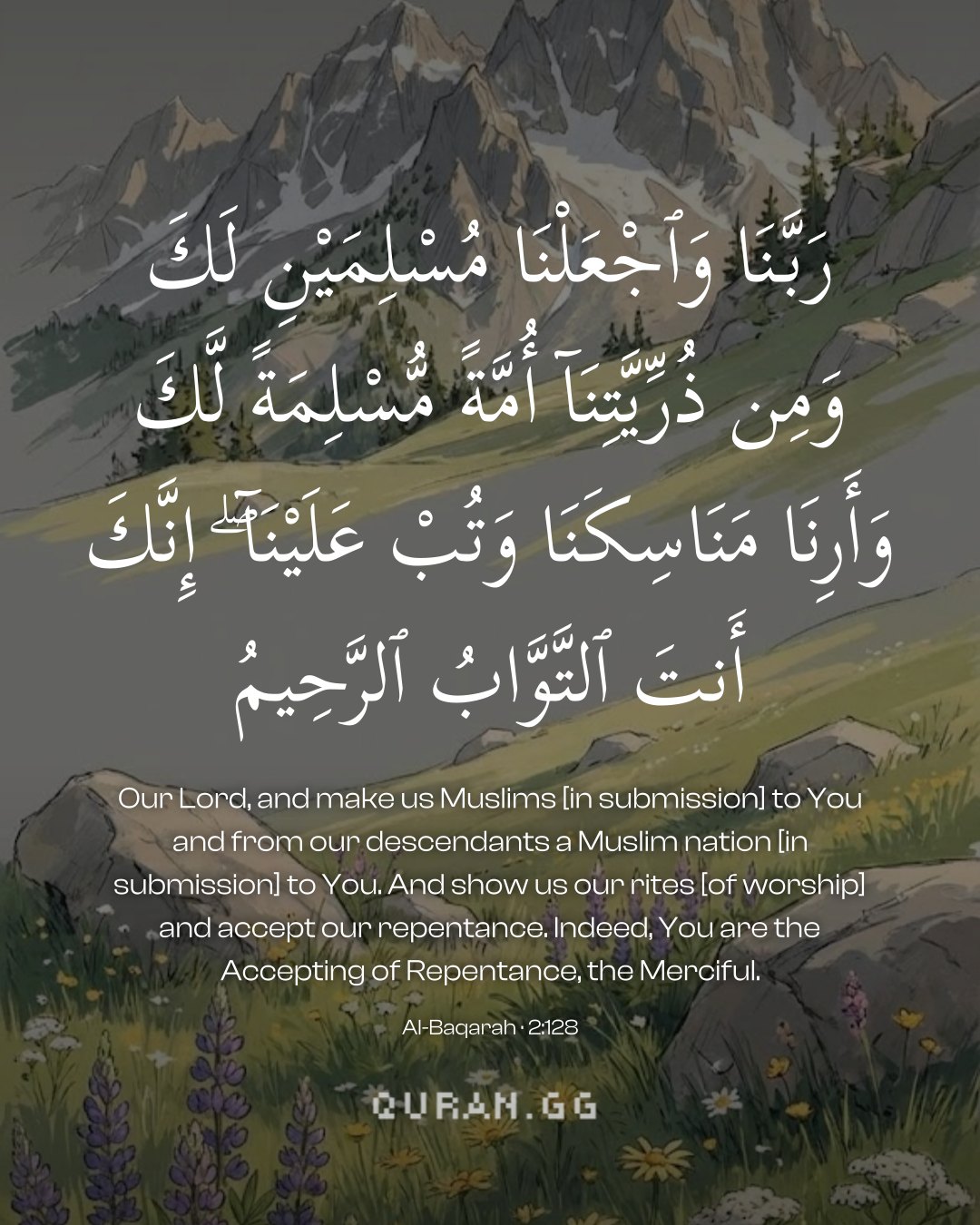
Our Lord, and make us Muslims [in submission] to You and from our descendants a Muslim nation [in submission] to You. And show us our rites [of worship] and accept our repentance. Indeed, You are the Accepting of Repentance, the Merciful.
(And We gave Our 'Ahd (command) to Ibrahim and Isma`il) means, "Allah ordered them to purify it from all filth and impurities, of which none should ever touch it." Also, Ibn Jurayj said, "I said to `Ata', `What is Allah's `Ahd' He said, `His command."' Also, Sa`id bin Jubayr said that Ibn `Abbas commented on the Ayah,
(that they should purify My House (the Ka`bah) for those who are circumambulating it, or staying (I`tikaf)) "Purify it from the idols." Further, Mujahid and Sa`id bin Jubayr said that,
Verse 128 reports that he further prayed to Allah "to make" him and his son obedient to His commandments and to His Will. This prayer too proceeds from the same sense of fear and awe, and from the same knowledge. He has, all his life, been performing exemplary deeds of obedience, and yet he prays to "be made" obedient. It is so, because the more one grows in one's knowledge of Divine Majesty, the more one comes to realize that one is not being faithful and obedient as is due.
It is significant. that Sayyidna Ibrahim (علیہ السلام) included his descendants too in his prayer. This shows that the "men of Allah" who never hesitate in sacrificing themselves and their children in the way of Allah, yet love them deeply. All the same, they know what the proper requirements of parental love are, and how they should be fulfilled. This is something beyond the reach of average men, who suppose the well-being of their children to reside in physical health and comfort alone, and spend all their love and care on providing just this to their family. But those who have received the favour of Allah show a much greater solicitude for the spiritual well-being of their children than for the physical, being more anxious as to what happens to them in the other world than in this. So, the great prophet prayed to Allah to make a group from among his descendants fully obedient to Him. This prayer aims at another advantage as well. Experience tells us that if those who enjoy a respectable position in their community, and their descendants keep to the right path, they are naturally held in esteem, and their conduct inspires others to reform themselves. (AI-Bahr al-Muhit) Allah heard this prayer too, and among the descendants of Sayyidna Ibrahim (علیہ السلام) there has always been a group of people obedient to Allah and firm in the Straight Path. Even in the Age of Ignorance (Jahiliyyah جاھلیہ ) when the whole world, and Arabia in particular, was lost in the darkness of idol-worship and Shirk شرک ، there still remained some men from among his descendants who had faith in the One God, who believed in the other world, and were obedient to Allah - for example, Zayd ibn ` Amr bin Nufayl, and Quss ibn Sa` idah. It has also been reported that ` Abd al-Muttalib ibn Hashim, the grand-father of the Holy Prophet ﷺ ، shunned idol-worship and Shirk شرک (Al-Bahr al-Muhit)
We might add an explanatory note about the word Manasik مناسک (the plural of Mansik) which occurs in Verse 128. This word signifies the different actions involved in the performance of the Hajj, and also the different places where the rites are performed - like ` Arafah عرفات ، Muzdalifah مزدلفہ or Mina منی . Both the meanings of the word are intended here, and the substance of the last part of the prayer is that Sayyidna Ibrahim (علیہ السلام) wanted the rites of the Hajj to be explained and their locations to be indicated. The verb which has been employed in this connection is Arina أَرِنَا - "show us." Now, seeing is done through the eyes, and also through the heart. So, the different locations of the rites were shown to him through the Archangel Jibra'il (علیہ السلام) and the injunctions regarding the Hajj were explained in detail.
Tazkirul Quran
Maulana Wahiduddin Khan
God ordained that a universal centre of Islamic dawah be established in Hijaz. Almighty God chose Abraham and his family to establish this centre and make provision for its functioning. The words which Abraham and Ishmael uttered when they were building the house of God in Makkah were, in addition to being supplications to God, an indication of their unwavering fidelity to God’s scheme of things. It is prayer of this kind that is most pleasing to God, so He accepted their prayer and a permanent fountain of spiritual life for the whole world gushed forth from the barren desert of Arabia. The name of this fountain was Islam. As for the people who inhabited this desert, the offspring of Ishmael, God made them enthusiastic proponents of the Islamic cause: He enabled them to propagate His word far and wide. Through them, he informed mankind how they should please their Lord, so that He might turn to them in mercy. It was to the Children of Ishmael that the final prophet was sent, and for the first time in history, the entire prophetic pattern was recorded for posterity, so that future generations could follow it.
Uthmani text of the Madinah mushaf (King Fahd Complex). Translation: Saheeh International. Tafsir via Quran.com.