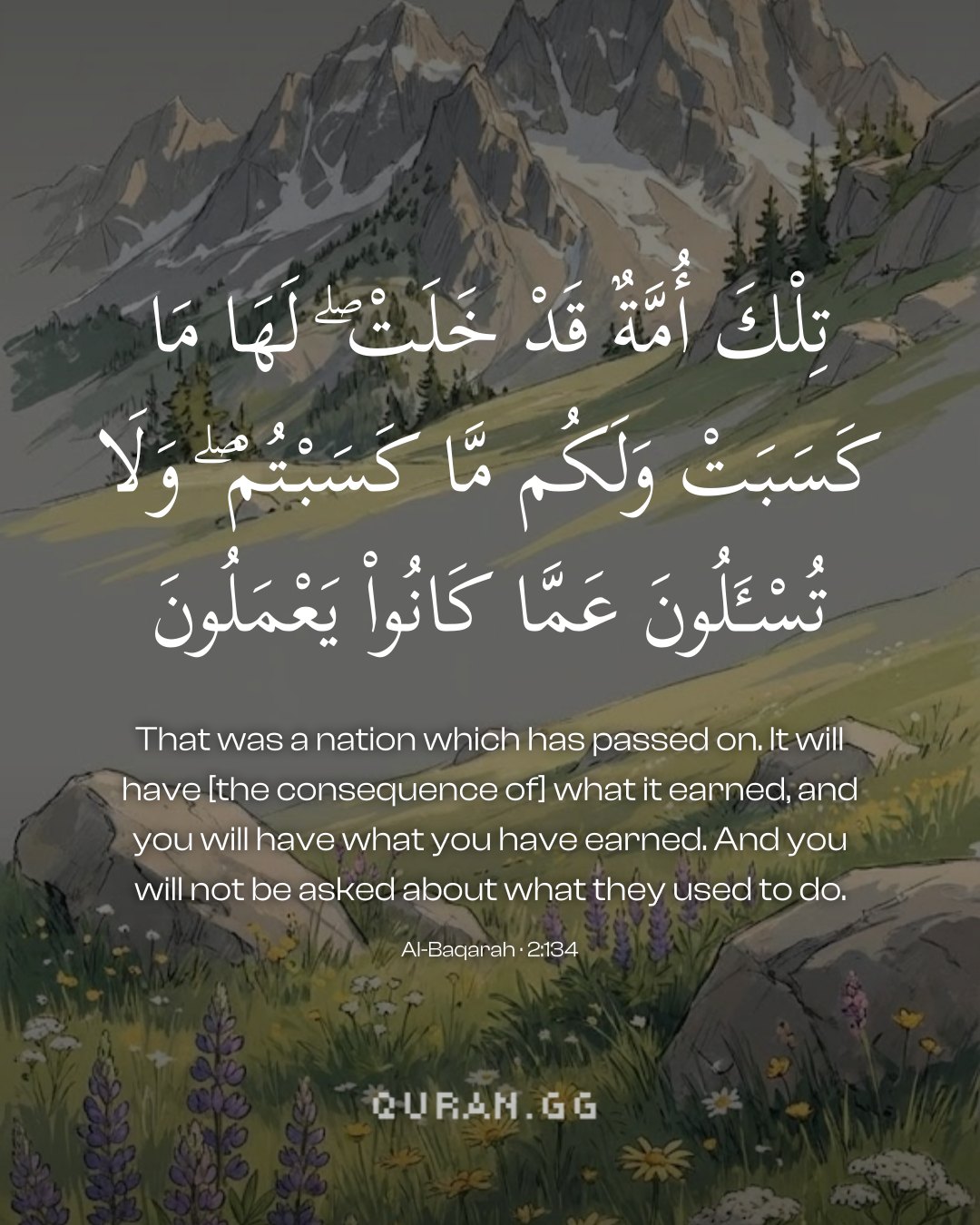
That was a nation which has passed on. It will have [the consequence of] what it earned, and you will have what you have earned. And you will not be asked about what they used to do.
Ya`qub's Will and Testament to His Children upon His Death
This Ayah contains Allah's criticism of the Arab pagans among the offspring of Isma`il as well as the disbelievers among the Children of Israel Jacob the son of Isaac, the son of Ibrahim. When death came to Jacob, he advised his children to worship Allah alone without partners. He said to them,
("What will you worship after me" They said, "We shall worship your Ilah (God ـ Allah) the Ilah of your fathers, Ibrahim, Isma`il, Ishaq,")
Mentioning Isma`il here is a figure of speech, because Isma`il is Jacob's uncle. An-Nahas said that the Arabs call the uncle a father, as Al-Qurtubi mentioned).
Verse 134 tells us that the good deeds of one's forefathers shall not suffice one, if one has not been performing good deeds oneself, and that, similarly, one shall not have to suffer for the misdeeds of one's forefathers, if one's own account is clean. It follows upon this principle that children of mushrikin مشرکین (associators) and Kafirin کافرین (infidels), if they die before having come of age, shall not be punished in the other world on account of the disbelief of their parents. The verse also refutes the claim of the Jews that irrespective of what they had been doing they would go to Paradise on account of the good deeds of their forefathers.
Let this be a warning to those Muslims who, being the descendants of the Holy Prophet ﷺ or of a saint, delude themselves with the hope that their sins would go unpunished in consideration of this privileged position. In fact, the Holy Qur'an is very explicit and very insistent on this point. For example:
"Each man shall reap the fruits of his own deeds, and no one shall bear the burden of another" (6:164).
Addressing his own clan, the Holy Prophet ﷺ said:
"Beware, 0 Banu Hashim, let it not be that on the Day of Judgment while others bring their good deeds with them, you on your part, having neglected good deeds, bring with you only the trust in being my relations, and so I have to tell you that on that day, I cannot save you from the wrath of Allah."
Another hadith says: من بطابہ عملہ لم یسرع بہ نسبہ :"He who has been pulled back by his deeds cannot be pushed forward by his ancestry."
Tazkirul Quran
Maulana Wahiduddin KhanOn ayahs 134–135
Attaching oneself to saints and prophets, living or dead, lulls one into a false sense of security. It leads one to imagine that just as one has been attached to them in this life, one will remain attached to them in the next. It makes one feel that their surplus of good deeds will make up for one’s own shortcomings. The People of the Book were immersed in this form of wishful thinking to the extent that they had invented a dogma of ancestral salvation, pinning all their hopes on the holiness of their elders. But it is sheer self-deception to think that one person will receive the reward of another’s actions. In reality, everyone will reap the rewards, and bear the burden of punishment for his own actions. No one will be made to share in the reward, or punishment, which is awarded to another by virtue of his actions on earth. One who submits to God finds that he has to face all kinds of difficulties in this life. His worldly hopes and ambitions will not necessarily be fulfilled. Yet one who is firm in the faith will not be put off by adversity; he will persevere, making sure that he leaves this world as a believer, so that he can look forward to God’s blessings in the next world.
Uthmani text of the Madinah mushaf (King Fahd Complex). Translation: Saheeh International. Tafsir via Quran.com.