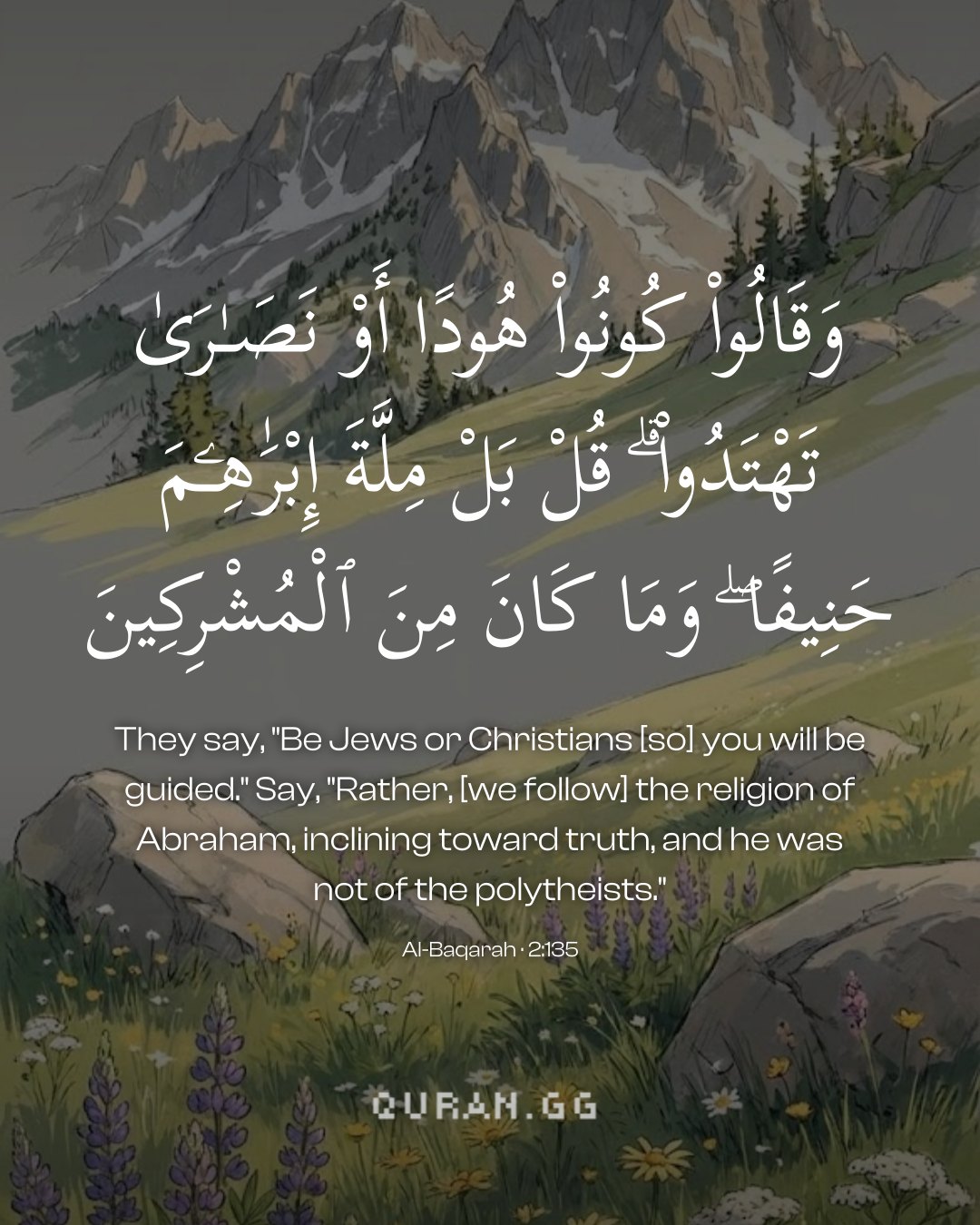
They say, "Be Jews or Christians [so] you will be guided." Say, "Rather, [we follow] the religion of Abraham, inclining toward truth, and he was not of the polytheists."
Muhammad bin Ishaq reported that Ibn `Abbas said that `Abdullah bin Suriya Al-A`war said to the Messenger of Allah ﷺ, "The guidance is only what we (Jews) follow. Therefore, follow us, O Muhammad, and you will be rightly guided." Also, the Christians said similarly, so Allah revealed,
(And they say, "Be Jews or Christians, then you will be guided.") Allah's statement,
قُلْ بَلْ مِلَّةَ إِبْرَهِيمَ حَنِيفًا
(Say (to them O Muhammad ), "Nay, (we follow) only the religion of Ibrahim, Hanif) means, "We do not need the Judaism or Christianity that you call us to, rather,
مِلَّةَ إِبْرَهِيمَ حَنِيفاً
((we follow) only the religion of Ibrahim, Hanif) meaning, on the straight path, as Muhammad bin Ka`b Al-Qurazi and `Isa bin Jariyah stated. Also, Abu Qilabah said, "The Hanif is what the Messengers, from beginning to end, believed in.")
Ma'arif al-Qur'an
Mufti Muhammad ShafiOn ayahs 135–136
The earlier verses have defined the religion (Millat مِلَّت of Sayyidna Ibrahim (علیہ السلام) and established that its present form is Islam. Now, the Jews and the Christians, in spite of their pretension to be his followers, did not in actual fact follow his religion. Each of these two groups, instead of accepting Islam, used to ask the Muslims to accept its own religion in order to find true guidance. No doubt, each of these two religions was, in its own time and for its own time, a genuine religion, but in its present form each had become distorted, and had also been abrogated by Allah. So, in answer to them, Allah asks the Holy Prophet $ to declare on his own behalf and on that of his followers that they are and shall remain steadfast in the religion of Sayyidna Ibrahim (علیہ السلام) who shunned all kinds of association (Shirk شرک), who adored nothing but the One God and obeyed no one but Him, and whose religion, therefore, did not have even a trace of distortion. Then, in the second of these verses Allah asks the Muslims to declare the basic tenets of this religion too, which are as follows:- (1) Muslims believe in Allah and in the guidance which He has sent them through the Holy Prophet ﷺ (2) They also believe in all the prophets sent by Allah from time to time - some of whom have been mentioned in this verse. (3) Some of the prophets may in some ways be superior to others, but it is essential for a Muslim to believe in all the prophets without making any distinction. (4) Muslims believe that the Shari` ah of all the prophets mentioned here were instituted by Allah Himself, but they have now been abrogated. So, Muslims follow the Shari'ah of the Holy Prophet ﷺ ، for this alone is now valid. (5) Muslims ultimately obey Allah alone, and submit themselves totally to Him.
In the second of these verses the progeny of Sayyidna Ya` qub (علیہ السلام) (Jacob) has been described as Asbat اسباط or "tribes." The reason is that he had twelve sons, and the offspring of each son came to form a tribe. Allah so blessed his seed that in Egypt, Sayyidna Yusuf (علیہ السلام) (Joseph) and his brothers made up a group of twelve men, but their lineage flourished, and when the Israelites left Egypt along with Sayyidna Musa (علیہ السلام) (Moses), their number ran into thousands. Another form of this blessing was that the progeny of Sayyidna Ya` qub (علیہ السلام) included a large number of prophets.
Tazkirul Quran
Maulana Wahiduddin KhanOn ayahs 134–135
Attaching oneself to saints and prophets, living or dead, lulls one into a false sense of security. It leads one to imagine that just as one has been attached to them in this life, one will remain attached to them in the next. It makes one feel that their surplus of good deeds will make up for one’s own shortcomings. The People of the Book were immersed in this form of wishful thinking to the extent that they had invented a dogma of ancestral salvation, pinning all their hopes on the holiness of their elders. But it is sheer self-deception to think that one person will receive the reward of another’s actions. In reality, everyone will reap the rewards, and bear the burden of punishment for his own actions. No one will be made to share in the reward, or punishment, which is awarded to another by virtue of his actions on earth. One who submits to God finds that he has to face all kinds of difficulties in this life. His worldly hopes and ambitions will not necessarily be fulfilled. Yet one who is firm in the faith will not be put off by adversity; he will persevere, making sure that he leaves this world as a believer, so that he can look forward to God’s blessings in the next world.
Uthmani text of the Madinah mushaf (King Fahd Complex). Translation: Saheeh International. Tafsir via Quran.com.