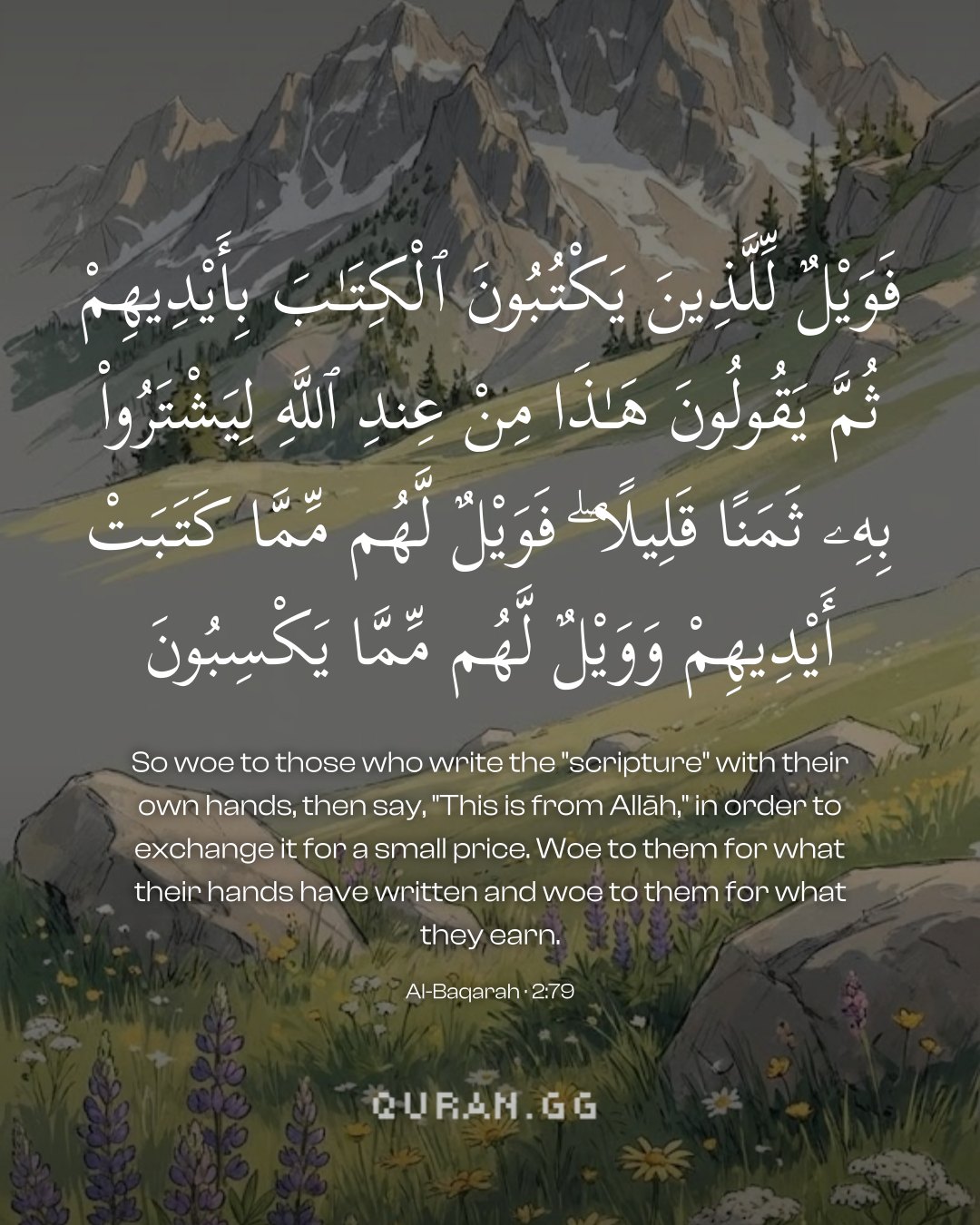
So woe to those who write the "scripture" with their own hands, then say, "This is from Allāh," in order to exchange it for a small price. Woe to them for what their hands have written and woe to them for what they earn.
(And there are among them Ummyyun people) meaning, among the People of the Book, as Mujahid stated. Ummyyun, is plural for Ummi, that is, a person who does not write, as Abu Al-`Aliyah, Ar-Rabi`, Qatadah, Ibrahim An-Nakha`i and others said. This meaning is clarified by Allah's statement,
لاَ يَعْلَمُونَ الْكِتَـبَ
(Who know not the Book) meaning, are they not aware of what is in it.
Ummi was one of the descriptions of the Prophet because he was unlettered. For instance, Allah said,
Allah reminds the Jews that He is omniscient, and knows what they try to keep concealed as well as what they say or do openly. So, it would make no difference at all, if the hypocrites tried to conceal their infidelity from the Muslims, or the other group, not to disclose the verses of the Torah which speak of the Holy Prophet ﷺ . For, Allah Himself has, on different occasions, informed the Muslims in the Holy Qur'an as to the hypocrisy of certain Jews and as to the testimony of the Torah also.
Verse 77 deals with the educated ones among the Jews, while Verse 78 speaks of those who were unlettered. These men had no knowledge of the Torah, and were even deficient in their understanding. Then, the Jewish scholars did not give them correct or proper information about their religion. No wonder, their minds were stuffed only with baseless superstitions which they found very pleasant and flattering.
One of the reasons for the promptness with which the people of Madinah recognized the Prophet Muhammad, and believed in him, was that they had often heard from their Jewish neighbours of the coming of a final prophet. They had, therefore, been expecting his arrival. The Jews then were responsible for the Muslims’ initial fervour for Islam. It was only natural that the Muslims, in their turn, should hope that the Jews would unhesitatingly accept the prophethood of Muhammad. With every hope of a positive response, it was with sublime feelings that they called on the Jews to join them in their belief in the Prophet. How shocked the Muslims were, then, when they found that, contrary to their expectations, the Jews were not ready to accept their invitation to accept Islam. Rather, their efforts had the opposite effect, for the Prophet’s opponents took the opportunity to ask the Muslims, ‘How are you so sure about the prophethood of Muhammad? If he were truly a prophet, the Jews would have been the first to believe in him, for their knowledge of what is written in the scriptures is greater than yours.’ But acceptance of a truth is not dependent upon knowledge alone; one has also to be sincere. As for the Jews, they had already altered their own scriptures, though they knew them to be the word of God. Seeking out loopholes in any part of the Holy scriptures that did not conform to their wishes, they altered the word of God at will; religion was subordinated to their worldly interests. However true something may be, if one is bent on denial and intentional distortion, one is sure to find some justification or the other for it. Such a perverse attitude finally leads to deliberate misrepresentation of the true word of God. One who has such irreverent attitude towards the divine scriptures can never appreciate the gravity of matters concerning God: he hears the word of God, but he can always find words to show that the commandment does not apply to him; he believes in God, but his insensitivity makes him commit acts of flagrant rebellion against Him which no one who really believes that God is watching over him, and hearing what he says, would ever dare to perpetrate.