On the Day of Judgement Everyone will be recompensed according to what He did of Good or Evil
Allah informs of what will happen on the Day of Judgement of the great horrors. He says,
كَلاَّ
(Nay!) meaning, truly.
إِذَا دُكَّتِ الاٌّرْضُ دَكّاً دَكّاً
(When the earth is flatened, Dakkan Dakka.) meaning, the earth and the mountains will be flattened, leveled and made even, and the creatures will rise from their graves for their Lord.
وَجَآءَ رَبُّكَ
(And your Lord comes) meaning, for the session of Judgement between His creatures. This is after they requested the best of the Sons of Adam -- Muhammad ﷺ-- to intercede with Allah. This will occur only after they have requested the other great Messengers, one after another. Yet, all of them will say, "I cannot do that for you." This will continue until the beseeching of the men reaches Muhammad ﷺ, and he will say, "I will do it, I will do it." So he will go and seek to intercede with Allah as the session of Judgement will have come, and Allah will allow him to intercede for that (the Judgement). This will be the first of the intercessions, and it is the praiseworthy station that has already been discussed in Surat Subhan (Al-Isra'). So Allah will come for the session of Judgement as He wills, and the angels will also come, lined up in rows upon rows before Him. Then Allah says,
Continue reading the tafsir of ayahs 21–30Ma'arif al-Qur'an
Mufti Muhammad Shafi
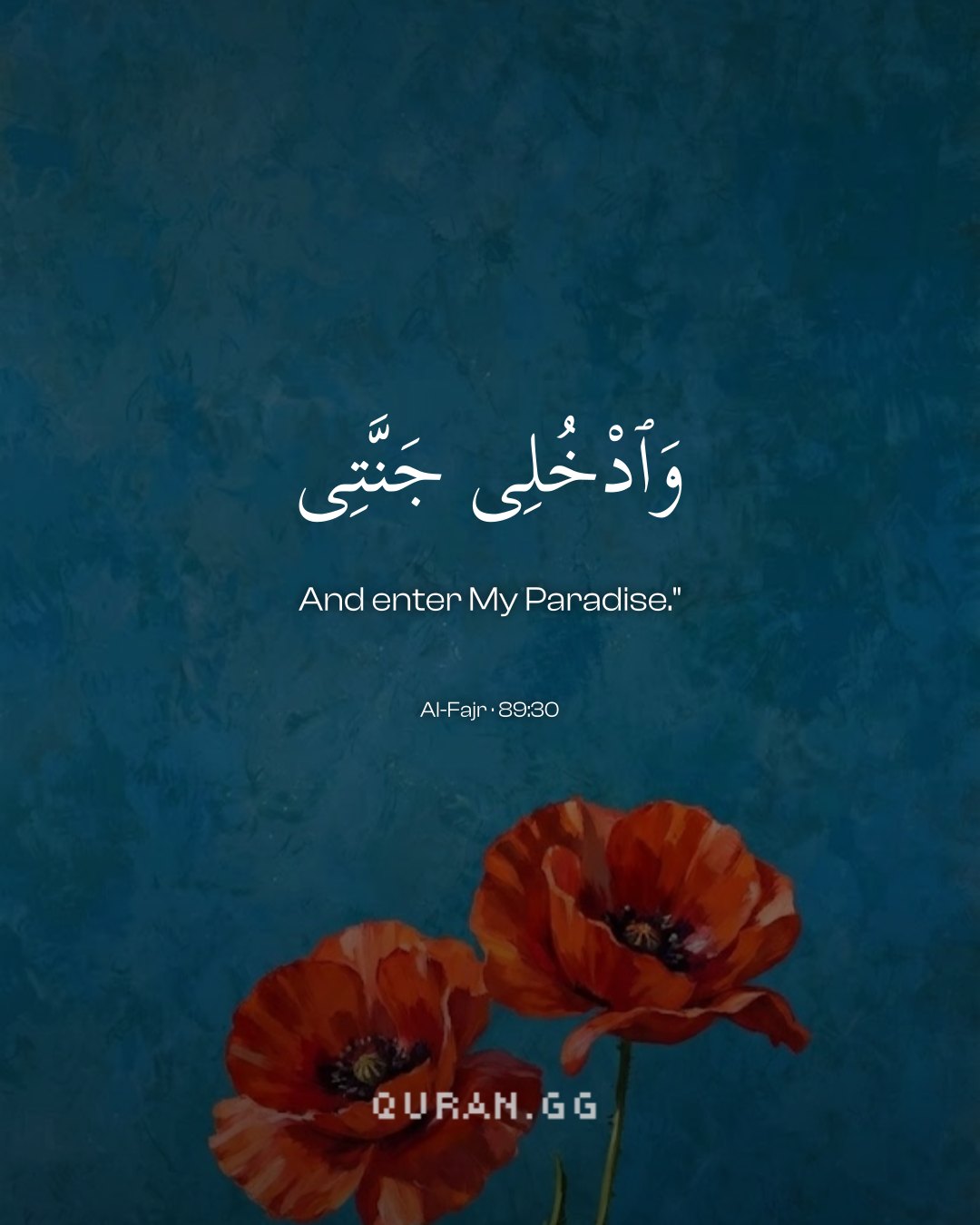
وَادْخُلِي جَنَّتِي (and enter My Paradise 89:30]. In this verse, Paradise is attributed to Allah, and Allah said 'My Paradise'. This is a great honour, and indicates that Paradise will not only have all sorts of eternal comfort, but above all it is a place of Allah's pleasure.
The preceding verses describe the reward of the believers in such a manner that on behalf of Allah, the angels will address their souls honourably and in a befitting manner, as in the verses. It is not clear when they will be addressed. Some commentators say that they will be addressed on the Day of Reckoning after the reckoning is over. The context of the verses confirms this. The punishment of the unbelievers was described above. That will take place in the Hereafter after the Judgment has been passed. It is obvious that the believers will be addressed at the same time. Other scholars indicate that the believers will be addressed in this world at the time of death. Many authentic traditions bear testimony to the veracity of this view. Ibn Kathir, on the other hand, reconciles the apparently conflicting statements thus: Allah will address the soul of the believers twice with these words. Once at the time of death, and again on the Day of Judgment.
Sayyidna ` Ubadah Ibn Samit's narration cited earlier supports the view that the address will be at the time of death. In a lengthy narration of Sayyidna Abu Hurairah, recorded in Musnad of Ahmad, Nasa'i and Ibn Majah, the Holy Prophet ﷺ said: "When death approaches a believer, the angels of mercy bring to him a piece of white silk and say: اخرجی راضیۃ مرضیّۃ الی روح اللہ وریحانہ 'Come out [ from this body ], well-pleased and well-pleasing, to Divine mercy and to the eternal comforts of Paradise' [ to the end of narration.] " Sayyidna Ibn ` Abbas ؓ says that one day he recited the verse يَا أَيَّتُهَا النَّفْسُ الْمُطْمَئِنَّةُ (0 contented soul) in the presence of the Holy Prophet ﷺ ، Abu Bakr ؓ who was present in the assembly, said: "0 Allah's Messenger, what a fine address and honour!" The Holy Prophet ﷺ said: "Behold, the angel will address you thus after your death."
A Few Strange Incidents
Said Ibn Jubair رضی اللہ تعالیٰ عنہ reports that Sayyidna Ibn ` Abbas ؓ passed away in Ta'if. After the funeral was prepared, a strange bird, the like of which was never seen before, came and entered the body, but no one saw it coming out of it. When it was lowered into the grave for burial, an invisible voice was heard reciting from the side of the grave: يَا أَيَّتُهَا النَّفْسُ الْمُطْمَئِنَّةُ Everyone looked around, but could not find anyone. Another incident is recorded by Hafiz Tabarani in his book Kitab-ul-` Aja'ib. He narrates with his chain of authorities, an incident about Fattan Ibn Razin Abi Hashim that once they were imprisoned in a Roman city. They were presented before their king. The king was an infidel. He coerced them to adopt his religion, and threatened them that if anyone refuses to comply with his command, he would be beheaded. They were a few people. Three of them feared for their lives, adopted his religion and thus became apostates. The fourth person refused to adopt the king's religion. He was beheaded and his head was thrown into a nearby river. When it was thrown, the head went to the bottom of the river. Later, it emerged from the water and came to the surface. Then it looked at the other three persons, and calling each one of them by name, recited:
يَا أَيَّتُهَا النَّفْسُ الْمُطْمَئِنَّةُ ﴿27﴾ ارْجِعِي إِلَىٰ رَبِّكِ رَاضِيَةً مَّرْضِيَّةً ﴿28﴾ فَادْخُلِي فِي عِبَادِي ﴿29﴾ وَادْخُلِي جَنَّتِي ﴿30﴾
"0 contented. soul, [ 27] come back to your Lord, well-pleased, well-pleasing [ 28] So, enter among My (special) servants, [ 29] and enter Paradise."[ 30]
After that it dived back into the water.
This was an unusual incident which everyone witnessed and heard. When the Christians of that place witnessed this, almost all of them embraced Islam which shook up the king's throne. The three persons who had become apostates reverted to Islam. Caliph Abu Ja'far Mansur had them all released from their [ enemy's ] prison.
Al-hamdulillah
The Commentary on
Surah Al-Fajr
Ends here
The other type of person is one who would bow down before God and thank Him when he received something, and when things were taken away from him, he would once again bow down before God and express his humility. It is the second type of person who has been called the contented soul or an-nafs al-mutmainnah. The position of the contented soul is attained by one who ponders over God’s signs in the universe; who derives spiritual nourishment, learns lessons and receives guidance from historical events; who proves that if there is a clash between the self and the Truth, he will ignore the self and accept the Truth; who, after once accepting the Truth, never renounces it, whatever the cost.
Uthmani text of the Madinah mushaf (King Fahd Complex). Translation: Saheeh International. Tafsir via Quran.com.