Which was revealed in Makkah
Recitation of Surat Al-Fajr in the Prayer
An-Nasa'i recorded a narration from Jabir that Mu`adh prayed a prayer and a man came and joined him in the prayer. Mu`adh made the prayer long, so the man went and prayed (alone) at the side of the Masjid, and then left. When Mu`adh was informed of this he said, "(He is) a hypocrite." He (Mu`adh) then informed the Messenger of Allah ﷺ of what happened. The Prophet then asked the young man (about it) and he replied, "O Messenger of Allah! I came to pray with him, but he made the prayer too long for me. So I left him and prayed at the side of the Masjid. Then I went to feed my she-camel." The Messenger of Allah ﷺ then said,
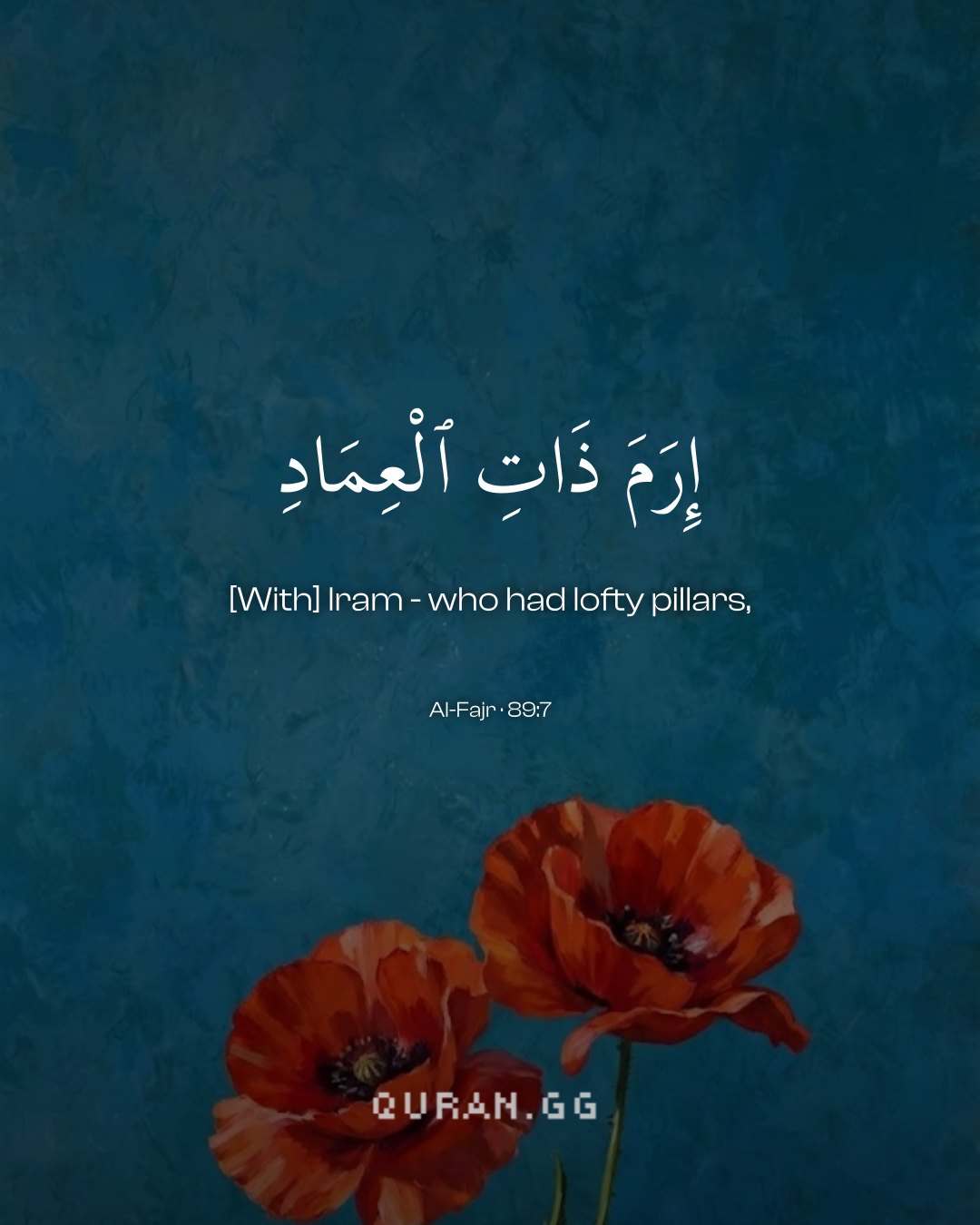
Continue reading the tafsir of ayahs 1–14 They are introduced here by the epithet: ذَاتِ الْعِمَادِ (the men of tall pillars)
The word ` imad' and 'amud' means 'pillar'. The people of ` Ad are mentioned as the men of tall pillars because they were very tall in stature. They were a stronger and more powerful people than any other nations. The Qur'an describes them explicitly, thus:
لَمْ يُخْلَقْ مِثْلُهَا فِي الْبِلَادِ (the like of whom were never created in the lands...89:8) The Qur'an made it clear that this nation was the tallest and the strongest in their physical stature, but the Qur'an did not state the exact measurement of the people because it was unnecessary [ for Qur'anic purposes ]. Therefore, that detail has been left out. Israelite traditions, however, narrate such incredible reports about their stature, height and power that are difficult to believe. It is reported from Sayyidna Ibn ` Abbas ؓ and Muqatil that they were six yards or eighteen feet [ 5.46] tall. This too seems to be derived from Israelite reports. And Allah knows best!
Some commentators say that 'Iram' is the name of the 'paradise' which ` Ad's son Shaddad had built. The epithet 'possessor of tall pillars' [ translated above as 'men of tall pillars'] is used for him. The [ so-called paradise ] was a lofty structure standing on tall pillars built with gold and silver and studded with jewels, gems and other precious stones, so that people may prefer an instant and ready at hand paradise instead of Paradise of the Hereafter. When this magnificent palace was ready for use, and Shaddad, together with the leaders of his kingdom, wanted to enter, Divine punishment overtook them. They, together with the palaces, were completely destroyed. [ Qurtubi ]. In this interpretation, the verse refers to a specific punishment which descended upon the paradise built by ` Ad's son Shaddad. In the first interpretation, which the majority of the commentators prefer, it refers to all the punishments that descended upon the nation of ` Ad.
Uthmani text of the Madinah mushaf (King Fahd Complex). Translation: Saheeh International. Tafsir via Quran.com.