More Attributes of the Servants of the Most Gracious
These are further attributes of the servants of the Most Gracious. They do not bear witness to falsehood, including lies, immorality, disbelief, foul speech and false words. `Amr bin Qays said, this refers to gatherings of sexual immorality. It was said that the Ayah,
لاَ يَشْهَدُونَ الزُّورَ
(And those who do not bear witness to falsehood,) refers to giving false testimony, which means lying deliberately to someone else. It was recorded in the Two Sahihs that Abu Bakrah said, "The Messenger of Allah ﷺ said three times:
«أَلَا أُنَبِّئُكُمْ بِأَكْبَرِ الْكَبَائِرِ؟»
(Shall I not tell you of the greatest of major sins) We said, "Of course, O Messenger of Allah." The Messenger of Allah ﷺ said:
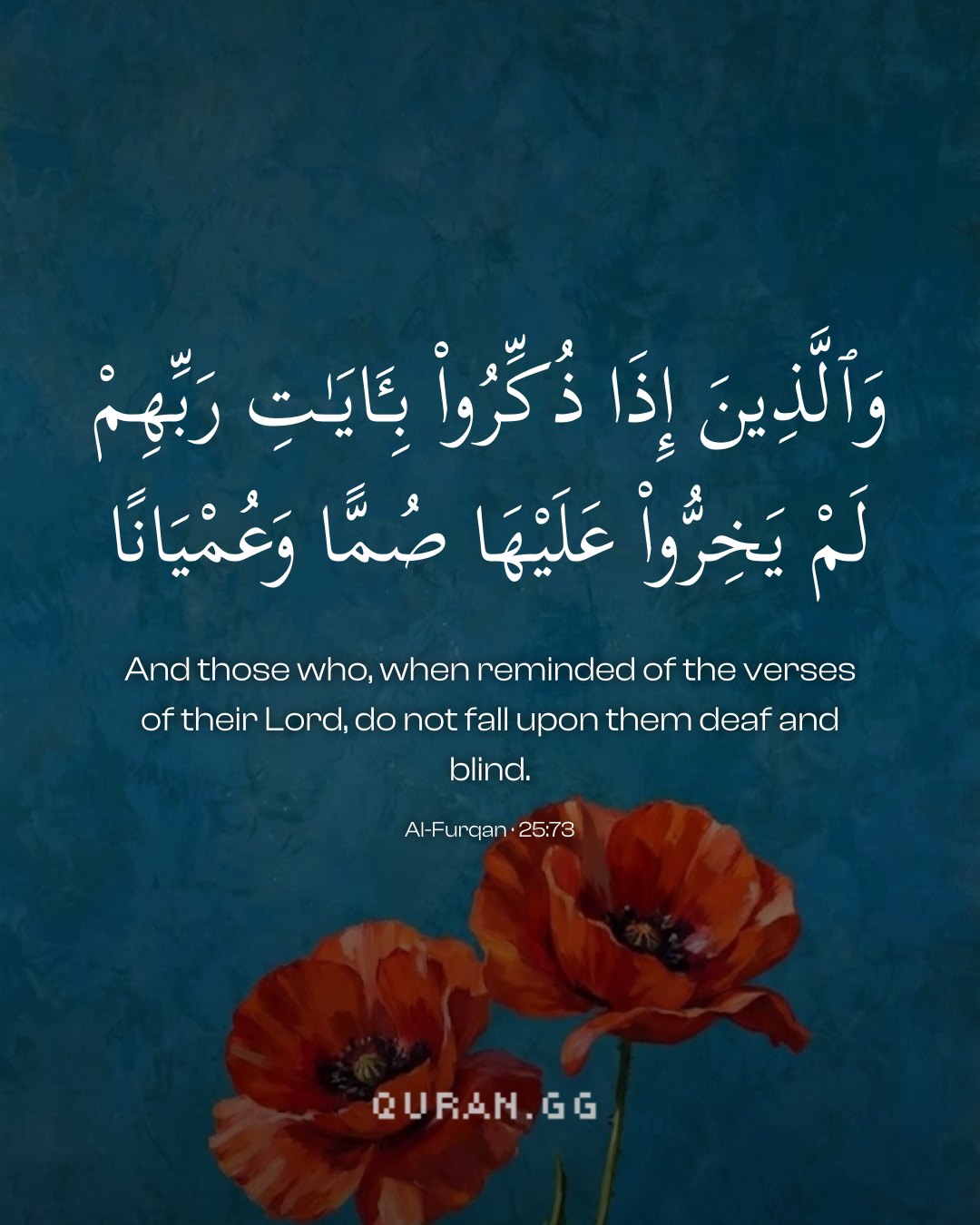
And those who, when they are reminded of the verses of their Lord, do not fall at them as deaf and blind ones - 25:73
That is when the blessed servants of Allah are reminded of His verses and the Hereafter, they do not throw themselves upon them as if they were blind and dumb, but pay heed to them like sober and sensible persons, and act upon them. They do not behave like the ignorant or negligent persons as if they have not seen or listened i.e. not understood the message. Two things are mentioned in this verse. One, to fall at Divine revelation i.e. to listen them with full attention. This is a virtuous and commendable act. Second, to fall at the verses like deaf and dumb people which means to listen to the message but without any purpose or commitment and act in a manner that the real message has not been registered, and even if they follow the Qur'anic message it is not in line with the practices of the companions of the Prophet or their followers. Such people follow their own whims based on hearsay, which is as bad as not following the Divine message.
Self-study of religious precepts is not enough but they need to be acted upon in the light of interpretation given by classic scholars
As it is condemned in the verses under study that Divine message is ignored. It is also pointed out with equal emphasis that it is listened and acted upon without due diligence, that is without comprehending the intent and spirit of the precept and according to one's own sweet will. Ibn Kathir has reported on the authority of Ibn ` Aun that he inquired from Hadrat Sha'bi رحمۃ اللہ علیہ that if he comes across a people who are in the state of sajdah (prostration), whether it is correct for him to join them in sajdah. Sha'bi (رح) replied in the negative explaining that it would not be correct for him to join in their prostration unless he finds out the purpose of that act. It is not proper for a believer to join in any action without knowing the purport of that act, rather he should seek to know the purpose behind an act before taking it up for himself. When one has not listened the verse of prostration, nor does he know the reason for their prostration it is not allowed for him to go in prostration.
It is a matter of great satisfaction that there is a new tendency among the younger generation and modern educated people to study the Qur’ an but to achieve this purpose they often deem it enough to study the Qur’ an and try to understand it through the translations of the Qur'an on their own. This practice being against the correct principles of learning something, often makes them fall into misconceptions. It is a well-settled fact that education and knowledge cannot be imparted only through books unless guidance of a teacher is available for explaining the intricacies of the subject which normally go unnoticed by an ordinary reader. It is rather strange why people feel that this basic rule does not apply to Qur'an and its related subjects and try to indulge in interpreting the Holy Book according to their own wishes. This type of study and interpreting Qur'an on one's own without the help and guidance of a well qualified teacher also falls under the purview of this verse i.e. "they do not throw themselves upon as if they were blind and dumb". May Allah lead us to the right path.
Tazkirul Quran
Maulana Wahiduddin KhanOn ayahs 72–73
In the present world, Satan has been at pains to glamourize wrongdoing and has taught the worshipper of untruth to present his case in the most appealing way. People, deceived by appearances, are therefore drawn towards evil. But if the outer covering of deceit could be removed, the wickedness thus uncovered would appear so ugly that people would be sure to keep their distance from it. From this point of view, every bad thing in which a man indulges is a falsehood. In the present world, the test of a man is that he should recognise falsehood. He should be able to tear down the outer curtain and see things in the light of reality. When a man is given advice which goes against his whims and fancies, he immediately becomes annoyed. In the eyes of God, such a person is blind and deaf, because he has not used his eyes to see reality and has not used his ears to hear the voice of Truth. If he has not welcomed the advice, it is because he is like a man deprived of the powers of hearing and seeing. In the eyes of God, a man capable of seeing and hearing is one who avoids pointless things when he sees them, but if true advice comes his way, immediately accepts it.
Uthmani text of the Madinah mushaf (King Fahd Complex). Translation: Saheeh International. Tafsir via Quran.com.