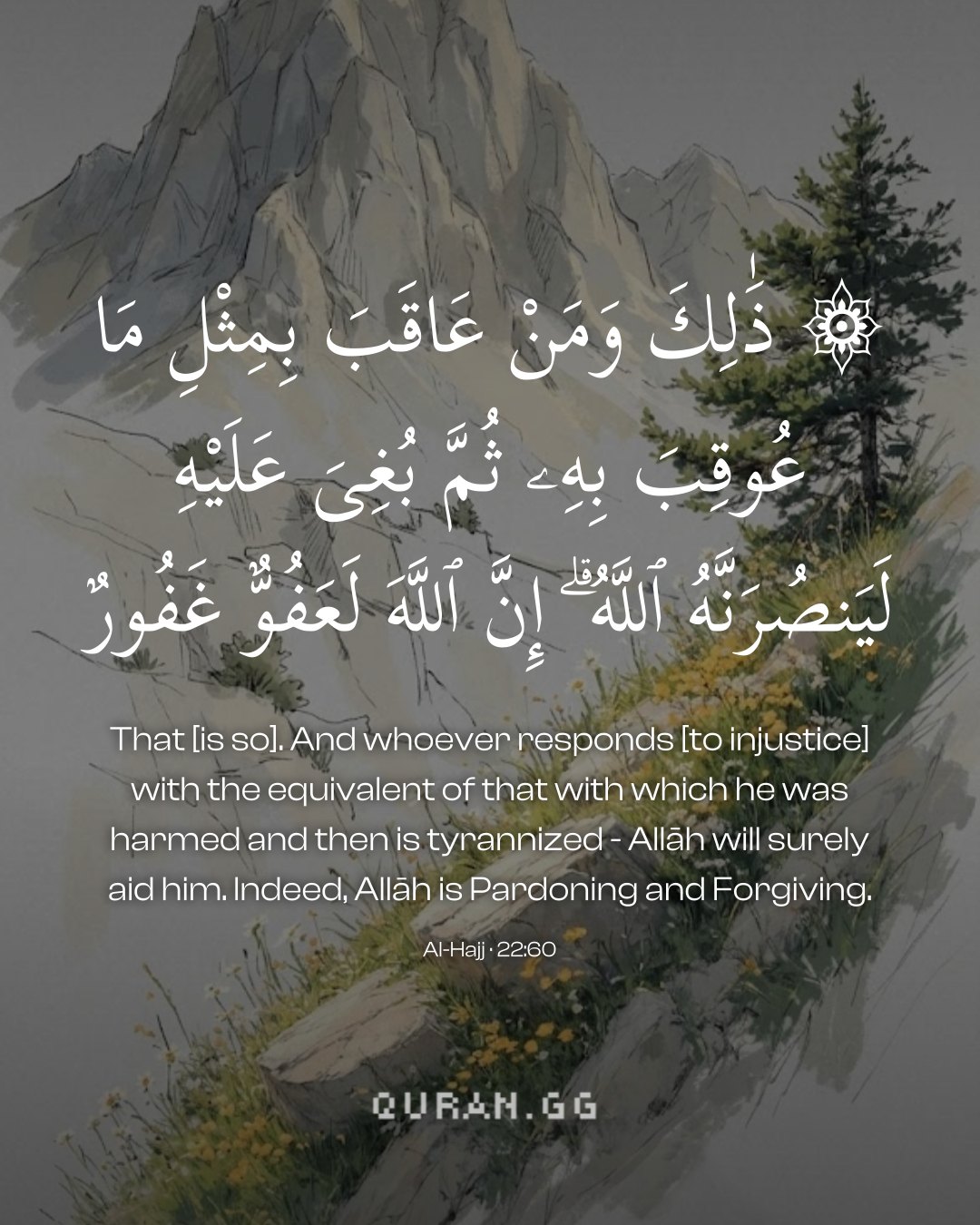
That [is so]. And whoever responds [to injustice] with the equivalent of that with which he was harmed and then is tyrannized - Allāh will surely aid him. Indeed, Allāh is Pardoning and Forgiving.
The Great Reward for Those Who migrate in the Cause of Allah
Allah tells us that those who migrate for the sake of Allah, seeking to earn His pleasure and that which is with Him, leaving behind their homelands, families and friends, leaving their countries for the sake of Allah and His Messenger to support His religion, then they are killed, i.e., in Jihad, or they die, i.e., they pass away without being involved in fighting, they will have earned an immense reward. As Allah says:
(And whosoever leaves his home as an emigrant unto Allah and His Messenger, and death overtakes him, his reward is then surely incumbent upon Allah) 4:100
In an earlier verse it has been mentioned that Allah Ta’ ala helps those who are wronged unjustly وَإِنَّ اللَّـهَ عَلَىٰ نَصْرِهِمْ لَقَدِيرٌ (Allah is powerful to give them victory - 22:39) Some people bear their sufferings patiently and do not seek vengeance from their oppressors, but there are others who retaliate and serve a full measure of retribution on their oppressors which should, therefore, place them both on even terms as being quits. But if the oppressor, incensed at the retaliation, attacks him again, then this person once again becomes the victim of oppression. This verse promises Allah's help for such a person also. On the other hand there are several verses which promise Allah's goodwill to those Muslims who bear their sufferings with patience and equanimity and do not seek vengeance from their oppressors. Some of these verses are:
But surely he who bears patiently and forgives - surely that is true constancy - 42:43.
In all these verses it is encouraged not to retaliate for revenge and rather forgive and forget, which is a magnanimous way of dealing with fellow human beings. This is the way Qur'anic teachings stand and call it a supreme and superior trait. Thus it may perhaps be argued that the person who retaliates against the wrongs done to him and conducts himself contrary to the course of action preferred by Allah Ta’ ala will be deprived of His support and help. But this doubt has been allayed in the final part of this verseإِنَّ اللَّـهَ لَعَفُوٌّ غَفُورٌ (22:60) that is, Allah will not punish him for this lapse and will help him if he is subjected to injustice by his oppressors ever again. (Ruh-ul-Ma’ ani)
Tazkirul Quran
Maulana Wahiduddin KhanOn ayahs 60–61
The people of faith were enjoined to adopt the ways of God who is forgiving and merciful, in that He repeatedly overlooks the excesses of the people and forgives them. Therefore, the respected companions (of the Prophet) were adherents of this divine code of ethics. They were subjected to atrocities, but they tolerated them. Provocative language was used against them, but they overlooked it. Yet, it happened that when some excess was committed against some Muslims, they gave way to a sudden emotional outburst, and retaliated. Harm was inflicted on them, so they inflicted harm in return. Their opponents, taking advantage of this, started vigorous propaganda against the Muslims. Forgetting their own persecution and, treating trivial actions on the part of the Muslims as an atrocity, they started defaming them. Such action shows the worst type of meanness. Those who indulge in such meanness are in reality challenging the honour of God. Apparently they are trying to prove a Muslim to be an oppressor: in reality they are themselves the worst oppressors and can bring no harm to the people of faith by their false propaganda. In consequence, they will meet with the severest punishment for their transgression.
Uthmani text of the Madinah mushaf (King Fahd Complex). Translation: Saheeh International. Tafsir via Quran.com.