The Supplies for All Things are with Allah
Allah tells us that He is the Owner of all things, and that everything is easy for Him. He has the supplies for all things with Him.
وَمَا نُنَزِّلُهُ إِلاَّ بِقَدَرٍ مَّعْلُومٍ
(and We do not send it down but in a known measure.) meaning, as He wills and as He wants. Doing so out of His great wisdom and mercy towards His servants, in a way that He is under no obligation to do. But He has decreed mercy for Himself. Yazid bin Abi Ziyad reported from Abu Juhayfah that `Abdullah said: "No year has more rain than another, but Allah divides the rain between them as He wills, it rains here a year and there a year. Then he recited:
Continue reading the tafsir of ayahs 21–25 Going Ahead and Remaining Behind in Righteous Deeds: The Difference in Degrees
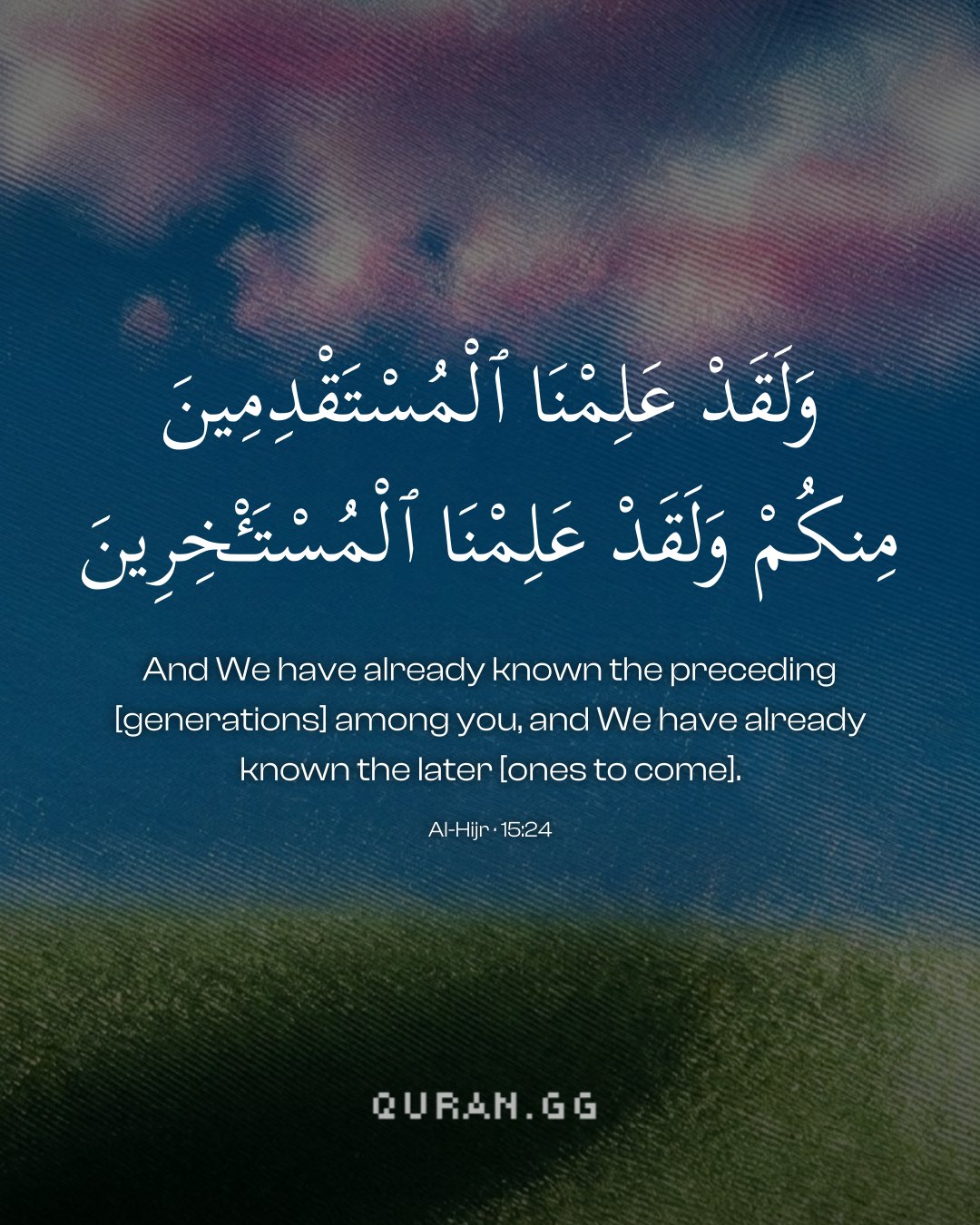
Some exegetic interpretations of the words: (al-mustaqdimin) : 'those who go ahead' and: (al-musta'khirin) : 'those who remain behind' appearing in verse 24: الْمُسْتَقْدِمِينَ ~.A11 have been variously reported from Tafsir authorities among the Sahabah ؓ and Tabi` in. These are:
1. 'Al-Mustaqdimin' are those born to date, and 'Al-Musta'khirin' are those not born yet [ Qatadah and ` Ikrimah ].
2. 'Al-Mustaqdimin' means the dead, and 'Al-Musta'khirin' means those alive till now [ Ibn ` Abbas and Dahhak ]
3. 'Al-Mustaqdimin' signifies good people who came before the appearance of the Ummah of the Holy Prophet ﷺ ، and 'Al-Mustakhirin' refers to his Ummah itself [ Mujahid ].
4. 'Al-Mustaqdimin' denotes people who obey Allah and do good deeds while 'Al-Musta'khirin' refers to people who disobey Him and neglect what is good [ Hasan and Qatadah ]
5. 'Al-Mustaqdimin' are people who remain ahead in the rows of Sal, or in the front lines of Jihad, and in other righteous deeds - and 'Al-Musta'khirin' are those who remain behind in these deeds of merit, stay in the rear rows and are used to being late [ which is the Tafsir given by leading authorities Hasan al-Basri, Said ibn al-Musaiyyab, al-Qurtubi, al-Sha` bi and others ]
It is obvious that there is no distinct conflict or contradiction in these sayings, in the real sense. They can be accommodated all in one because the all-encompassing knowledge of Allah Ta` ala covers all kinds of people 'who go ahead' or 'remain behind.'
In his Tafsir, Al-Qurtubi has said that this verse indicates the merit of performing Salah in the first row, and soon after the time it becomes due. This is in accordance with the Hadith where the Holy Prophet ﷺ has been reported to have said: If people were to find out the enormous merit of calling the Adhan and standing in the first row of Salah, everyone would have started making the effort to necessarily stand in the first row, and when there would remain no space for everybody to stand there, lots would have to be drawn.
With this, Al-Qurtubi has also reported the saying of Sayyidn Ka'b ؓ : 'There are some people in this Ummah who, when they put their forehead on the ground for their Sajdah, forgiveness is granted to all those who are praying behind them.' Therefore, Sayyidna Ka'b liked to be in the last row in the hope that 'perhaps, there may be in the front rows, some servant of Allah of the class, because of whose barakah (blissful presence), I may be forgiven.'
What is apparent here is that real merit does lie in praying in the first row - as stands proved from the clear statements of the Qur'an and Sunnah. But, a person who does not, for some reason, find a place in the first row, then, he too will have a sort of merit in that there may perhaps be some righteous servant of Allah praying in the front rows for whose sake, he too may be forgiven. And the way praying in the first row of Salah stands proved from this verse, also proved is the superiority of being in the front lines of Jihad.
The principle of keeping within limits is inherent in all the things of the universe. The wind, although sometimes developing into a gale or a tornado, never exceeds certain limits. Except for minor variations due to its elliptical orbit, the distance of the earth from the sun remains constant. If the earth were to move further away, it would become frozen like ice. If it were to come nearer the sun, it would become like a burning oven. The pull of gravity remains at the most suitable level. Had the size of the earth been double, its gravitational pull would have increased so much that man would have found it difficult to walk on the earth, as his weight would have pulled him down. And had the size of the earth been half of what it is now, its gravitational pull would have decreased to such an extent that man and his dwellings would have become too light to have any stability. This is the condition of all those things amongst which man lives. There are fixed parameters for everything: natural phenomena go neither above nor below fixed limits. The life of man and all living things on earth depend on water. From the underground reservoirs of water to the clouds spread throughout the atmosphere, the system of providing water is so complex and functions on such a large scale that its establishment could never be within the powers of man. This wonderful and gigantic arrangement is continuously maintained by God in exact accordance with human needs. The human being is an extremely delicate creature. Any difference in atmospheric pressure and composition would be enough to upset his existence. The atmosphere, in spite of having innumerable possibilities, is stable as regards its particular composition and pressure which are suitable for a creature like a human being. This balance and this proportion could not have been accidental. Certainly, this is so thanks to the earth’s most Majestic Creator and Sustainer. In view of this, one who does not accept God, or believes God to have partners, merely proves his own lack of reason and not the unreasonableness of the concept of the one God.
Continue reading the tafsir of ayahs 22–24 Uthmani text of the Madinah mushaf (King Fahd Complex). Translation: Saheeh International. Tafsir via Quran.com.