Which was revealed in Makkah
The Prostration of Recitation in Surat Al-Inshiqaq
It is reported from Abu Salamah that while leading them in prayer, Abu Hurayrah recited,
إِذَا السَّمَآءُ انشَقَّتْ
(When the heaven is split asunder.) and he prostrated during its recitation. Then when he completed the prayer, he informed them that the Messenger of Allah ﷺ prostrated during its recitation. This was recorded by Muslim and An-Nasa'i on the authority of Malik. Al-Bukhari recorded from Abu Rafi` that he prayed the Night prayer with Abu Hurayrah) recited,
إِذَا السَّمَآءُ انشَقَّتْ
(When the heaven is split asunder.) then he prostrated. So Abu Rafi` said something to him about it (questioning it). Abu Hurayrah replied, "I prostrated behind Abul-Qasim (the Prophet ), and I will never cease prostrating during its recitation until I meet him."
Continue reading the tafsir of ayahs 1–15Ma'arif al-Qur'an
Mufti Muhammad Shafi
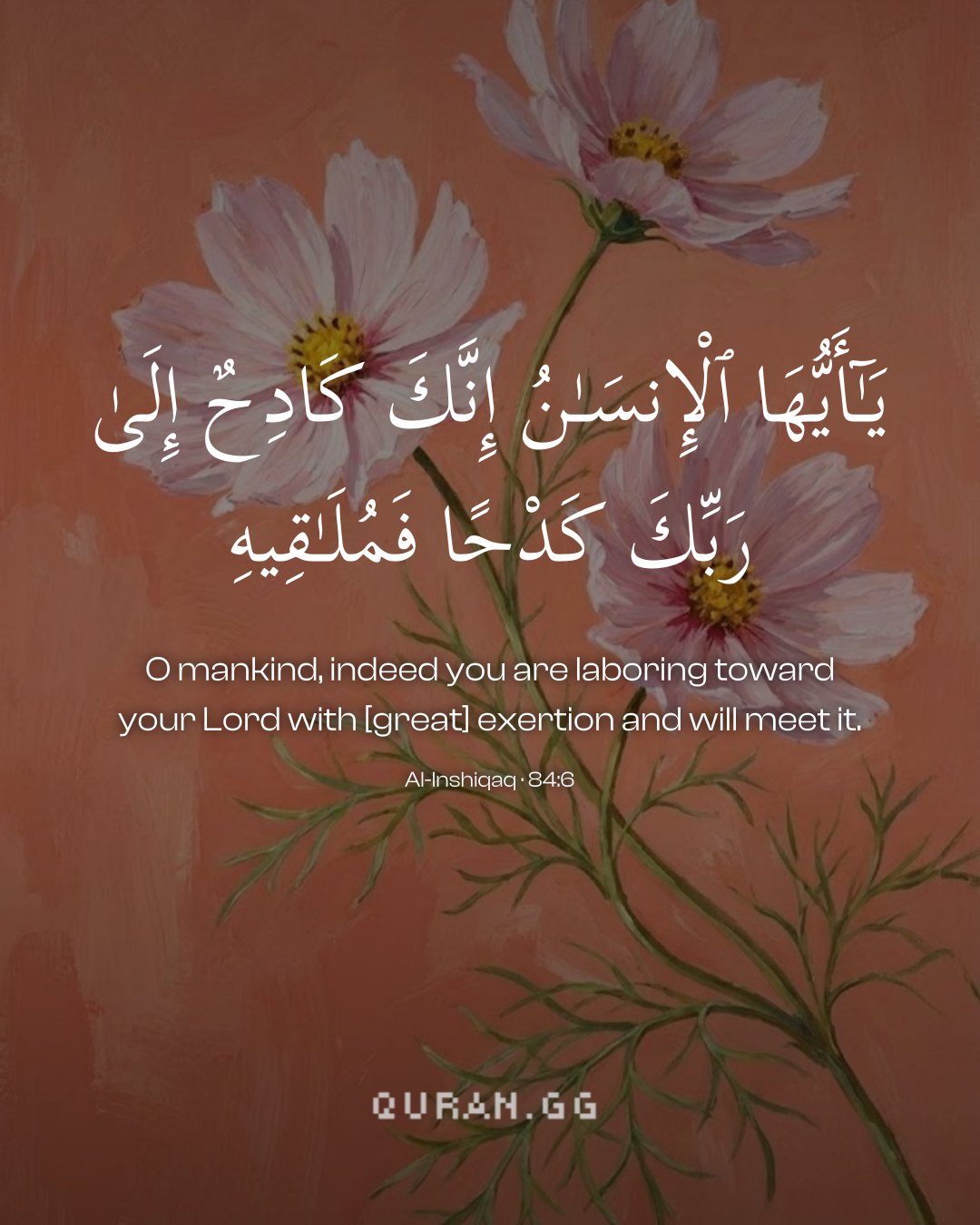
يَا أَيُّهَا الْإِنسَانُ إِنَّكَ كَادِحٌ إِلَىٰ رَبِّكَ كَدْحًا فَمُلَاقِيهِ (0 man, you have to work hard constantly to reach your Lord, then you have to meet Him...84:6) The word kadh means to 'exert one's efforts fully', and 'to your Lord' means 'to meet your Lord'. In other words, every effort of man would end at his Lord.
Return to Allah
Mankind is addressed in this verse and shown a road that if he were to think about it carefully, and use his sense and intelligence, he could exert his efforts in the right direction that will ensure for him welfare, well-being and safety in this world, as well as in the Hereafter. First, it has been pointed out that man, whether he is good or bad, believer or non-believer, has the natural tendency to exert himself in order to achieve his goal. A good-natured person will work hard and adopt lawful means to acquire his livelihood and necessities of life. A bad person cannot obtain his needs and objective without working hard. Thieves, robbers, rouges, cheats and looters apply their minds and exert their physical strength in order to achieve their objective. Secondly, it has been pointed out that if the intelligent man were to think carefully, all his movements and pauses are stations of a long journey he is going through, though unconsciously. This journey will end at his presence before Allah, that is, at death. This is stated in the phrase ila rabbika to your Lord'. This is a statement of reality which none can deny. All efforts, [ good or bad ], must end with death. The third point is that after death, in the presence of his Lord, he will have to give an account of his movements and deeds, and of his efforts. This is rationally necessary and justified, so that the consequences of good and bad may be separately known, because such distinction is not known in this life. A good person may work hard for a month or so in order to obtain his livelihood and necessities of life, but thieves and looters may obtain them overnight. If there is no time of reckoning or punishment, both of them [ the good and the bad ] will be equal, which is contrary to reason and justice. At the end, the verse says: فَمُلَاقِيهِ (then you have to meet Him.) The translation given above is based on the assumption that the attached pronoun (hi) refers to Allah. The sense is that every person has to meet his Lord and to present himself before him to give the account of his deeds. Another possible interpretation is that the attached pronoun (hi) refers to 'kadh' (working hard). Given this interpretation, the translation of the verse would be: "0 man, you have to work hard constantly to reach your Lord, then you have to meet it." And the sense would be: 'you have to meet the good or bad consequences of your working hard.'
The verses that follow depict separately the consequences of the good and the bad people, of the believers and the non-believers. First, the ledger of deeds must be received in the right or the left hand. Those who receive the ledgers in their right hands will be the inmates of Paradise with its eternal blessings. Those who receive the ledgers in their left hands will be the inmates of Hell. The point for careful consideration is that necessities of life, as well as unnecessary desires are fulfilled by both righteous and wicked people in this world, and thus both spend their lives in some way or the other, but the consequences of the two [ for the Hereafter ] are diametrically opposite to each other. One results in eternal and unending comfort, and the other results in eternal perdition, torture and torment. Man still has the chance [ while he is living ] to redirect his attention to working hard towards switching the situation in a direction that not only fulfils his legitimate needs and desires in this world, but also attains the eternal pleasures of the Hereafter.
Whatever is related here about Doomsday refers apparently to an unknown world. However, such evidence exists as points to its veracity. An example of this is the present world itself. The very existence of the world proves that another similar or different world may come into existence. Furthermore, certain extraordinary aspects of the Quran prove that it is the Book of God. (For details see The Quran: An Abiding Wonder and The Call of the Quran by the commentator).
Uthmani text of the Madinah mushaf (King Fahd Complex). Translation: Saheeh International. Tafsir via Quran.com.