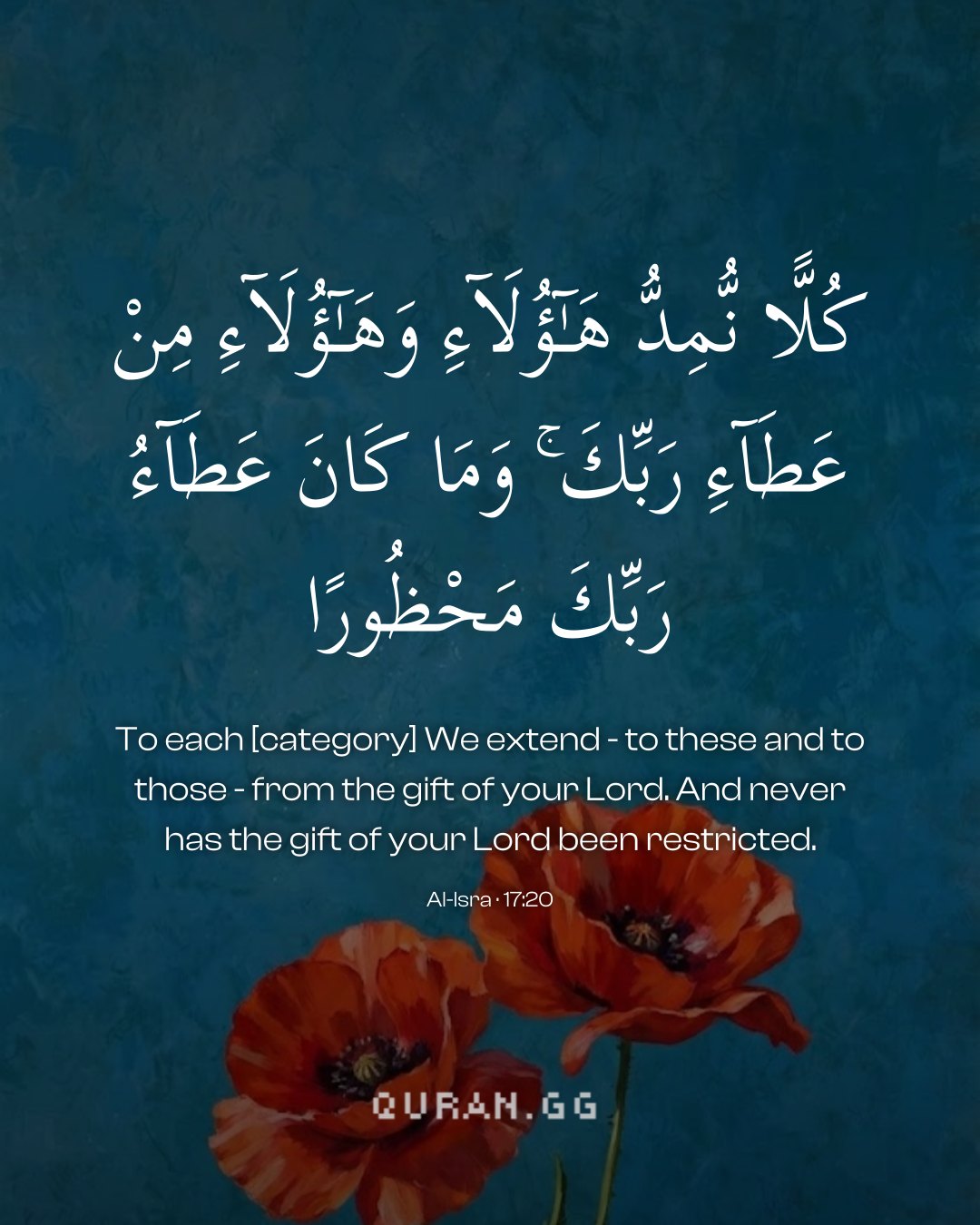
كَلاَّ
On each meaning, on each of the two groups, those who desire this world and those who desire the Hereafter, We bestow what they want
مِنْ عَطَآءِ رَبِّكَ
(from the bounties of your Lord.) means, He is the One Who is in control of all things, and He is never unjust. He gives to each what he deserves, whether it is eternal happiness or doom. His decree is unstoppable, no one can withhold what He gives or change what He wants. Allah says:
وَمَا كَانَ عَطَآءُ رَبِّكَ مَحْظُورًا
(And the bounties of your Lord can never be forbidden.) meaning, no one can withhold or prevent them. Qatadah said,
وَمَا كَانَ عَطَآءُ رَبِّكَ مَحْظُورًا
(And the bounties of your Lord can never be forbidden.) "(It means) they can never decrease".
وَمَا كَانَ عَطَآءُ رَبِّكَ مَحْظُورًا
(And the Bounties of your Lord can never be forbidden) Al-Hasan and others said, "(It means) they can never be prevented." Then Allah says:
انظُرْ كَيْفَ فَضَّلْنَا بَعْضَهُمْ عَلَى بَعْضٍ
(See how We prefer one above another,) meaning in this world, so that some are rich and some are poor, and others are in between; some are beautiful, some are ugly and others are in between; some die young while others live to a great age, and some die in between.
وَلَلاٌّخِرَةُ أَكْبَرُ دَرَجَـتٍ وَأَكْبَرُ تَفْضِيلاً
(and verily, the Hereafter will be greater in degrees and greater in preferment.) means, the differences between them in the Hereafter will be greater than the differences between them in this world. Some of them will be in varying levels of Hell, in chains and fetters, while others will be in the lofty degrees of Paradise, with its blessings and delights. The people of Hell will vary in their positions and levels, just as the people of Paradise will. In Paradise there are one hundred levels, and the distance between one level and another is like the distance between heaven and earth. It is recorded in the Two Sahihs that the Prophet said:
«إِنَّ أَهْلَ الدَّرَجَاتِ الْعُلَى لَيَرَوْنَ أَهْلَ عِلِّيِّينَ كَمَا تَرَوْنَ الْكَوْكَبَ الْغَابِرَ فِي أُفُقِ السَّمَاء»
(The people of the highest levels (of Paradise) will see the people of `Illiyin as if they are looking at distant stars on the horizon.) Allah says:
وَلَلاٌّخِرَةُ أَكْبَرُ دَرَجَـتٍ وَأَكْبَرُ تَفْضِيلاً
(and verily, the Hereafter will be greater in degrees and greater in preferment.)
A self-opinionated deed and an act of religious innovation, no matter how appealing, is not acceptable
In this verse (19), by adding the word: سَعْيَهَا (as due), it has been made explicit that every deed and every effort is not necessarily beneficial or acceptable with Allah. Instead, the only deed or effort credible is that which is appropriate to the essential objective (of the Hereafter). And whether or not it is appropriate can only be found out from the statement of Allah Ta’ ala and His Messenger ﷺ . Therefore, even well meaning efforts made by insisting on bland personal opinion and self-invented ways - which includes common customs of Bid'ah (innovations in established religion) - no matter how good and beneficial they may appear at their face, but are not appropriate to the effort made for the Hereafter. Consequently, they are neither acceptable with Allah nor are they of any use in the Hereafter.
Explaining the word: سَعْيَهَا (as due), Tafsir Ruh al-Ma’ ani says that the 'effort' should be in accordance with 'sunnah.' Along with it, it adds that this effort or deed should also have uprightness and firmness. In other words, this deed should be beneficial in accordance with the Sunnah as well as it should be upright and constant. Doing it haphazardly or doing it in a cycle of doing and not doing is not good. It never yields the maximum benefit.
In the present world as man travels towards his ultimate destination, he finds himself standing before a fork in the road. One side leads to the path of immediate gains, while the other is a path on which everything is to be given on merit. One who follows the first path chooses instant benefit (‘ajilah), whereas one who follows the other path chooses the Hereafter (akhirah). On the one hand, man has before him the way of opportunism, which leads him straight to immediate honour and wealth. On the other hand, there is the way of infinite love of truth, the credit for which man will receive only when he begins his life after death. If a man has a grievance, one way of dealing with it is to become vindictive and vengeful. The other option is to forgive and, offering prayers to God, leave the whole matter in His hands. Similarly, man may spend his wealth in fulfilling his desires and furthering his ambitions, or he may spend it for the cause of God. Likewise, there are two different ways of dealing with life’s contingencies: one is to fulfil one’s own desires, while the other is to dedicate oneself to the worship of God. One is to give importance to appearances, the other is to give credence to the reality of the unseen; one is the way of expediency, while the other is the way of principle. The former bears the mark of impatience while the latter makes manifest the virtue of patience. The first way is associated with temporary gain followed by eternal deprivation. The second way is that of temporary loss followed by everlasting honour and success.
Uthmani text of the Madinah mushaf (King Fahd Complex). Translation: Saheeh International. Tafsir via Quran.com.