The Example of the Rich Idolators and the Poor Muslims
After mentioning the idolators who were too arrogant to sit with the poor and weak among Muslims, showing off before them with their wealth and noble lineage, Allah then gives a parable for them of two men, one of whom Allah gave two gardens of grapes, surrounded with palm trees and cultivated with crops throughout. All of the trees and plants were abundantly fruitful, providing readily accessible, good quality produce. Allah says:
كِلْتَا الْجَنَّتَيْنِ آتَتْ أُكُلَهَا
(Each of those two gardens brought forth its produce,) meaning, produced its fruits,
وَلَمْ تَظْلِمِ مِّنْهُ شَيْئًا
(and failed not in the least therein,) meaning, nothing at all was diminishing.
Continue reading the tafsir of ayahs 32–36 Commentary
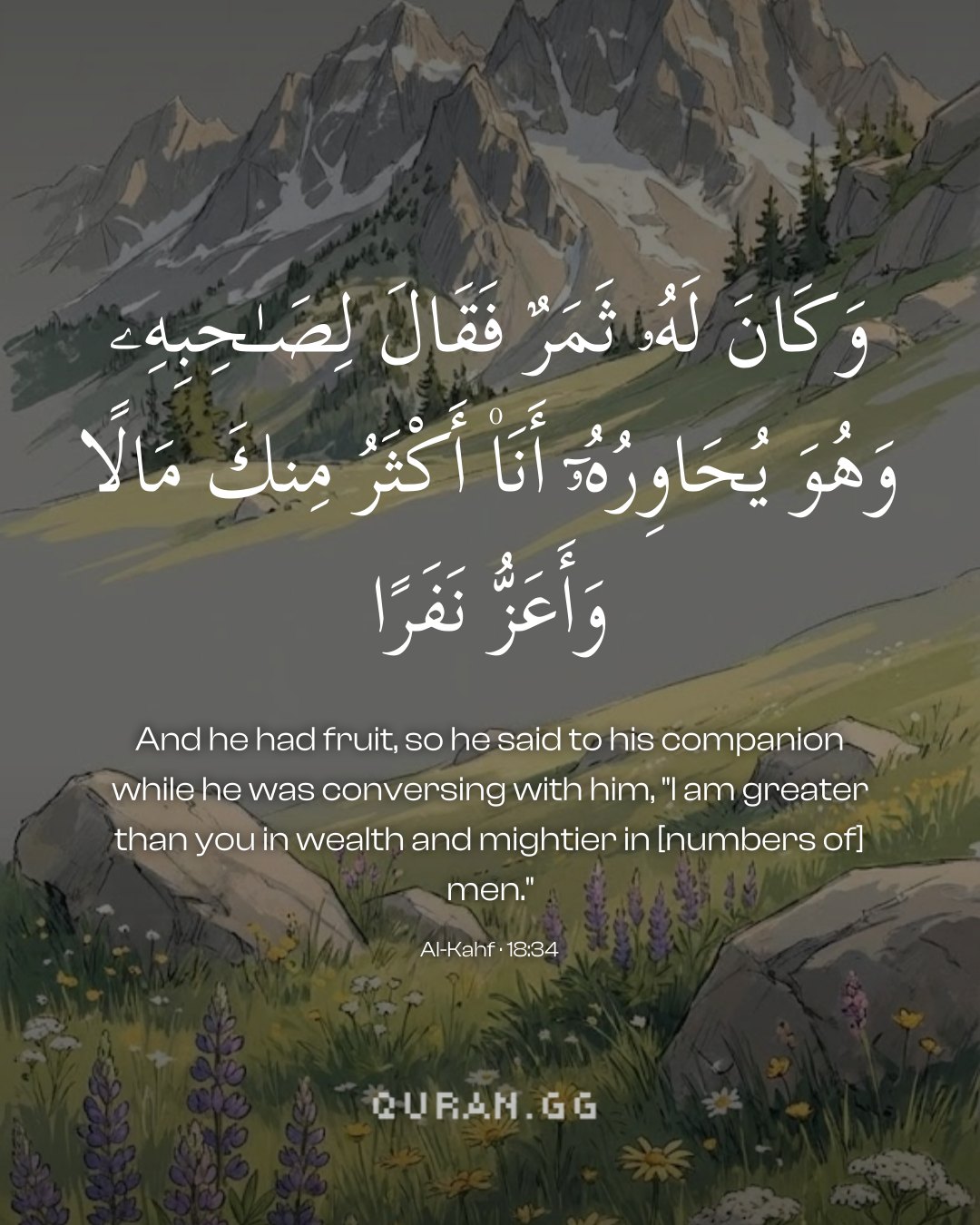
The word: ثَمَرٌ (thamar) in: وَكَانَ لَهُ ثَمَرٌ (And he had wealth - 34) means the fruit of trees as well as wealth, in an absolute sense. At this place, Sayyidna Ibn ` Abbas ؓ ، Mujahid and Qatadah have taken it in the later sense (Ibn Kathir) According to the Lexicon, al-Qamus, this word is used to denote the fruit of the tree and wealth of all kinds. This tells us that not only did he own gardens and farms, he also had gold, silver and other luxuries. Even his words reported by the Qur'an: (I am greater than you in wealth -34) also express the same sense. (Ibn Kathir)
About the statement: مَا شآء اللہ لا قُوَۃَ اِلَّا بِاللہِ : "[ Everything is ] as Allah wills. There is no power except with Allah," it has been reported in Shu'ab al-'Iman on the authority of Sayyidna Anas ؓ that the Holy Prophet ﷺ said, "whoever sees something, likes it - and says 'masha'Allahu la quwwata illa bil-lah' - nothing will harm it (that is, what he likes will stay protected).' And it appears in other reports, 'whoever recites this kalimah when he likes something he sees, it will stay protected against the evil eye.'
The gist of the arguments of these two persons, as explained by Maulana Ashraf Ali Thanavi (رح) in Khulasa-e-Tafsir
These verses have described the event of two persons one of whom had a lot of wealth and, proud of it, he refused to accept that there is any life after death, and if there is one, he claimed, he will be given more wealth and reward therein. His argument was that if Allah was not pleased with him, he would not have this amount of wealth in this world.
The other person, though less than him in wealth, was a true believer. He refuted the argument of the former one by saying that the worldly wealth is not a sign of one's being close to Allah, because the worldly benefits are given by Allah, in one way or the other, even to the disbelievers and sinful persons, rather to the snakes, scorpions and beasts. It is a horrible mistake to presume that they are the signs of one's being approved by Allah. Therefore, neither your wealth is the proof of your behaviour being approved by Allah, nor my lesser wealth is a proof of disapproval by Him. Allah's approval or disapproval depends on one's faith and deeds alone and not on the amount of wealth one has.
The condition of those who are free from pride, consideration of self-interest and love of outward show is such that when God’s Truth appears before them, they immediately recognise it, even though such Truth might have come through the medium of a human being like themselves. They prostrate themselves before the Truth, and begin to mould their lives in submission to the Truth instead of attempting to mould the Truth to fit their lives. Those who prove to be worshippers of Truth in this manner are God’s near and dear ones. They will be showered with splendid rewards in the life hereafter.
Uthmani text of the Madinah mushaf (King Fahd Complex). Translation: Saheeh International. Tafsir via Quran.com.