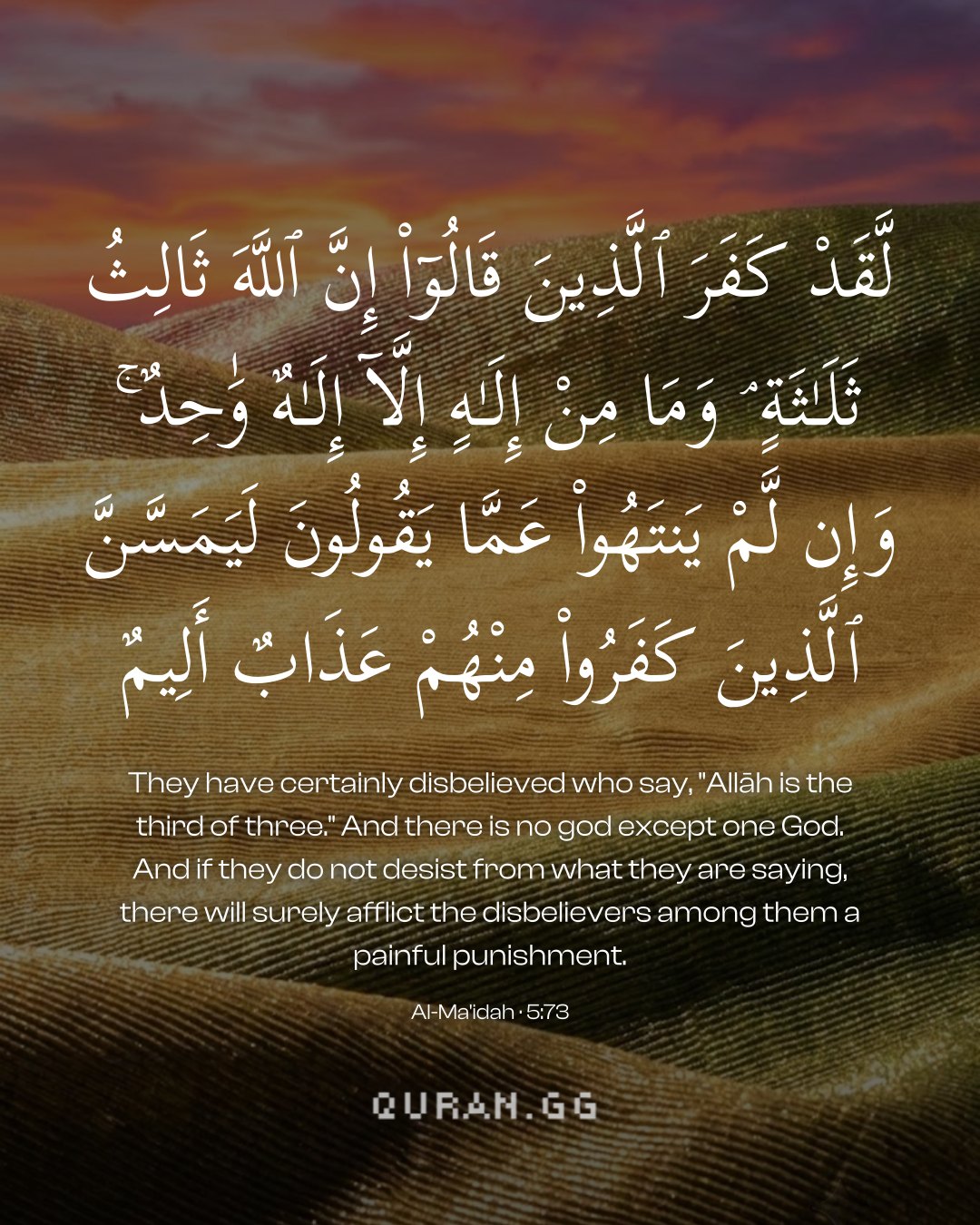
The Disbelief of the Christians; `Isa Only called to Tawhid
Allah states that the Christians such sects as Monarchite, Jacobite and Nestorite are disbelievers, those among them who say that `Isa is Allah. Allah is far holier than what they attribute to Him. They made this claim in spite of the fact that `Isa made it known that he was the servant of Allah and His Messenger. The first words that `Isa uttered when he was still a baby in the cradle were, "I am `Abdullah (the servant of Allah)." He did not say, "I am Allah," or, "I am the son of Allah." Rather, he said,
إِنِّى عَبْدُ اللَّهِ ءَاتَانِىَ الْكِتَـبَ وَجَعَلَنِى نَبِيّاً
(Verily, I am a servant of Allah, He has given me the Scripture and made me a Prophet.) until he said,
Continue reading the tafsir of ayahs 72–75 Commentary
1. The words: إِنَّ اللَّـهَ ثَالِثُ ثَلَاثَةٍ in verse 72, translated here literally as ` Allah is the third of the three,' refers to Sayyidna Masih (Jesus Christ), Ruhul-Quds (The Holy Spirit) and Allah, or to Masih, Maryam (Mary) and Allah - with all three taken as God (Refuge with Allah). Thus, Allah becomes a one-third partner with them, then all three of them become one, and that one is three. This unity in trinity, with three persons in one godhead, is the common belief of Christians. They explain this belief which is supported by neither reason nor revelation with a language that is kept circuitous and ambiguous. When not un-derstood, they declare it to be reality beyond comprehension. (Shabbir Ahmad Usmani - Notes)
2. In verse 75, by saying: قَدْ خَلَتْ مِن قَبْلِهِ الرُّسُلُ (There have been messengers before him), the assigning of godhood to Sayyidna Masih (علیہ السلام) has been refuted. Prophets came to this world. They completed their mission. Then, they were gone. They were not eternal which is the mark of godhood. Similarly, Sayyidna Masih, may peace be upon him (being human like them) was not eternal. So, he cannot be what God is.
A little reflection will show that everyone who needs to eat and drink almost depends on everything in the world. We cannot say that the earth, the air, the water, the sun and the animals are what we do not need. Look into your own self. There is that grain of food outside you, then begins its journey from the entry into the stomach to the next destination of its digestion. Think of all those factors involved and things required directly and indirectly in this complex procedure. Then, there will be a chain of effects generated through eating and no one can tell precisely how far will they go. So, by pointing out that Sayyidna Masih and his pious mother used to eat, the Holy Qur'an has referred to the endless chain of needs it entails. The argument, thus runs that Masih and Maryam, may peace be upon them both, were not free of the need for eating and drinking which is proved by observation and authentic narrations (not denied by even Christians). And anyone who is not free from the need of eating and drinking cannot be free from anything in this world. How then, a human person, who like all human beings is not free of the need to depend on the chain of causa-tion for survival, could become God? This is a strong and clear proof which can be understood by the educated and the uneducated alike - that is, eating and drinking is contrary to godhood. Though, not eating too is not a proof in favour of godhood, otherwise all angels would become gods! (Refuge with Allah) (Tafsir Usmani)
3. Was Sayyidah Maryam a prophet or saint? This is a debated issue. In the present verse (75), the complimentary use of the word "Siddiqah" (truthful) obviously seems to indicate that she was a godly person, not a Nabiyy ( prophet) - because on a complimentary occasion, what is mentioned is the higher rank. If she had the station of prophethood, the word used for her at this place would have been "Nabiyyah"- but, the word used here is "Siddiqah" which is the station of sainthood or godliness (abridged from Ruh al-Ma` ani).
According to the majority of Muslim scholars, the station of Nu-buwwah (prophethood) has never appeared among women. This mission has been particular with men:
وَمَا أَرْسَلْنَا مِن قَبْلِكَ إِلَّا رِجَالًا نُّوحِي إِلَيْهِم مِّنْ أَهْلِ الْقُرَىٰ
And We have not sent any (one) before you but men to whom We revealed from among the peoples of the towns - Surah Yusuf, 12 : 109. (Tafsir Usmani)
The bearers of divine scriptures in later periods developed the belief that they were the special people of God and that whatever they did, they would not have to face any reckoning. In the teachings of God, there are clear statements against such beliefs, but they became blind and deaf to them. They built around themselves such barriers of self-made beliefs and fictitious stories that God’s warnings went unnoticed. The history of the Jews shows that whenever a community bearing the scriptures was made to suffer subjugation by its ‘enemies’, this was designed as a testing period for it. Light punishment administered to the community was meant to awaken its moral sense. If feelings of devotion to God were then aroused in its members, there was a cessation of the punishment, but if this did not happen, God rejected them, cast them away and did not turn His attention towards them ever again. Almighty God granted Jesus the power to perform extraordinary miracles. This was done so that people should recognize him as a prophet and have faith in him. But it turned out otherwise. Jesus had been sent by God purely for the guidance of the people, but looking to his miracles, the Christians developed the belief that he was God and that God was incarnate in him. The Jews for their part ignored him, relegating him to the position of a magician and conjurer. While the latter group rejected him, the former group was inspired by him to establish polytheistic beliefs.
Uthmani text of the Madinah mushaf (King Fahd Complex). Translation: Saheeh International. Tafsir via Quran.com.