Ma'arif al-Qur'an
Mufti Muhammad Shafi
Commentary
Four Sources of Tranquility
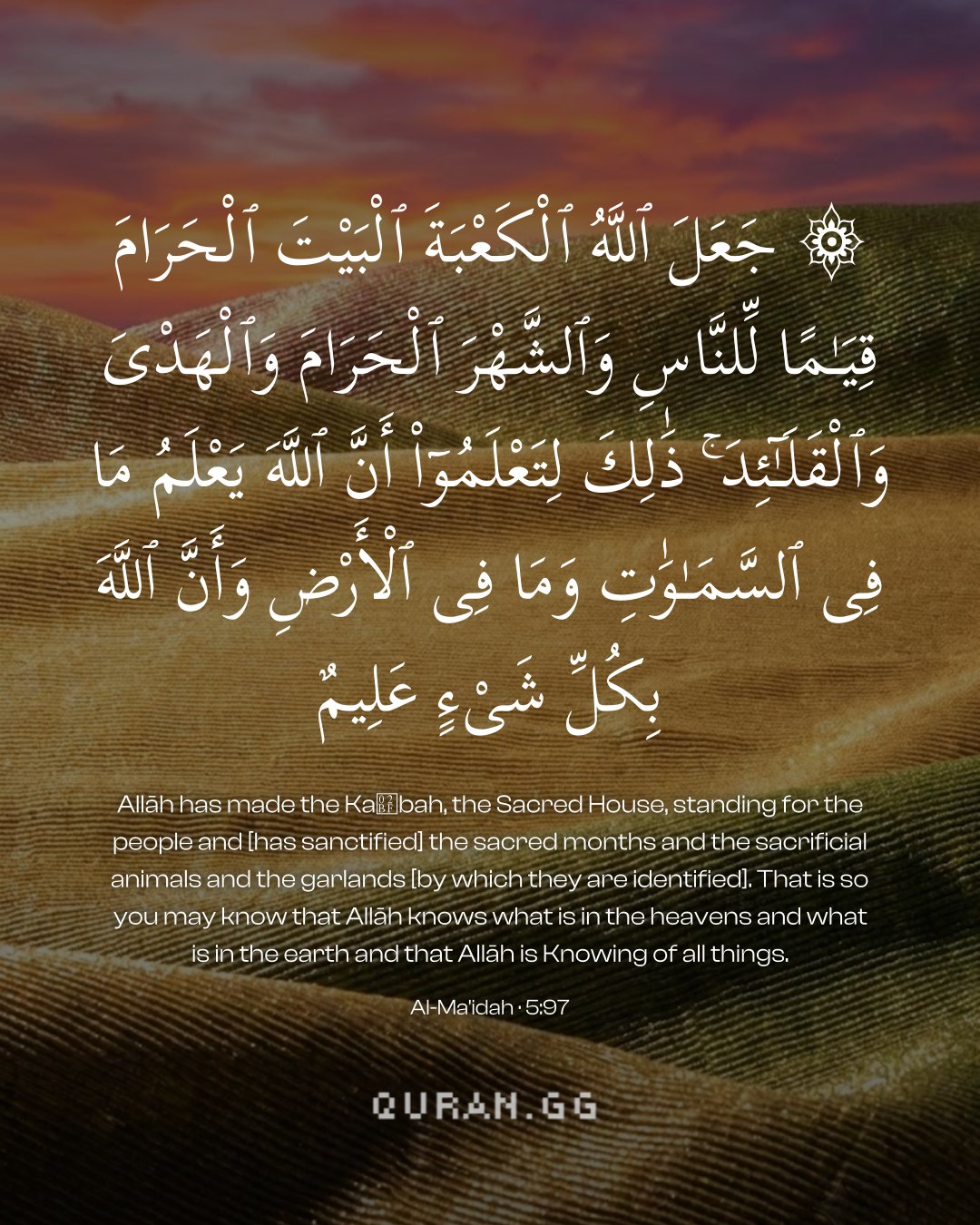
The first verse (97) mentions four things as the cause of constancy, survival and tranquility for people.
The first is the Ka'bah. In Arabic, Ka'bah is the name of a place which is square. Another house made by the Arab tribe of Khath'am carried the same name, that is, al-ka'bah-al-Yamaniyah, to be exact. Therefore, to distinguish the Baytullah (House of Allah) from this place, the words: الْبَيْتَ الْحَرَامَ (Al-Baytul-Haram: The Sacred House) were added to the name of the Ka'bah.
The word "Qiyam" and Qiwam are verbal nouns. They refer to that on which the stability and survival of something depends. Therefore, " قِيَامًا لِّلنَّاسِ " in the text comes to mean that the Ka'bah and its adjuncts are the cause and source of the stability and survival of people.
Lexically, the word: النَّاسِ (annas) is used for people in general. At this place, because of the topical context, they could mean the people of Makkah proper, or the people of Arabia and the peoples of the world as well. Obviously, it includes human beings of the whole world - however, the people of Makkah and the people of Arabia do have a unique status. Therefore, the sense of the verse would be that Allah Ta` ala has made Ka'batullah کعبۃُ اللہ (The Ka'bah of Allah) and what is mentioned later, the source of stability, survival and tranquility for people. As long as people of the world from each country, each region and each direction keep turning their orientation towards Baytullah to say their Salah, and the Hajj of Baytullah continues to be performed by those on whom its performance has become obligatory (fard) - until then, this whole world will keep going and stay safe. And if, there ever comes that fatal year when no one makes Hajj, or no one turns towards Baytullah to offer Salah, then, the whole world will be overtaken by mass Punishment.
Baytullah is the Mainstay of the Universe
The respected master of Tafsir, 'Ata' has stated the subject in the words which follow: لَو ترکوہ عامًا واحدا لم ینظروا یؤخروا (Al-Bahr Al-Mubit). This tells us that, significance-wise, Baytullah is the pillar of this whole world. As long as people keep turning towards it and Hajj keeps being performed, the world will stay. And if, this reverence of Baytullah were to terminate at some time, the world will also be terminated. However, there remains the question: What is the connection and linkage between the universal system and Baytullah? But then, knowing its reality is not necessary - who knows the reality behind the mutual connection of magnet and iron and lightening and straw? But, it is a reality proved through observation. It cannot be rejected. The comprehension of the reality of the mutual linkage between Baytullah and the universal system is also not within the reach and control of mortal man. That can be known only when the Creator of the universe tells us about it. That Baytullah is the cause of the survival of the whole universe is a thing of the spirit. Physical insight or formal research cannot reach it. But, its being the cause of peace and tranquility for Arabia and the people of Makkah stands proved by long experiences and observations.
Baytullah : Symbol and Substance of Peace
Peace is generally maintained in the world through government laws and its implementation. That is why robbers, thiefs, killers and plunderers do not dare. But, during the Arab Jahiliyyah, there was no formal government nor was there some general law to maintain public peace. Whatever political system there was, it was based on tribal con-siderations. One tribe could attack the life, property and honour of another tribe anytime at its choice. Therefore, no tribe had the occasion to enjoy peace and tranquility any time. Allah Almighty, with His perfect power, made the Baytullah in Makkah al-Mukarramah stand as a regular government ushering peace and tranquility. As anyone in his right frame of mind would not dare breaking the law of a strong government in our day, so it was, even during those days of ignorance, that Allah Almighty had impinged the reverence of the Baytullah on the hearts of common people in a manner that they would throw all their personal desires and emotions behind their backs when it came to upholding its honour and station.
So, this was Arab Jahiliyyah, the so called Age of Ignorance, proverbial for tribal prejudices and long drawn wars. But, such was the reverence for Baytullah and its adjuncts which Allah had placed in their hearts that they would say just nothing to even their sworn enemy despite their anger and chagrin - if the enemy had entered the Haram. A son who met the killer of his father in the Haram would lower his gaze and walk away from him.
Similarly, as much respect was also given to a person who had embarked on his Hajj and ` Umrah or who had been carrying animals for sacrifice in the Haram. The result was that even the worst person around would not hurt him in anyway - to the limit that they would say nothing to even a sworn enemy if he was in a condition when signs of his being on Hajj and ` Umrah, such as the garments of Ihram or garlands, were all too visible.
Take an example. The year was Hijrah 6. The Holy Prophet ﷺ accompanied by a group of his Sahabah entered into the Ihram of ` Umrah and started for his journey towards Baytullah. He stopped at Hudaybiyah close to the Haram limits and sent Sayyidna ` Uthman al-Ghani ؓ to Makkah along with some colleagues so that they can tell the chiefs of Makkah that Muslims have come at this time not for fighting but for performing ` Umrah, therefore, they should not be obstructed.
It was after a good deal of debate that they sent a representative of theirs to the Holy Prophet ﷺ . When he saw him, he said: This person is an upholder of the sanctities of Baytullah, therefore, the sacrificial animals marked for sacrifice should be brought before him.
When the representative saw these sacrificial animals, he conceded that such people should never be stopped from going to Baytullah.
So, as said earlier, Allah Almighty had placed such awe of the venerated Haram - even during the days of Jahiliyyah - that it became the very cause and source of peace and tranquility. As a direct result of this reverence, only those who either went in and out of Haram, or those who came for their Hajj and ` Umrah with some sign of the intended pilgrimage on them, were the ones who remained protected - outsiders did not benefit from this peace and tranquility. But, in Arabia itself, the way they honoured the site of Baytullah and its environs universally, they would also give equal respect to the months of Hajj. They called these, the Sacred Months. Some had included the month of Rajab along with them. During these months, fighting and killing - even outside the Haram - was considered by the whole Arabia as prohibited, from which they would abstain.
1. Therefore, the Holy Qur'an has included three more things as being قِيَامًا لِّلنَّاسِ (stability for people) along with the Ka'bah. The first is: الشَّهْرَ الْحَرَامَ , that is, the Sacred Month. Since the word, شَّهْرَ (shahr: month) has been placed here in its singular form, most commentators say that it means the month of Dhul-Hijjah at this place, the month during which the rites of Hajj are performed. Some commentators have said that, though the word used is singular, but it signifies category where-by all Sacred Months are included here.
2. Mentioned secondly is "al-hady" الْهَدْيَ which refers to an animal sacrificed in Haram. It was common Arab practice not to check and obstruct anyone carrying such sacrificial animals who could travel on in peace and be able to do what he intended to do. Thus, ` sacrificial animals' also became a cause of the establishment of peace.
3. The third thing is الْقَلَائِدَ "Al-Qala'id." The word is the plural form of Qiladah. It means a garland. There was a custom in the age of Arab Jahiliyyah that a person who went out for Hajj would put a garland round his (sacrificial animal) neck as a sign so that people may know that here was someone going for Hajj and that he should not be molested. Similarly, they would put garlands round the necks of their sacrificial animals too. These were also known as the قَلَائِدَ Qala'id. So, the Qala'id also became a source of peace and tranquility.
A little thought will show that ` the sacred month,"the sacrificial animal,' and ` the Qala'id' are all adjuncts or auxiliaries of the Baytullah. Reverence for them is part of the reverence of Baytullah. Allah Ta` ala has made the combination of these a source of stability (even constancy and resilience) in all matters relating to the worldly and otherworldly life of the people of Arabia, and that of the people of Makkah particularly - as well as, for all humanity in general.
While explaining the expression: قِيَامًا لِّلنَّاسِ (stability for people), some commentators have said that it means that the Baytullah and the Sacred Haram around it has been made a place of peace for everyone. Others have said that it refers to the extended means of sustenance for the people of Makkah, for what is not grown or made there indigenously keeps reaching them from all over the world by the grace of Allah Ta` ala. Still some others have said that people of Makkah known as the custodians of Baytullah were held in great esteem as special people serving the House of Allah, therefore, it is the particular distinc-tion of these people which has been identified in the Qur'anic expression translated as ` stability for people.'
Imam al-Razi has said that there is no contradiction in all these sayings which are included within the sense of قِيَامًا لِّلنَّاسِ (stability for people) since Allah Ta` ala has made Baytullah the source of betterment, prosperity and success (both materially and spiritually) for the stay, survival, stability, sustenance and return (to it, as well as, through it to the final destination of the Hereafter) for all peoples. And as for the people of Arabia, particularly those of Makkah, they have been blessed by Allah with its outward and inward blessings.
At the end of the verse, it was said: ذَٰلِكَ لِتَعْلَمُوا أَنَّ اللَّـهَ يَعْلَمُ مَا فِي السَّمَاوَاتِ وَمَا فِي الْأَرْضِ وَأَنَّ اللَّـهَ بِكُلِّ شَيْءٍ عَلِيمٌ (All this so that you may learn that Allah knows what is in the heavens and what is in the earth, and that Allah is All-Knowing in respect of everything). It means that Allah has made Baytullah and its adjuncts the source of stability, survival, peace and tranquility for people, something the people of Arabia keep witnessing particularly. This has been said so that everyone should know that Allah Ta` ala knows everything in the earth and the heavens and He alone is capable of managing and administering it.
Uthmani text of the Madinah mushaf (King Fahd Complex). Translation: Saheeh International. Tafsir via Quran.com.