Sa`id bin Al-Musayyib, Sa`id bin Jubayr and others commented on Allah's statement;
أُحِلَّ لَكُمْ صَيْدُ الْبَحْرِ
(Lawful to you is (the pursuit of) water game...) that it means, what one eats fresh from it, while,
وَطَعَامُهُ
(And its use for food) what is eaten dry and salted. Ibn `Abbas said that `water game' refers to what is taken from water while still alive, while,
وَطَعَامُهُ
(and its use for food) refers to what the water throws ashore dead. Similar statements were reported from Abu Bakr As-Siddiq, Zayd bin Thabit, `Abdullah bin `Amr, Abu Ayyub Al-Ansari, `Ikrimah, Abu Salamah bin `Abdur-Rahman, Ibrahim An-Nakha`i and Al-Hasan Al-Basri. Allah's statement,
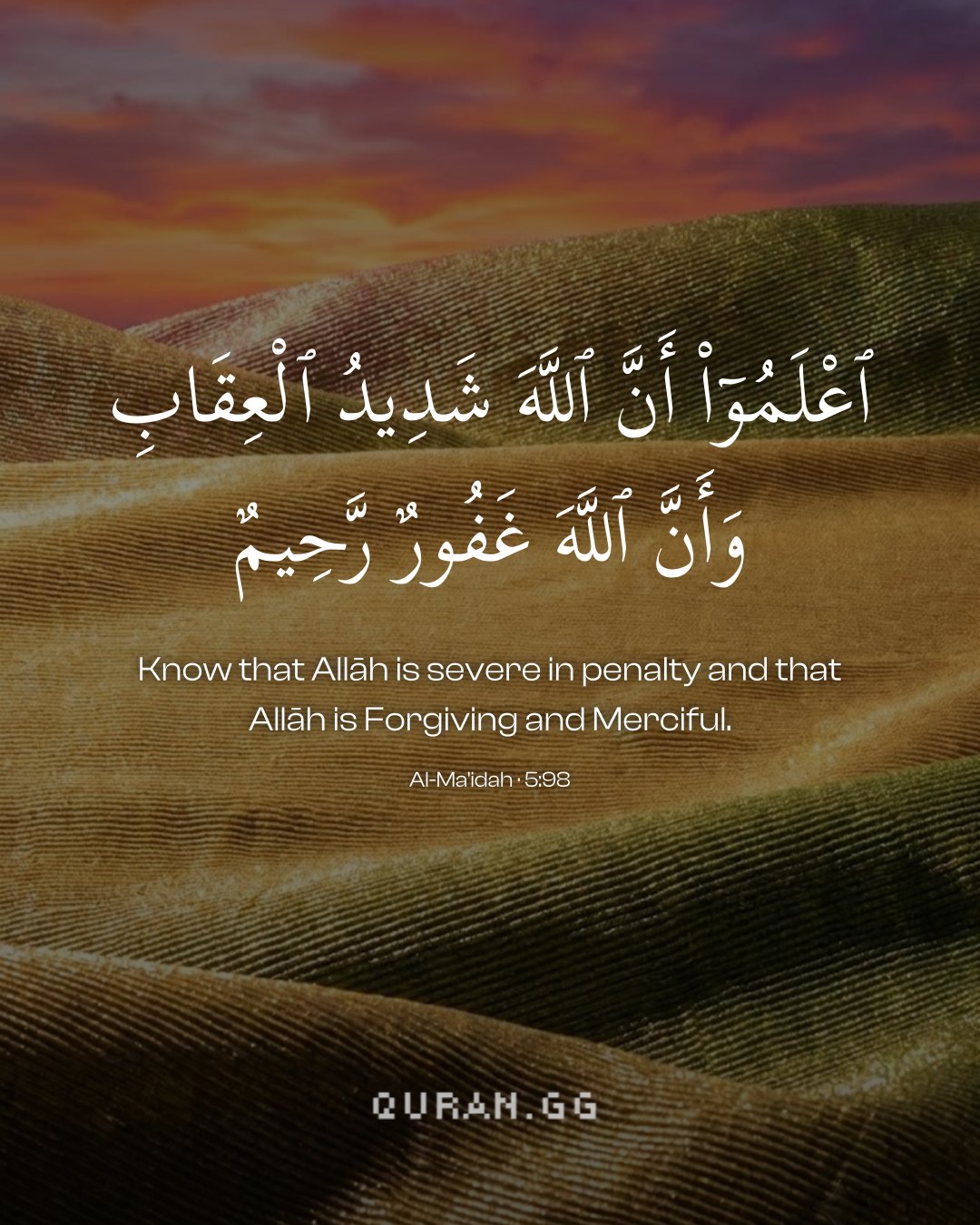
In the second verse (98), it was said اعْلَمُوا أَنَّ اللَّـهَ شَدِيدُ الْعِقَابِ وَأَنَّ اللَّـهَ غَفُورٌ رَّحِيمٌ(Be sure that Allah is severe in punishment and that Allah is Most Forgiving, Very Merciful). This is telling us that the prescribed injunctions of Halal (lawful) and حَرَام haram (unlawful) are based on ideal wisdom and consideration. As long as they are obeyed and followed, they would bring nothing but good for the person who does just that. However, electing to do what is contrary to them is nothing but embracing the worst of curse and punishment. Along with the warning, it was also said that, should someone commit a sin forgetfully or heedlessly, then, Allah Ta` ala does not punish instantly, instead of which, the doors of Allah's forgiveness stay open for those who repent and feel ashamed of what they have done.
Tazkirul Quran
Maulana Wahiduddin KhanOn ayahs 97–101
The Ka‘bah is the eternal centre for Islam and the Islamic community. By declaring it essential to turn towards the Ka‘bah to say one’s prayers (salat,), God has linked each and every Muslim with the centrality of the Ka‘bah. Then by means of Hajj (pilgrimage) it has been made the international meeting place of Islam. The symbolic rites to be performed in connection with the pilgrimage to the Ka‘bah are of great importance, not because of any inherent holiness in them, but because they are the signs of the trial of man. When a subject of God carries out His commandments on these symbolic rites, he reminds himself that though God is not apparently visible, He is actively present—He gives commands; He keeps a watch on His subjects; He is aware of all our actions. These thoughts develop fear of God in man and make him able to remain a true subject of God throughout the vicissitudes of his life. It is a human weakness to give the utmost importance to the drawing of crowds, and to accumulating an abundance of showy worldly goods, etc. In the eyes of God, however, importance attaches only to quality. Quantity has no value for Him. Those who rush towards ‘abundance’ and attach no value to truth think they are very clever, but in reality they are unwise. One who orders his life in fear of God and not on account of material considerations or worldly cares, is the one who is truly successful.
Uthmani text of the Madinah mushaf (King Fahd Complex). Translation: Saheeh International. Tafsir via Quran.com.