The Reward of those Who fear their Lord unseen
Allah informs of he who fears standing before his Lord, being frightened about matters between himself and Allah when he is not in the presence of other people. So he refrains from disobedience and he performs acts of obedience when no one sees him except Allah. Allah mentions that this person will have forgiveness and a great reward. This means that his sins will be remitted and he will be rewarded abundantly. This is similar to what has been confirmed in the Two Sahihs,
«سَبْعَةٌ يُظِلُّهُمُ اللهُ تَعَالى فِي ظِلِّ عَرْشِهِ يَوْمَ لَا ظِلَّ إِلَّا ظِلُّه»
(There are seven people whom Allah the Exalted will shade in the shade of His Throne on the Day when there will be no shade except its shade.) Then he mentioned that among those people are:
Continue reading the tafsir of ayahs 12–15Ma'arif al-Qur'an
Mufti Muhammad Shafi
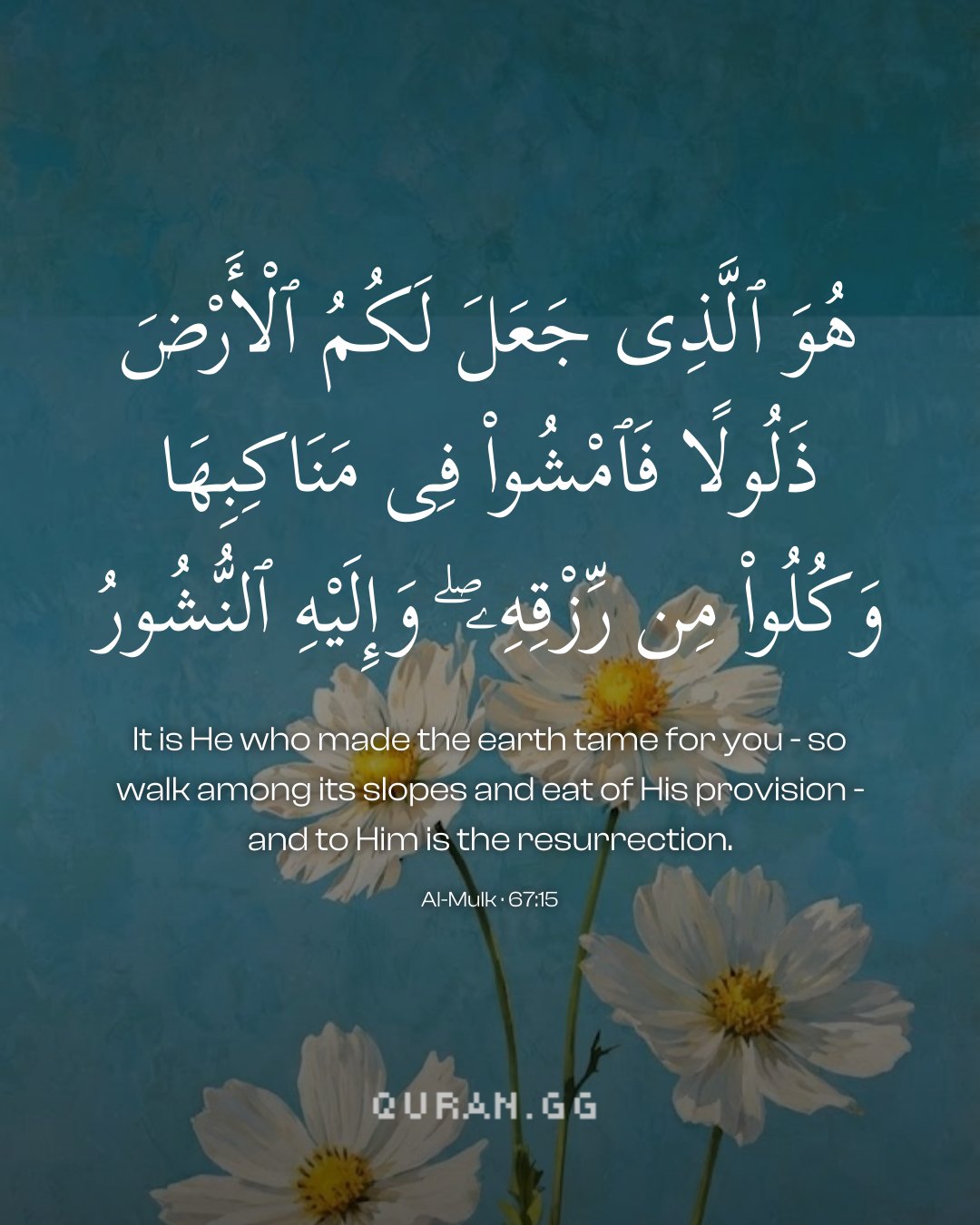
هُوَ الَّذِي جَعَلَ لَكُمُ الْأَرْضَ ذَلُولًا (He is the One who has made the earth submissive for you ...67:15) The word dhalul signifies 'submissive'. When dhalul is used for an animal, it means that it is not insolent when someone is riding it. The word manakib is the plural of mankib, which means 'shoulder', which in animals refer to the upper part of their front legs. Normally, this is not the part of the animals where a rider would sit to ride them. Their back or neck is involved in riding. But an animal that offers its shoulders as well to the riders is very obedient and submissive. Therefore, the verse says that Allah 'has made the earth submissive for you, so walk on its shoulders'. Allah has made the structure of earth such that it is not liquid like water so that it flows, nor is it like mud, mire or slime, because if the earth were to be in any of these states, it would not have been possible for man to live in it. Nor is it made hard like rocks or iron, for in that state it would not have been possible for him to plough the fields to sow his crops and derive various other types of benefit from the earth. Wells and rivers could not have been dug. It would not have been possible to dig trenches into the ground to lay foundations of huge buildings. With such well-balanced infrastructure, He granted him tranquility that it is possible for buildings to stand on it and for people, moving on its surface, to avoid slipping.
وَكُلُوا مِن رِّزْقِهِ (...and eat out of His provision ...67:15). After directing man to travel on earth, it is said 'eat out of His provision'. This probably indicates that commercial trips carried out for import and export are the doors for obtaining livelihood from Allah.
وَإِلَيْهِ النُّشُورُ (...and to Him is the Resurrection...67:15). This warning tells us that man is permitted to draw benefits of eating, drinking and living from the earth, but he is reminded at the same time not to be neglectful of death and life-after-death. Eventually, he will have to leave this world for the Hereafter. Whilst living on the earth, he must prepare for life-after-death. In this verse, man is warned that eventually he will return to Allah on the Day of Resurrection. The next verse warns that the Divine punishment can overtake him, even when living on the earth.
Everything on earth is extremely well-balanced. It is this balance which has made the earth habitable for human beings. Should the slightest disturbance ever occur in this balance, man’s life would be destroyed. We should be grateful to God for the balanced world provided to us and seek His gracious help against any destructive conditions that may develop as a result of the world’s equilibrium being upset.
Uthmani text of the Madinah mushaf (King Fahd Complex). Translation: Saheeh International. Tafsir via Quran.com.