(In the Name of Allah, the Most Gracious, the Most Merciful.
The Command to stand at Night (in Prayer)
Allah commands His Messenger to cease being wrapped up, and this means to be covered during the night. He commands him to get up and stand in prayer to His Lord. This is as Allah says,
(Their sides forsake their beds, to invoke their Lord in fear and hope, and they spend out of what We have bestowed on them.) (32:16) Thus, the Prophet did as Allah ordered him, by standing for prayer at night. This was obligatory upon him alone, as Allah said,
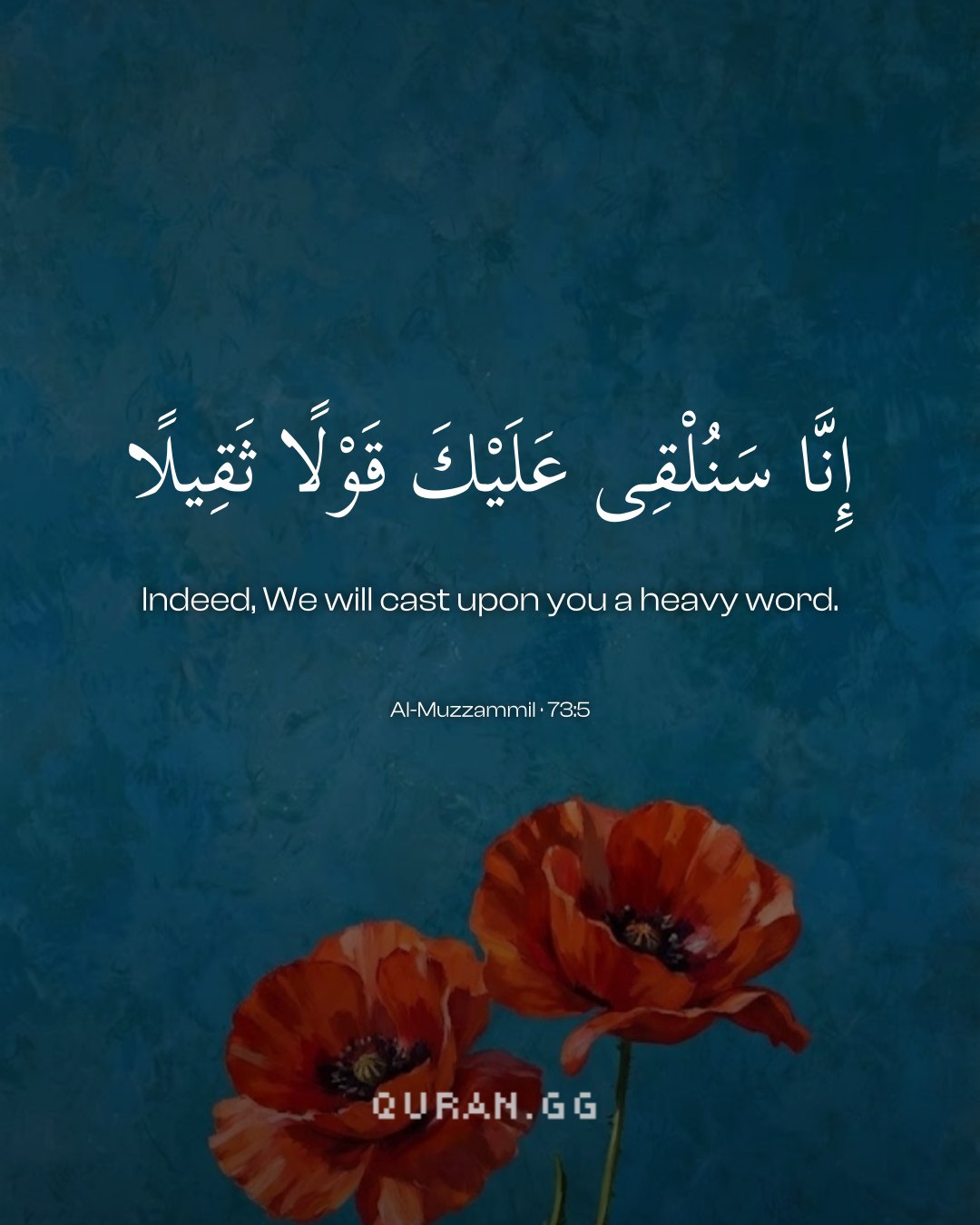
إِنَّا سَنُلْقِي عَلَيْكَ قَوْلًا ثَقِيلًا ('We are going to send down to you a weighty discourse... 73:5) ' The word thagil means 'heavy' and the phrase 'weighty discourse' refers to the Qur'an, because the Qur'anic teachings of lawful and unlawful are permanently binding and carrying them out is the weightiest task for human nature, except those for whom Allah makes it easier. According to oft-quoted Ahadith, whenever a revelation descended upon the Holy Prophet t, he went into a trance and felt a peculiar sensation, so that even on an extremely cold day drops of sweat fell from his forehead, and he felt his body has become heavier. The Qur'anic revelation being 'a weighty discourse', his paroxysm was due to this sensation. If the Holy Prophet ﷺ received revelation while he was on his riding animal, it would begin to move the bottom of its neck intensely. [ Bukhari and others ].
The verse under comment prescribes tahajjud prayer on man, so that he may become accustomed to the difficulty of waking at night. This is a struggle against excess sleep and comfort of the carnal self. This exercise will make it easier to abide by the injunctions contained in the 'weighty discourse', that is, the Holy Qur'an.
Tazkirul Quran
Maulana Wahiduddin KhanOn ayahs 5–13
Literally ‘weighty words’ refers to that order for giving warning which is mentioned in the next chapter, ‘Arise and give warning’ ( 74:2 ). This means inform people about the hazards of the Hereafter. Undoubtedly this is the most difficult task in the world. For this, the missionary has to stand by the pure and unadulterated Truth, even if he becomes a stranger to all his people. He has to tolerate being tormented by the people, so that the relationship between him and his addressees remains unaffected till the last moment. He has to be unilaterally governed by the principles of patience and avoidance of confrontation, so that his status as da‘i should not be damaged.
Uthmani text of the Madinah mushaf (King Fahd Complex). Translation: Saheeh International. Tafsir via Quran.com.