Which was revealed in Makkah
بِسْمِ اللَّهِ الرَّحْمَـنِ الرَّحِيمِ
(In the Name of Allah, the Most Gracious, the Most Merciful.
The Command to stand at Night (in Prayer)
Allah commands His Messenger to cease being wrapped up, and this means to be covered during the night. He commands him to get up and stand in prayer to His Lord. This is as Allah says,
تَتَجَافَى جُنُوبُهُمْ عَنِ الْمَضَاجِعِ يَدْعُونَ رَبَّهُمْ خَوْفاً وَطَمَعاً وَمِمَّا رَزَقْنَـهُمْ يُنفِقُونَ
(Their sides forsake their beds, to invoke their Lord in fear and hope, and they spend out of what We have bestowed on them.) (32:16) Thus, the Prophet did as Allah ordered him, by standing for prayer at night. This was obligatory upon him alone, as Allah said,
Continue reading the tafsir of ayahs 1–9Ma'arif al-Qur'an
Mufti Muhammad Shafi
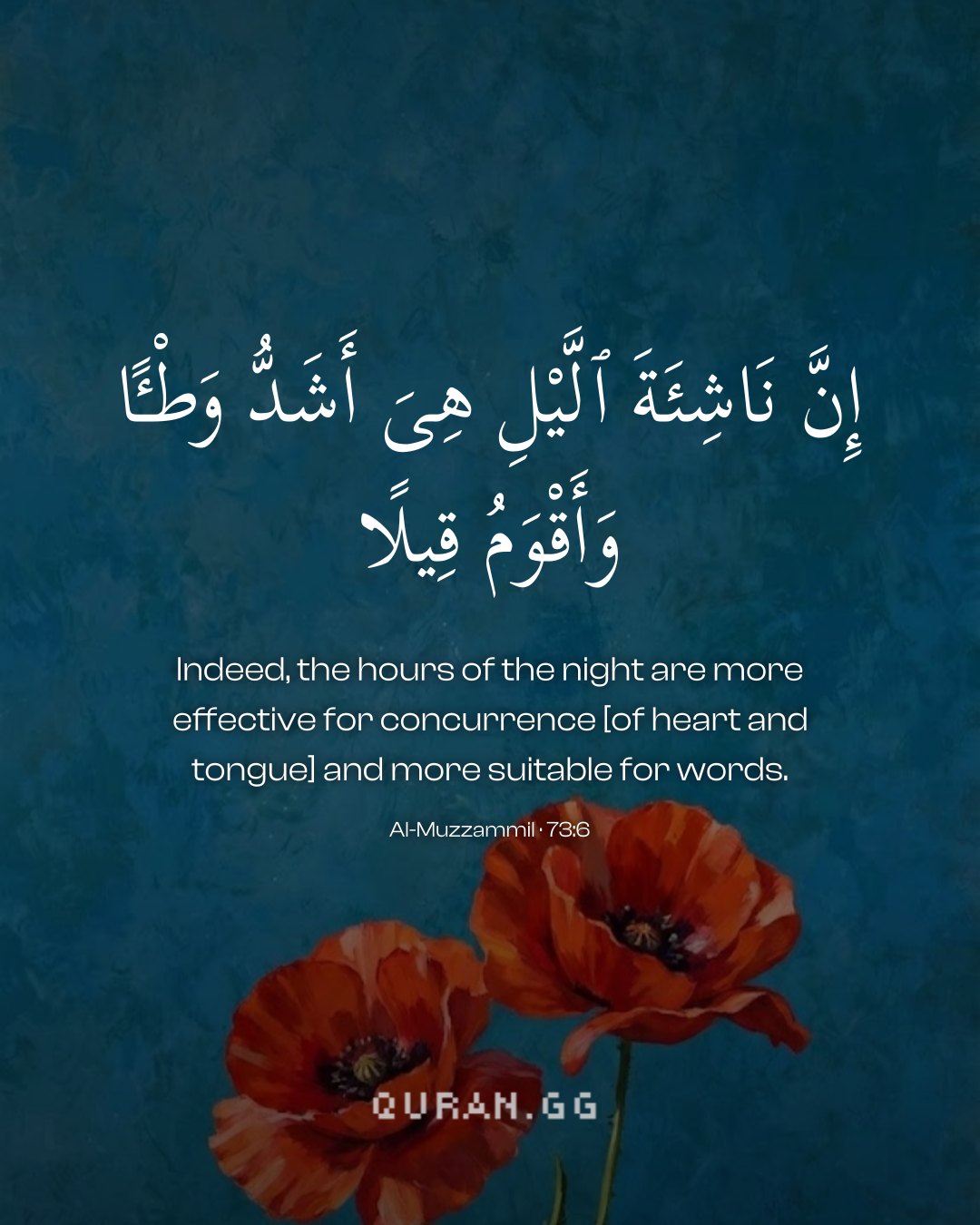
إِنَّ نَاشِئَةَ اللَّيْلِ ('Truly, rising by night [ for prayer of tahajjud ] is the most effective way to subdue (one's self) and to make speech more upright.... 73:6). The word nashi'ah, on the grammatical measure of ` afiyah, is an infinitive noun which signifies 'to rise by night for prayer'. Sayyidah ` A'ishah ؓ said that nashi'at-ul-lail means 'to rise by night for night-prayer after sleeping'. According to this definition, nashi'at-ul-lail refers to tahajjud prayer. Furthermore, the word tahajjud itself, literally, means 'to sleep at night and then wake up to perform the prayer'. Ibn Kaisan (رح) has said that prayer at the later part of the night is called nashi'at-ul-lail. Ibn Zaid (رح) says that performing prayer at any part of the night is nashi'at-ul-lail. Hasan al-Basri (رح) says that any prayer after the ` Isha' prayer is nashi'at-ul-lail. Ibn Abi Mulaikah ؓ says that he asked Sayyidna Ibn ` Abbas and Ibn Zubair u about the meaning of nashi'at-ul-lail, they replied as follows: الّیل کلّھا ناشٔۃ (The entire night is nashi'ah." - Mazhari)
There is no conflict in these interpretations. The point is that the terms nashi'ah of the night and qiyam of the night are general, and may refer to any hour of night. Thus the two terms apply equally to
performing night-prayer in any part of the night, especially the one performed after ` Isha' prayer as explained by Sayyidna Hasan al-Basri (رح) . However, the constant practice of the Holy Prophet ﷺ ، that of the overwhelming majority of the Companions and their pupils, and that of the righteous predecessors of the 'Ummah was that they performed this prayer in the later part of the night after waking from sleep, and therefore it is more virtuous, more meritorious and attracts more blessings. Performing any nafl [ voluntary ] prayer after ` Isha' prayer fulfills the sunnah requirement of nashi'ah of the night and qiyam of the night.
هِيَ أَشَدُّ وَطْئًا (...is the most effective way to subdue (one's self) and to make speech more upright... 73:6). The word wat'an, with the letter waw carrying fath [=a ], is an infinitive which means 'to subdue' or 'to suppress'. Given this meaning, the sense is that this time of night helps one to suppress his evil desires and keep them under, control. This meaning is adopted by Maulana Ashraf Ali Thanawi (رح) and the translation of the text is based on this interpretation. In another qira'ah (version), however, the word is pronounced 'wita'an'. It is an infinitive that means 'to conform'. On another occasion in the Qur'an, we come across the following verse wherein a verb derived from this root is contained. The word in that verse is used in the same sense, thus:
لِّيُوَاطِئُوا عِدَّةَ مَا حَرَّمَ اللَّـهُ
'...so that they may conform (only) to the number of what Allah has sanctified - [ 9:37] '
Leading authorities on Tafsir, like Ibn Zaid and Ibn ` Abbas ؓ ، have interpreted the word in the same sense here. Ibn Zaid ؓ said that getting up in the night for prayer is the most effective means of making the heart, eye, ear and tongue to mutually correspond and conform. Ibn ` Abbas ؓ said that the phrase means that during this time there is the closest degree of conformity and harmony between the ear and the heart. This is because there is no noise at the time of night when most people are asleep and one will not be disturbed as one is during the daytime. At night time when the tongue recites the Qur'an, the ears will be conducive to listening to the recitation with due concentration, and the heart will be conducive to understanding and considering its meaning and message.
وَأَقْوَمُ قِيلًا (And to make speech more upright - 73:6) The word aqwam means 'more upright'. The verse signifies that the recitation of the Qur'an is more upright and concentrated, because during the night there are no noises and commotion to distract the heart or the mind.
In sum, the purport of the verse is to put forward the wisdom underlying the injunction of the 'night-prayer' for the common people. The preceding verse put forward its wisdom for the Holy Prophet ﷺ :
إِنَّا سَنُلْقِي عَلَيْكَ قَوْلًا ثَقِيلًا
'We are going to send down to you a weighty discourse.[ 73:5] '.
The 'weighty discourse' was concerned specifically with the Holy Prophet ﷺ as it was revealed to him. But for common people, Night-Prayer has two characteristics: [ 1] bringing harmony between the heart and the tongue; and [ 2] peace of mind - making it easier to recite the Qur'an.
Uthmani text of the Madinah mushaf (King Fahd Complex). Translation: Saheeh International. Tafsir via Quran.com.