The Wisdom Behind the Losses Muslims Suffered During Uhud
Allah states to His believing servants who suffered losses in the battle of Uhud, including seventy dead,
قَدْ خَلَتْ مِن قَبْلِكُمْ سُنَنٌ
(137... Many similar ways (and mishaps of life) were faced before you), for the previous nations who followed their Prophets before you, they too suffered losses. However, the good end was theirs, and the ultimate defeat was for the disbelievers. This is why Allah said,
The second verse that follows gives consolation to Muslims from another angle. It has been said that if Muslims were wounded or hurt in that particular battle, so also were those fighting against them. If seventy Muslim men were martyred with many wounded, is it not that they had condemned an identical number of their enemies to Hell, and wounded many, a year ago? Then, in this very battle, many a men from the enemy ranks were killed and wounded initially. So, when the text says:
If you receive a wound, they have received a similar wound. And such days we rotate among the people..
It guides us to another important principle and rule of procedure.
In this mortal world, the customary practice of Allah Almighty is to cause the days of hardship and ease, pain and comfort, suffering and peace occur among people by turns. If, for some reason, a falsely-motivated power succeeds in getting a short-lived upper hand, the group motivated by the truth should not lose heart and come to think that, from this point onwards, they are always doomed to nothing but defeat. Instead of taking this negative attitude, they should rather go about finding out the causes of that defeat, and once they have discovered those, they should take corrective measures and eliminate all possibilities of repeating those mistakes. In the end, the group motivated by the truth shall emerge as the ultimate victor.
Tazkirul Quran
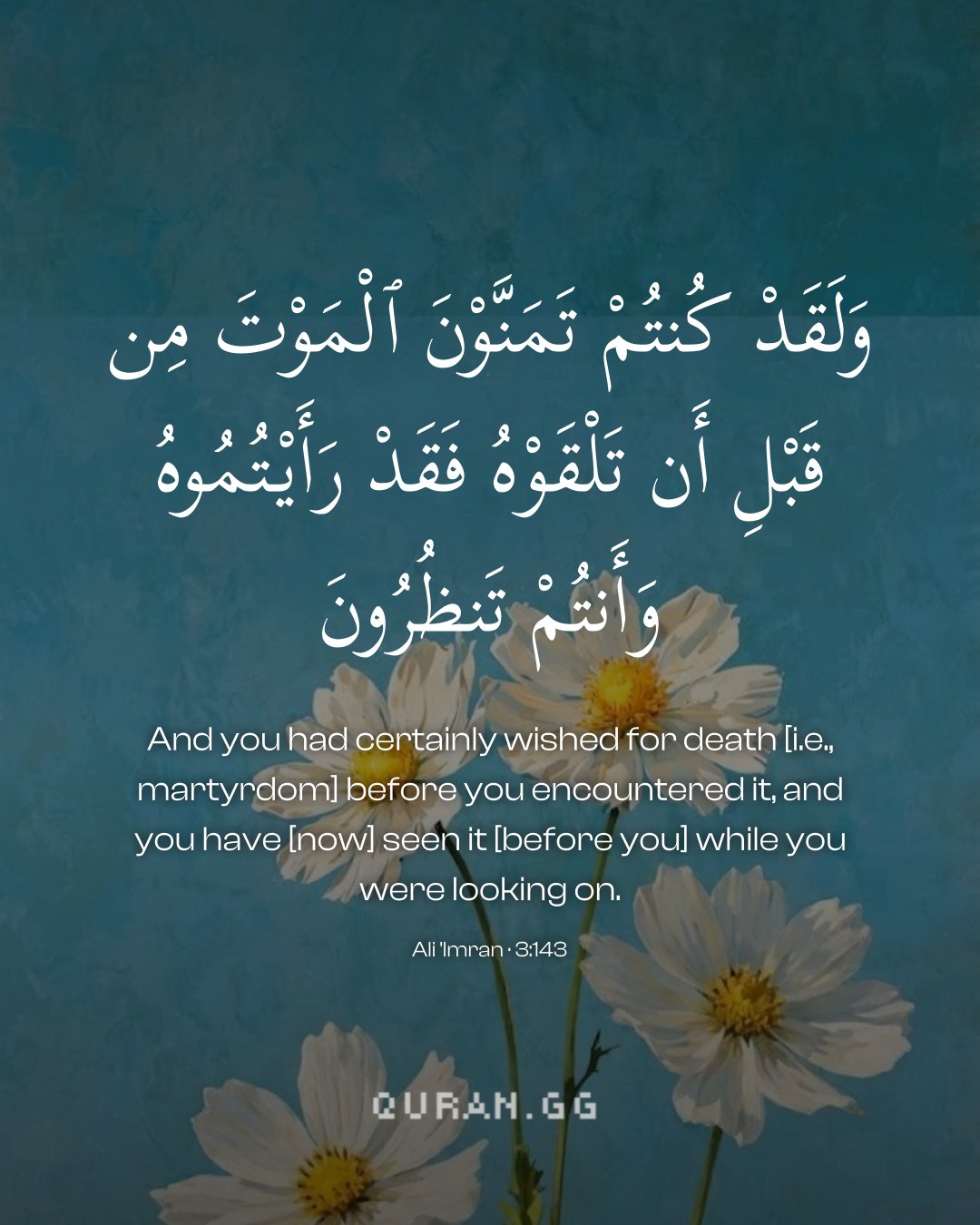
Maulana Wahiduddin KhanOn ayahs 143–144
When an individual resolves to follow the path of God, he is confronted with many kinds of problems and difficulties created by others. Sometimes these problems produce in him a state of uncertainty; sometimes they make him think of opting for a policy of expediency; sometimes they arouse negative feelings within him; sometimes he is tempted to embrace such a version of God’s religion as has great public appeal. Herein lies the test of man in the present world. Whatever reaction man shows on such occasions serves as an indicator of whether he is false or true in his acceptance of faith. If his actions correspond to his verbal claim of faith, he is true, and if not, he is false. Becoming God’s witness is the final destination of this journey. Let us imagine a servant of God who comes forward as a preacher of truth before the people. He himself fully practises what he preaches. People may regard him as insignificant, but he does not mind. He faces difficulties, but he is not discouraged; he perseveres in sending out the call of truth. He is neither disheartened nor given to negative thinking. Even when he has to pay the price with his life and property, his stand is not shaken. This test is a momentous one; but it is as a result of his passing this test that God selects him to be a witness in His divine court. When, despite all sorts of adverse situations, man continues to perform the task of conveying the divine message, he proves that he is convinced of the truth of the message he preaches. Furthermore, this also shows that the message he conveys to others is not just a trivial matter, but an extremely serious one.
Uthmani text of the Madinah mushaf (King Fahd Complex). Translation: Saheeh International. Tafsir via Quran.com.