Surah Ali 'Imran Ayah 65 (3:65) — Meaning & Tafsir | Quran.GG

Surah Ali 'Imran, Ayah 65

3:65 · Meaning and tafsir

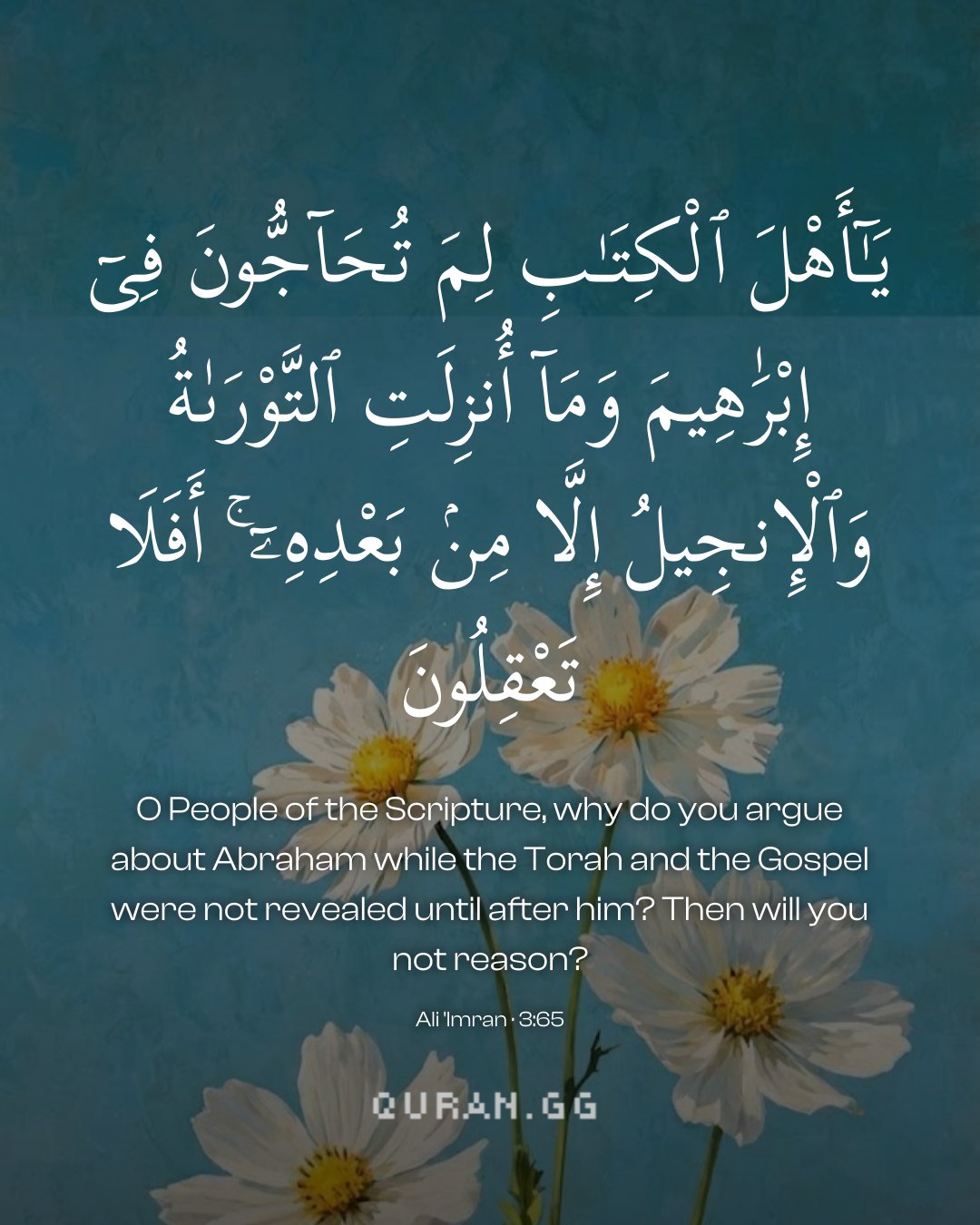
يَـٰٓأَهْلَ ٱلْكِتَـٰبِ لِمَ تُحَآجُّونَ فِىٓ إِبْرَٰهِيمَ وَمَآ أُنزِلَتِ ٱلتَّوْرَىٰةُ وَٱلْإِنجِيلُ إِلَّا مِنۢ بَعْدِهِۦٓ ۚ أَفَلَا تَعْقِلُونَ ٦٥

O People of the Scripture, why do you argue about Abraham while the Torah and the Gospel were not revealed until after him? Then will you not reason?

Surah Ali 'Imran 3:65 in Arabic with its translation: “O People of the Scripture, why do you argue about Abraham while the Torah and the Gospel were not revealed…”

Make something with this ayah

Turn it into a video for Stories, Reels or TikTok, recited by the reciter you pick, or an image on a background you choose. Free, in your browser.

Download this image

Tafsir Ibn Kathir (abridged)

Disputing with the Jews and Christians About the Religion of Ibrahim

Allah censures the Jews and Christians for their dispute with Muslims over Ibrahim Al-Khalil and the claim each group made that he was one of them. Muhammad bin Ishaq bin Yasar reported that Ibn `Abbas said, "The Christians of Najran and Jewish rabbis gathered before the Messenger of Allah ﷺ and disputed in front of him. The rabbis said, `Ibrahim was certainly Jewish.' The Christians said, `Certainly, Ibrahim was Christian.' So Allah sent down,

يأَهْلَ الْكِتَـبِ لِمَ تُحَآجُّونَ فِى إِبْرَهِيمَ

(O people of the Scripture (Jews and Christians)! Why do you dispute about Ibrahim,) meaning, `How is it that you, Jews, claim that Ibrahim was Jew, although he lived before Allah sent down the Tawrah to Musa How is it that you, Christians, claim that Ibrahim was Christian, although Christianity came after his time" This is why Allah said,

أَفَلاَ تَعْقِلُونَ

(Have you then no sense)

Allah then said,

هأَنتُمْ هَـؤُلاءِ حَـجَجْتُمْ فِيمَا لَكُم بِهِ عِلمٌ فَلِمَ تُحَآجُّونَ فِيمَا لَيْسَ لَكُمْ بِهِ عِلْمٌ

(Verily, you are those who have disputed about that of which you have knowledge. Why do you then dispute concerning that of which you have no knowledge)

This Ayah criticizes those who argue and dispute without knowledge, just as the Jews and Christians did concerning Ibrahim. Had they disputed about their religions, which they had knowledge of, and about the Law that was legislated for them until Muhammad ﷺ was sent, it would have been better for them. Rather, they disputed about what they had no knowledge of, so Allah criticized them for this behavior. Allah commanded them to refer what they have no knowledge of to He Who knows the seen and unseen matters and Who knows the true reality of all things. This is why Allah said,

وَاللَّهُ يَعْلَمُ وَأَنتُمْ لاَ تَعْلَمُونَ

(It is Allah Who knows, and you know not.)

Allah said,

مَا كَانَ إِبْرَهِيمُ يَهُودِيًّا وَلاَ نَصْرَانِيًّا وَلَكِن كَانَ حَنِيفًا مُّسْلِمًا

(Ibrahim was neither a Jew nor a Christian, but he was a true Muslim Hanifa), shunning Shirk and living in Iman,

وَمَا كَانَ مِنَ الْمُشْرِكِينَ

(and he was not of the Mushrikin.)

This Ayah is similar to the Ayah in Surat Al-Baqarah,

وَقَالُواْ كُونُواْ هُودًا أَوْ نَصَـرَى تَهْتَدُواْ

(And they say, "Be Jews or Christians, then you will be guided...") 2:135.

Allah said next,

إِنَّ أَوْلَى النَّاسِ بِإِبْرَهِيمَ لَلَّذِينَ اتَّبَعُوهُ وَهَـذَا النَّبِىُّ وَالَّذِينَ ءَامَنُواْ وَاللَّهُ وَلِىُّ الْمُؤْمِنِينَ

(Verily, among mankind who have the best claim to Ibrahim are those who followed him, and this Prophet and those who have believed. And Allah is the Wali (Protector and Helper) of the believers.)

This Ayah means, "The people who have the most right to be followers of Ibrahim are those who followed his religion and this Prophet, Muhammad ﷺ , and his Companions from the Muhajirin, Ansar and those who followed their lead." Sa`id bin Mansur recorded that Ibn Mas`ud said that the Messenger of Allah ﷺ said,

«إِنَّ لِكُلِّ نَبِيَ وُلَاةً مِنَ النَّبِيِّينَ، وَإِنَّ وَلِيِّي مِنْهُمْ أَبِي وَخَلِيلُ رَبِّي عَزَّ وَجَل»

(Every Prophet had a Wali (supporter, best friend) from among the Prophets. My Wali among them is my father Ibrahim, the Khalil (intimate friend) of my Lord, the Exalted and Most Honored)

The Prophet then recited,

إِنَّ أَوْلَى النَّاسِ بِإِبْرَهِيمَ لَلَّذِينَ اتَّبَعُوهُ

(Verily, among mankind who have the best claim to Ibrahim are those who followed him...)

Allah's statement,

وَاللَّهُ وَلِىُّ الْمُؤْمِنِينَ

(And Allah is the Wali (Protector and Helper) of the believers.) means, Allah is the Protector of all those who believe in His Messengers.

Ma'arif al-Qur'an

Commentary

The argumentation referred to in verse 65 was to decide whether Sayyidna Ibrahim (علیہ السلام) followed the way of the Jews, or that of the Christians. The futility of their exercise already stood exposed as both these ways in religion appeared long after the revelation of the Old and New Testaments. These just did not exist before that. How, then, could it be claimed that Sayyidna Ibrahim (علیہ السلام) . It adhered To these ways?

Verse 66 points out to the hollowness of their approach when they indulged in their argumentation on the basis of incomplete knowledge. That they would venture to do so on the basis of no knowledge could hardly he explained. The truth is that only Allah knows the way of Ibrahim (علیہ السلام) .

That way has been described in Verse 67.

Verse 68 declares that the closest of people to Sayyidna Ibrahim (علیہ السلام) were those who followed him during his time and now the closest to him is the Prophet of Islam, Muhammad a1-Mustafa ﷺ and so are the believers in him and in past prophets. These believers are the community of Muhammad ﷺ and their guardian is Allah and He will reward them for their belief.

Tazkirul Quran

Najran (about 150 miles north of Sana‘ towards Yemen) was a great centre of Christianity at the time of the revelation of the Quran. In the 10th year of the Hijra, a Christian deputation came from Najran, to discuss Christian beliefs with the Prophet Muhammad. The Prophet presented many arguments to them. He asked how Christ could be God’s son, when God is a living being who would never die, whereas Jesus would eventually be overcome by death. They could not counter his arguments but, nevertheless, stood their ground. When the Prophet saw that they were not going to accept his arguments, however sound they might be, he gave them a final challenge. He said that if they really believed that they were right (in believing Christ to be the son of God) they should be ready for a mubahalah, i.e., a solemn meeting, in which both sides should summon not only their men, but their women and children, to pray earnestly to God, and invoke the curse of God on those who lied. Those who were pure and sincere in their faith would not hesitate. The next day the Prophet came out of his home accompanied by his grandsons, Hasan and Husayn, and his daughter Fatimah, and son-in-law ‘Ali. On seeing this the Christians were so impressed that they sought some time to reconsider. In their consultations one of their religious scholars said: ‘You know God has promised to send a Prophet among the Ishmaelites. Suppose he be the same prophet. In that case, the only result of engaging in a mubahalah with him would be the destruction of all our people and its effect would even extend to our next generations. By God, I am seeing such faces as could move mountains with their prayers. So it is better to enter into certain peace treaties with him and go back to our homes.’

Continue reading the tafsir of ayahs 63–65

Uthmani text of the Madinah mushaf (King Fahd Complex). Translation: Saheeh International. Tafsir via Quran.com.