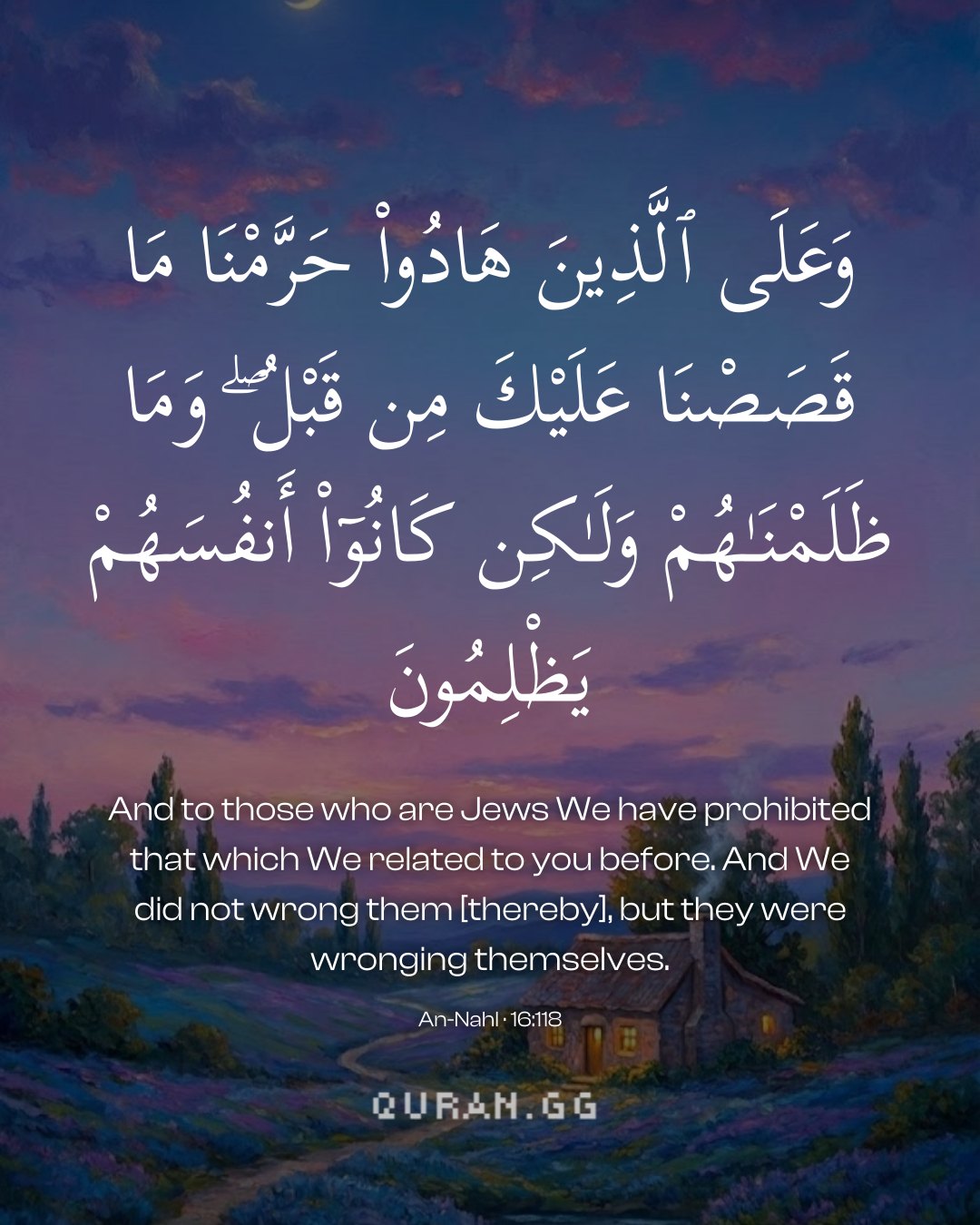
Some Good Things were Forbidden for the Jews
After mentioning that He has forbidden us to eat dead meat, blood, the flesh of swine, and any animal which is slaughtered as a sacrifice for others than Allah, and after making allowances for cases of necessity - which is part of making things easy for this Ummah, because Allah desires ease for us, not hardship - Allah then mentions what He forbade for the Jews in their laws before they were abrogated, and the restrictions, limitations and difficulties involved therein. He tells us:
وَعَلَى الَّذِينَ هَادُواْ حَرَّمْنَا مَا قَصَصْنَا عَلَيْكَ مِن قَبْلُ
(And for those who are Jews, We have forbidden such things as We have mentioned to you before.) meaning in Surat Al-An`am, where Allah says:
وَعَلَى الَّذِينَ هَادُواْ حَرَّمْنَا كُلَّ ذِى ظُفُرٍ وَمِنَ الْبَقَرِ وَالْغَنَمِ حَرَّمْنَا عَلَيْهِمْ شُحُومَهُمَآ إِلاَّ مَا حَمَلَتْ ظُهُورُهُمَآ
(And unto those who are Jews, We forbade every (animal) with undivided hoof, and We forbade them the fat of the ox and the sheep except what adheres to their backs) Until,
لَصَـدِقُونَ
(We are indeed truthful) 6:146 Hence Allah says here:
وَمَا ظَلَمْنَـهُمْ
(And We did not wrong them,) meaning, in the restrictions that We imposed upon them.
وَلَـكِن كَانُواْ أَنفُسَهُمْ يَظْلِمُونَ
(but they wronged themselves. ) meaning, they deserved that. This is like the Ayah:
فَبِظُلْمٍ مِّنَ الَّذِينَ هَادُواْ حَرَّمْنَا عَلَيْهِمْ طَيِّبَـتٍ أُحِلَّتْ لَهُمْ وَبِصَدِّهِمْ عَن سَبِيلِ اللَّهِ كَثِيراً
(Because of the wrong committed of those who were Jews, We prohibited certain good foods which had been lawful for them - and (also) for their hindering many from Allah's way.) (4:160) Then Allah tells us, honoring and remin- ding believers who have sinned of His blessings, that who- ever among them repents, He will accept his repentance, as He says:
ثُمَّ إِنَّ رَبَّكَ لِلَّذِينَ عَمِلُواْ السُّوءَ بِجَهَـلَةٍ
(Then, your Lord for those who did evil out of ignorance) Some of the Salaf said that this means that everyone who disobeys Allah is ignorant.
ثُمَّ تَابُواْ مِن بَعْدِ ذَلِكَ وَأَصْلَحُواْ
(and afterward repent and do righteous deeds) meaning, they give up the sins they used to commit and turn to doing acts of obedience to Allah.
إِنَّ رَبَّكَ مِن بَعْدِهَا
(verily, after that, your Lord is...) means, after that mistake
لَغَفُورٌ رَّحِيمٌ
(...Pardoning, Most Merciful.)
Commentary
Nature of Prohibitions: The Correct View
The restrictive particle: اَنَّمَا (innama: only) appearing in verse 115 seems to give the impression that things Haram are no more than the four mentioned in the verse. This impression emerges more clearly in another verse: قُل لَّا أَجِدُ فِي مَا أُوحِيَ إِلَيَّ مُحَرَّمًا (Say, I do not find, in what has been revealed to me, anything prohibited... - Surah a1-An` am, 6:145). It seems to be suggestive of nothing being Haram other than the things mentioned in the verse while the fact is that according to clarifications of the Qur'an and Sunnah and by the Consensus of the Muslim Ummah, there are many more things rated as Haram. The answer to this difficulty comes through deliberation into the context of these very verses which tells us that the purpose at this place is not to describe Halal and Haram as they are commonly understood. Instead, the purpose is to point out to what the mushrikin of the period of Jahiliyah had done. They had made many things Haram on their own although Allah Ta’ ala had never ordered them about their unlawfulness. It amounts to saying: Out of the things you have (arbitrarily) made out as Haram, only that which is really Haram is being mentioned here. A comprehensive explanation of this verse along with a detailed description of these four prohibitions has appeared in the Commentary of Surah al-Baqarah, Ma` ariful-Qur’ an, Volume I, pages 424-438, under Verses 173-174. Those interested may see it there.
This verse relates to things which are eaten from day to day out of the eatable things created by God. All things are permissible (halal) with just a few exceptions. However, the ancient polytheists prohibited for themselves many things which were permissible. On the contrary, atheists have treated many things prohibited by God as being permissible for themselves. Both these approaches negate the spirit, which is intended to be developed in man through the bounties of food. Food is the most important of all man’s needs. It is a need which is experienced morning and evening. God desires that, whenever a man uses food, he should eat it considering it as a gift from God and he should be grateful to Him for it. But man has reversed the whole matter. In the ancient polytheistic period, they attributed these foods to false gods and in this way made it the means of remembering false gods instead of the one and only God. In the atheistic modern period, man having made the whole matter subject to his personal tastes, those things prohibited by God have been treated as permissible by him. This has resulted in the things created by God becoming mere foodstuffs to cater to his tastes at the dining table. If, under compulsion, anyone goes against the law of God regarding food, he should do it with a sense of shame and not with arrogance. In that way his mentality will be uncorrupted.
Uthmani text of the Madinah mushaf (King Fahd Complex). Translation: Saheeh International. Tafsir via Quran.com.