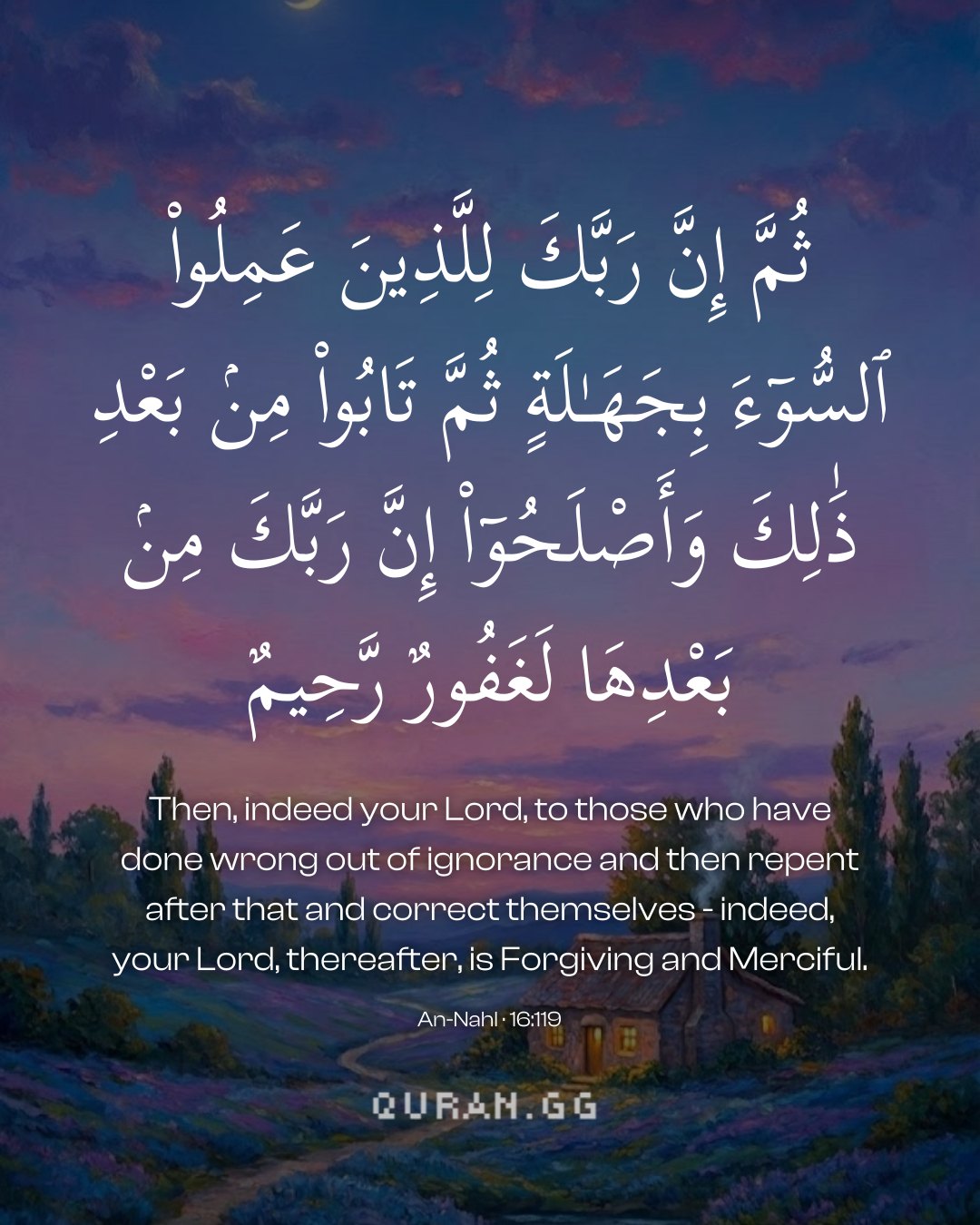
Then, indeed your Lord, to those who have done wrong out of ignorance and then repent after that and correct themselves - indeed, your Lord, thereafter, is Forgiving and Merciful.
After mentioning that He has forbidden us to eat dead meat, blood, the flesh of swine, and any animal which is slaughtered as a sacrifice for others than Allah, and after making allowances for cases of necessity - which is part of making things easy for this Ummah, because Allah desires ease for us, not hardship - Allah then mentions what He forbade for the Jews in their laws before they were abrogated, and the restrictions, limitations and difficulties involved therein. He tells us:
Repentance from Sin brings Forgiveness: Is it Open or Restricted?
In the last verse (119): ثُمَّ إِنَّ رَبَّكَ لِلَّذِينَ عَمِلُوا السُّوءَ بِجَهَالَةٍ (Then your Lord – for those who did evil through ignorance ...), it will be noticed that the sense of ignorance has been conveyed by the use of the word: جَهَالَةٍ (jahalah), not: جَھل (jahl). As for the word: جَھل (jahl), it is employed as an antonym of: عِلَم (` ilm: knowledge) and releases the sense of a lack of knowledge or understanding while the word: جَهَالَةٍ (jahalah) denotes acting ignorantly - even if done knowingly. This tells us that the forgiveness of sins through Taubah (repentance) is not restricted to a situation where a sin is committed with lack of understanding or volition. (Rather, a true taubah or repentance may forgive all sins, even though committed deliberately).
Tazkirul Quran
Maulana Wahiduddin Khan
When feelings of arrogance and prejudice add up to evil, the individual in question will not be ready to steer clear of it, though many arguments may be advanced to prove his actions wrong. But there is another kind of evil which arises due to stupidity. A man sometimes errs due to his lack of knowledge or to his being dominated by his own desires. Such a man generally exhibits no bravado. When his mistake is made clear by argument, he immediately turns back and sets himself on the right path once again. There is no question of pardon for the first category of people. But as for the second category, there is the good news that God will extend His grace to them because He is truly merciful on this subject.
Uthmani text of the Madinah mushaf (King Fahd Complex). Translation: Saheeh International. Tafsir via Quran.com.