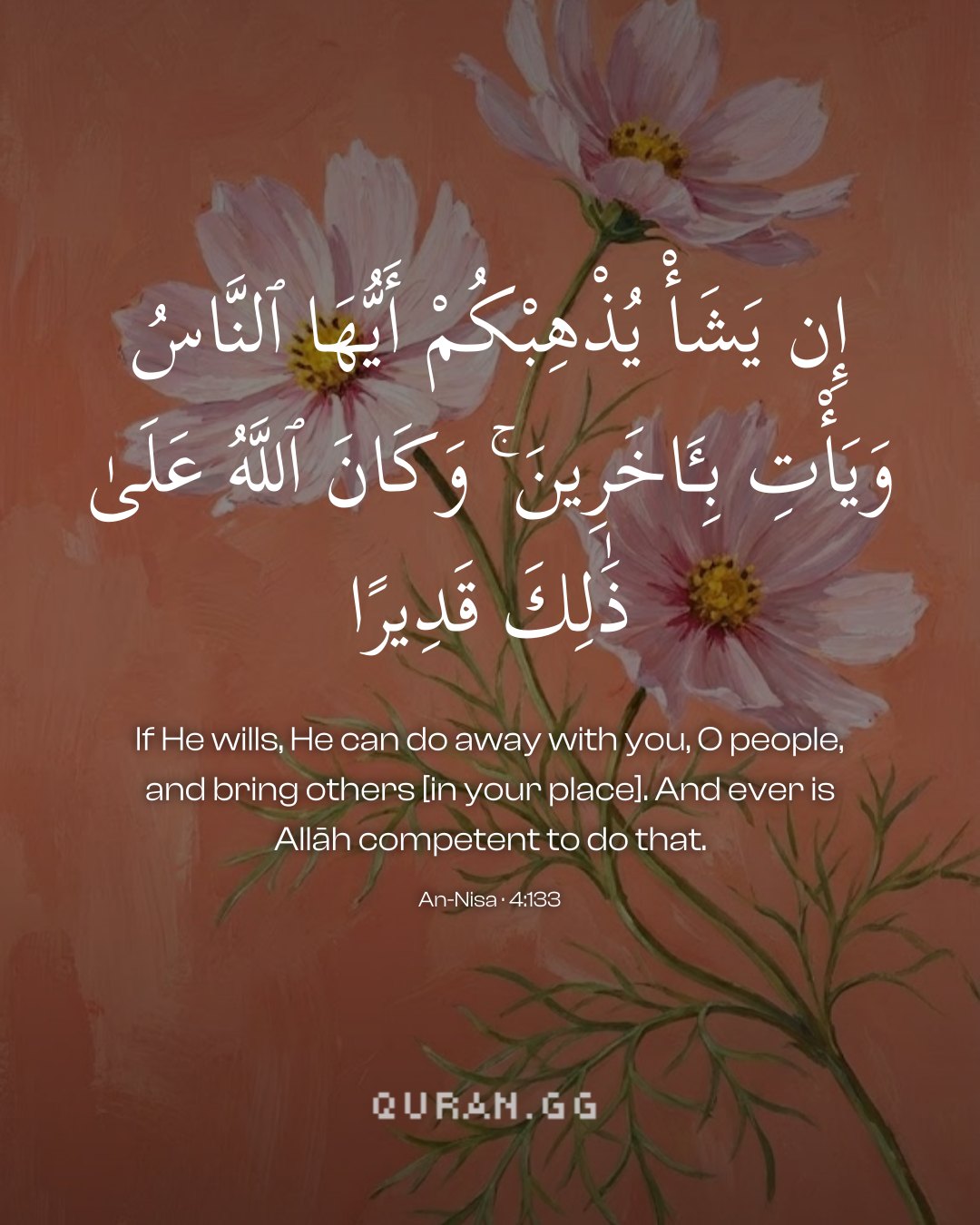
(And verily, We have recommended to the People of the Scripture before you, and to you) meaning, We have recommended to you what We recommended to the People of Scriptures; Taqwa of Allah, by worshipping Him Alone without partners. Allah then said,
(But if you disbelieve, then unto Allah belongs all that is in the heavens and all that is in the earth). In another Ayah, Allah said that Musa said to his people,
The third mention of these words embodies a statement of Allah's mercy which makes things work for people. It means: Should one fear Allah and be obedient to Him, Allah will fulfill all his needs, because He is the owner of everything in this universe.
Tazkirul Quran
Maulana Wahiduddin KhanOn ayahs 132–134
The present world is a world of trial. Here everyone is being tested to find out who is good and who is bad. To serve this purpose the present world has been built to provide for every kind of freedom. In this world one even has the liberty to label one’s misdeeds as good deeds. Here people have every opportunity to be involved in all kinds of sinful acts, yet pass themselves off as pious people. Here people find beautiful words to justify themselves. Here it is possible to refute an open truth and find a beautiful explanation to justify its denial. Here it is possible for one to build his life on honour-seeking, popularity, hoarding, self-interest, expediency, self-glorification, and yet succeed in convincing others that he is engaged in the genuine cause of truth. Here it is possible for a person to exploit God’s religion for the achievement of his worldly and material purposes, and yet continue to flourish in this world. Here it is possible to abandon what is lawful in favour of what is unlawful; to take the path of tyranny instead of justice, and yet go scot free. In all these instances, if man wanted, he could bind himself either to truth and justice or to injustice and haughtiness. The truth is that, of all the aspects of man’s relationship with God, what is of most importance is whether man fears God or not. Because it is fear of God which enables the individual to lead a responsible life. Without the fear of God, there is nothing to check one from following the path of evil. This is particularly true in a world where evil can be couched in beautiful words to mislead the people; in a world where great personal advancement can be achieved on the basis of injustice; where every tyrant finds fine words to hide his tyranny.