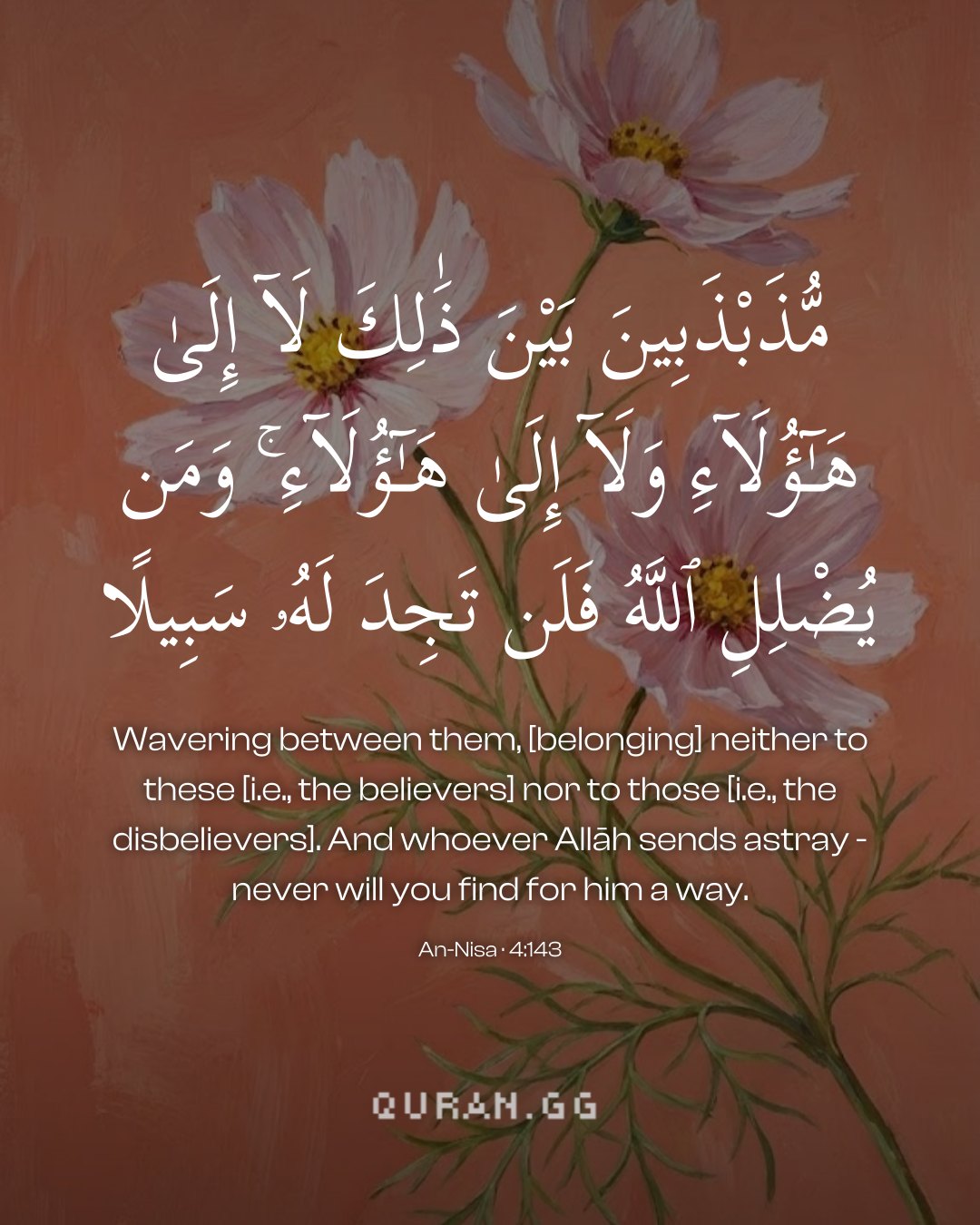
Wavering between them, [belonging] neither to these [i.e., the believers] nor to those [i.e., the disbelievers]. And whoever Allāh sends astray - never will you find for him a way.
(Verily, the hypocrites seek to deceive Allah, but it is He Who deceives them.) There is no doubt that Allah can never be deceived, for He has perfect knowledge of the secrets and what the hearts conceal. However, the hypocrites, due to their ignorance, scarce knowledge and weak minds, think that since they were successful in deceiving people, using Islamic Law as a cover of safety for themselves, they will acquire the same status with Allah on the Day of Resurrection and deceive Him too. Allah states that on that Day, the hypocrites will swear to Him that they were on the path of righteousness and correctness thinking that such statement will benefit them with Allah. For instance, Allah said,
Maulana Ashraf ` Ali Thanavi (رح) has, in his Tafsir Bay-an al-Qur'an, taken up the question of 'standing up lazily' in the expression: قَامُوا كُسَالَ which appears in verse 142 saying: 'The laziness censured here is doctrinal laziness, (that is, slothfulness towards observance of the articles of faith due to lack of true conviction). However, laziness which is there despite correct beliefs stands excluded from the purview of this censure. Then, should this laziness be there due to some excuse, such as, sickness, fatigue or sleepiness, it is not even blameworthy. But, when without excuse, it is.'
Tazkirul Quran
Maulana Wahiduddin KhanOn ayahs 141–146
The hypocrite is one who is outwardly religious but inwardly irreligious. Having no principles, he watches out for opportunities to turn events to his own advantage. He associates himself with any group which may help him realise his worldly ambitions, be it composed of believers or of those who deny the truth. Into whichever gathering he goes, he speaks to please everybody. For reasons of worldly convenience or expediency he has to associate himself at times with believers, but he is not their well-wisher. Since the very existence of true believers becomes a criterion of Truth in a society, those who stand on the ground of false religiosity want such criteria as expose their false religiosity to be demolished. However, the evil wishers of the believers can make mischief only in this world. Believers will be safe from their mischief in the Hereafter. A hypocrite is bracketed with those who deny the truth, because in God’s judgement, there is no difference between outward religiosity and blatant irreligiosity. This is because although both the states may appear to be different, in reality they are identical. To God, what is of importance is the inward state (the reality) and not the outward appearance.
Uthmani text of the Madinah mushaf (King Fahd Complex). Translation: Saheeh International. Tafsir via Quran.com.