The Necessity of Surrendering the Inheritance According to the Portions that Allah Ordained
Sa`id bin Jubayr and Qatadah said, "The idolators used to give adult men a share of inheritance and deprive women and children of it. Allah revealed;
لِّلرِّجَالِ نَصيِبٌ مِّمَّا تَرَكَ الْوَلِدَنِ وَالاٌّقْرَبُونَ
(There is a share for men from what is left by parents and those nearest in relation)." Therefore, everyone is equal in Allah's decision to inherit, even though their shares vary according to the degree of their relationship to the deceased, whether being a relative, spouse, etc. Ibn Marduwyah reported that Jabir said, "Umm Kujjah came to the Messenger of Allah ﷺ and said to him, `O Messenger of Allah! I have two daughters whose father died, and they do not own anything.' So Allah revealed;
Continue reading the tafsir of ayahs 7–10Ma'arif al-Qur'an
Mufti Muhammad Shafi
Now look at the beauty and delicacy of the Qur'anic arrangement of things. On the one hand, there is the just rule offered by the Qur'an itself - that the nearer in kinship shall exclude the farther. On the other hand, there is that wonderful concern for the disappointment of the excluded farther'. Therefore, a regular verse (8) has been devoted to carry the necessary instruction as to how this situation will be handled:
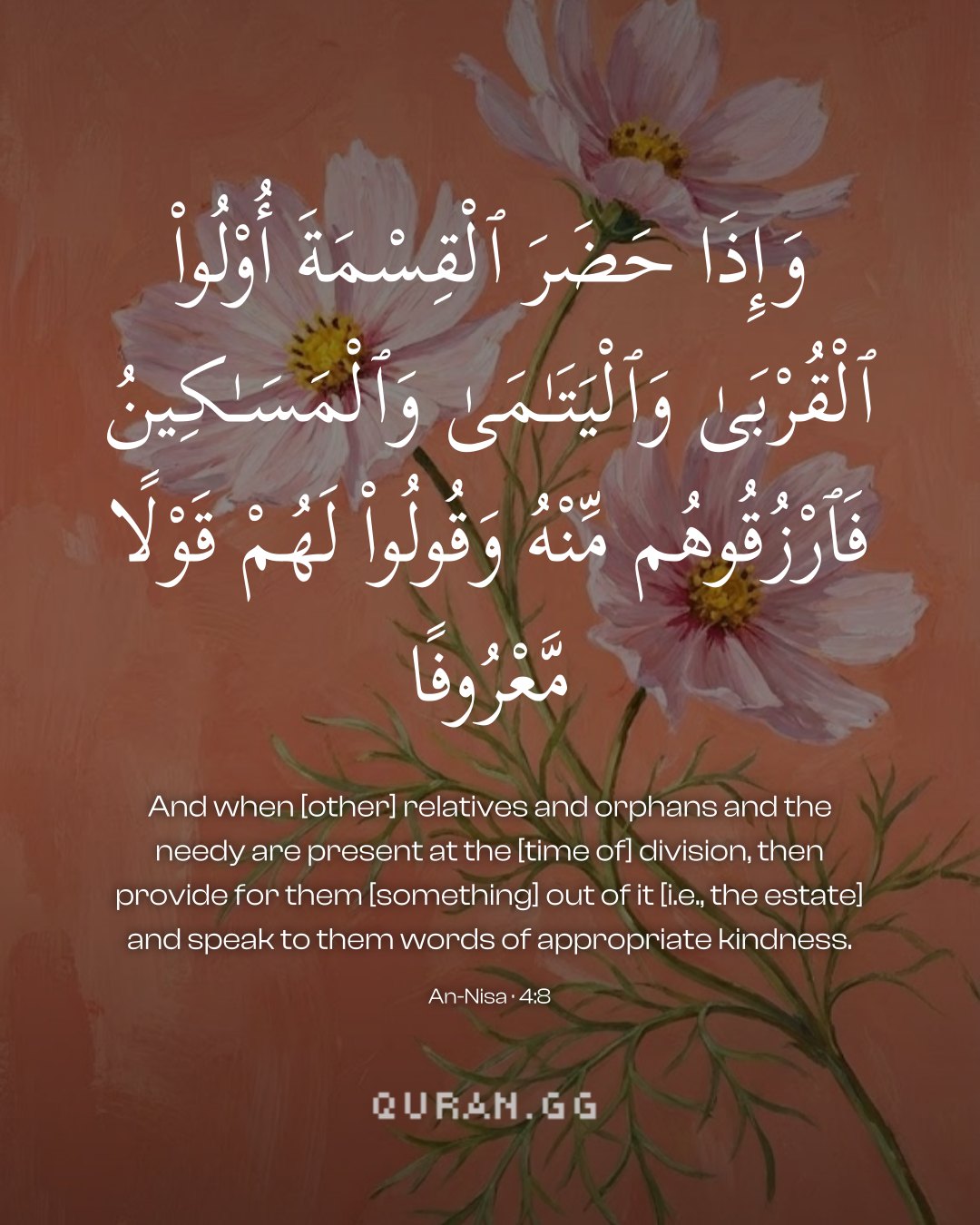
وَإِذَا حَضَرَ الْقِسْمَةَ أُولُو الْقُرْبَىٰ وَالْيَتَامَىٰ وَالْمَسَاكِينُ فَارْزُقُوهُم مِّنْهُ وَقُولُوا لَهُمْ قَوْلًا مَّعْرُوفًا ﴿8﴾
It means that distant relatives, orphans and the needy who are to be excluded from having a share in the inheritance and who, nevertheless, show up at the time of its distribution, then, it is the moral obligation of those who get a share in the inheritance that they voluntarily give them some of it, which would become an act of charity for them, and certainly, a modality of reward from Allah. At a time like this, when wealth and property are coming to them, without their having made any effort, simply through the mercy of Allah Almighty - then, their own hearts should beat with the urge to give whatever they can, in the way of Allah, an example of which appears in another verse (Al an'am: 6:141) cited below:
كُلُوا مِن ثَمَرِهِ إِذَا أَثْمَرَ وَآتُوا حَقَّهُ يَوْمَ حَصَادِهِ
That is, eat the fruit of your farm when it bears fruit and on the day of its harvesting give away the due (of the poor and the needy) on it.
In short, the fact that distant kindred, orphans and the needy assemble at the time of the distribution of inheritance should be no cause of irritation. On the contrary one should be grateful to Allah that He has bestowed on him something he did not work for, therefore, it will be good to give away a part from it as a token of gratitude. In fact, one should take it as a God-sent opportunity to let these people have a little from what they have received which would certainly compensate the sense of deprivation faced by these people. Incidentally, this includes and covers the grandson of the deceased who was excluded from the inheritance.
His uncles and paternal aunts should actually be pleased to give him something each from their respective shares.
The statement at the end of the verse (8): وَقُولُوا لَهُمْ قَوْلًا مَّعْرُوفًا (and speak to them in fair words) gives the guideline in case these people are not satisfied with the manner and quantum of what they get but start demanding a share equal to that of everybody else, then, this demand being unjust and contrary to Shari'ah, there is no way to satisfy it, however, instead of behaving to them in a crude manner which may hurt their feelings, the actual rules-of Shari'ah should be explained to them in a polite manner. They can be told that they do not have a share in the inheritance as stipulated by the rule of Islamic law and that which has been given to them has been given to them as a gift. At this point, one should make sure that the gift or donation given to such people does not come out of the total property inherited. Here it is important that the donation should be made by adult inheritors present, from their respective shares. Such gifts from the shares of the minor and the absent are not allowed in Shari'ah.
Property is meant neither for luxury nor for the manifestation of pride. It is a means of livelihood for man, supporting his existence in the world. As such, it is not proper on the one hand to consider its acquisition one’s goal in life, while on the other, it is extremely important that any wasteful use of property should be checked and earnest efforts be made, when it falls into the wrong hands, to restore it to its rightful owner. Any misappropriation of anyone’s belongings is akin to creating a breach in God’s arrangement of bestowing a livelihood upon His servants. In the case of an orphan, who happens to be the weakest member of society, it becomes even more imperative that his property be well-protected and he be dealt with in fairness and justice. It is also necessary that a justified settlement with orphans should be recorded in writing and witnessed so that the executor’s responsibility may be honourably discharged with no question of future disputes or complaints. Whenever one takes someone’s affairs in hand, he must proceed with the realization that any injustice he may commit is in the knowledge of God. It is possible that the person whose affairs are being settled is weak and cannot deal effectively with unjust treatment, but surely God will catch hold of the arbiter on the Day of Reckoning and punish him severely for any unjustified settlement. This is inevitable and none can escape it.
Uthmani text of the Madinah mushaf (King Fahd Complex). Translation: Saheeh International. Tafsir via Quran.com.