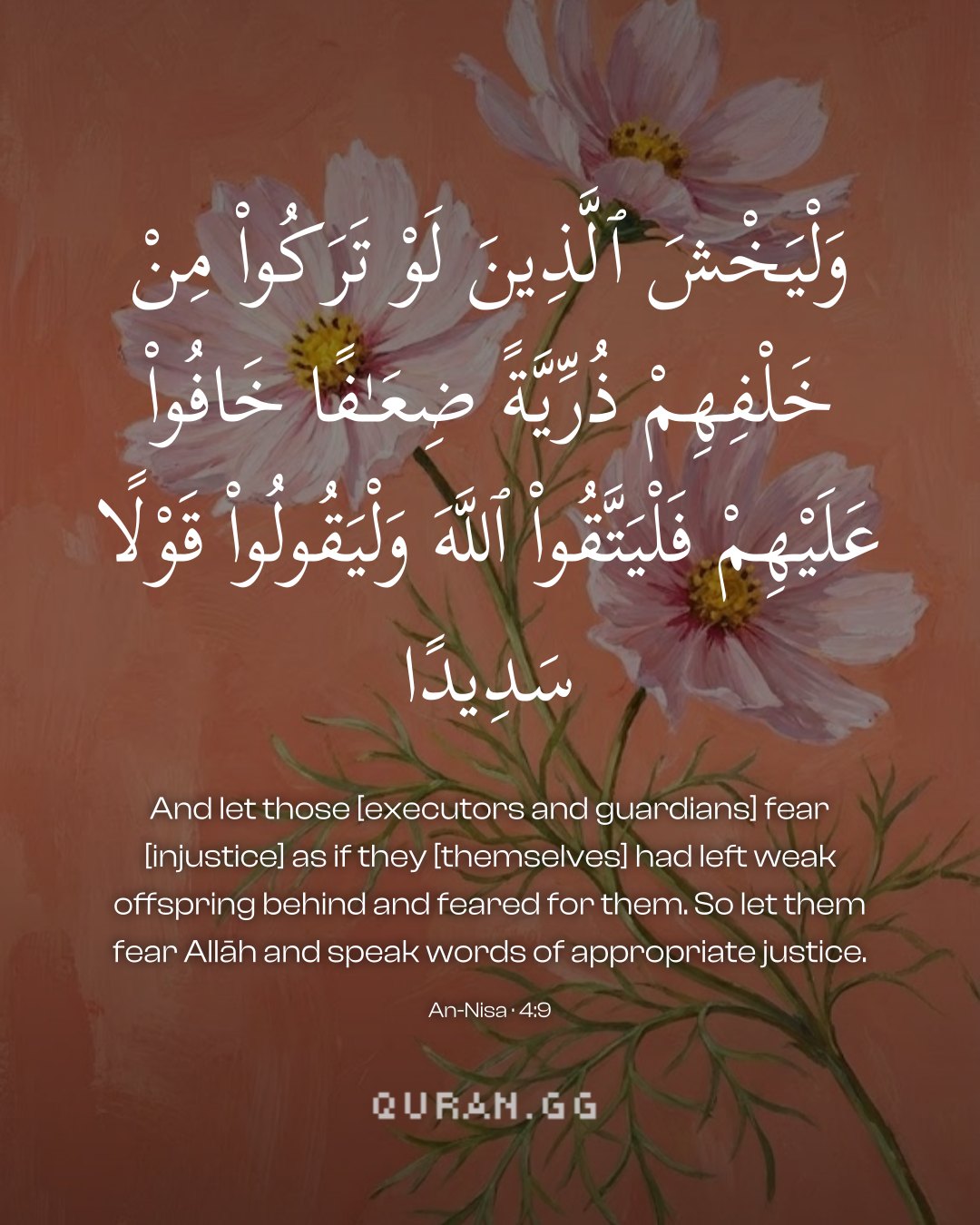
And let those [executors and guardians] fear [injustice] as if they [themselves] had left weak offspring behind and feared for them. So let them fear Allāh and speak words of appropriate justice.
(There is a share for men from what is left by parents and those nearest in relation)." Therefore, everyone is equal in Allah's decision to inherit, even though their shares vary according to the degree of their relationship to the deceased, whether being a relative, spouse, etc. Ibn Marduwyah reported that Jabir said, "Umm Kujjah came to the Messenger of Allah ﷺ and said to him, `O Messenger of Allah! I have two daughters whose father died, and they do not own anything.' So Allah revealed;
The third verse (9) addresses Muslims in general exhorting them to make it certain that the inheritance of the deceased reaches his children fully and fairly. They must abstain from any mode of action which may affect the share of the children adversely. The general sense of the verse covers the eventuality when one sees a Muslim making a will or disposing property off in a manner which could cause damage or loss to his children and other inheritors. If so, one must stop him from such bequeathal or such disposal, very much like what the Holy Prophet ﷺ did when he stopped the blessed Companion, Sayyidna Sa'd ibn Abi Waqqas ؓ ، from giving the whole, or half, of his property in charity (Sadaqah), allowing him to give only one-third of his property as such (Mishkat, Bab al-Wasaya, p. 265), because, 'If the whole, or half of the property was given in charity, the share of the inheritors would have either been all consumed, or curtailed.
Also included in the general sense of the verse is that guardians of the orphaned children should protect their property and give it to them in full when they become mature. They should take pains to accomplish this mission of trust and never let the least negligence on their part affect their duty; if they wish that others treat their children well after them, without causing them any harm or injustice, then, they should treat the children of others - the orphans - in the same manner.
Tazkirul Quran
Maulana Wahiduddin KhanOn ayahs 6–9
Property is meant neither for luxury nor for the manifestation of pride. It is a means of livelihood for man, supporting his existence in the world. As such, it is not proper on the one hand to consider its acquisition one’s goal in life, while on the other, it is extremely important that any wasteful use of property should be checked and earnest efforts be made, when it falls into the wrong hands, to restore it to its rightful owner. Any misappropriation of anyone’s belongings is akin to creating a breach in God’s arrangement of bestowing a livelihood upon His servants. In the case of an orphan, who happens to be the weakest member of society, it becomes even more imperative that his property be well-protected and he be dealt with in fairness and justice. It is also necessary that a justified settlement with orphans should be recorded in writing and witnessed so that the executor’s responsibility may be honourably discharged with no question of future disputes or complaints. Whenever one takes someone’s affairs in hand, he must proceed with the realization that any injustice he may commit is in the knowledge of God. It is possible that the person whose affairs are being settled is weak and cannot deal effectively with unjust treatment, but surely God will catch hold of the arbiter on the Day of Reckoning and punish him severely for any unjustified settlement. This is inevitable and none can escape it.
Uthmani text of the Madinah mushaf (King Fahd Complex). Translation: Saheeh International. Tafsir via Quran.com.