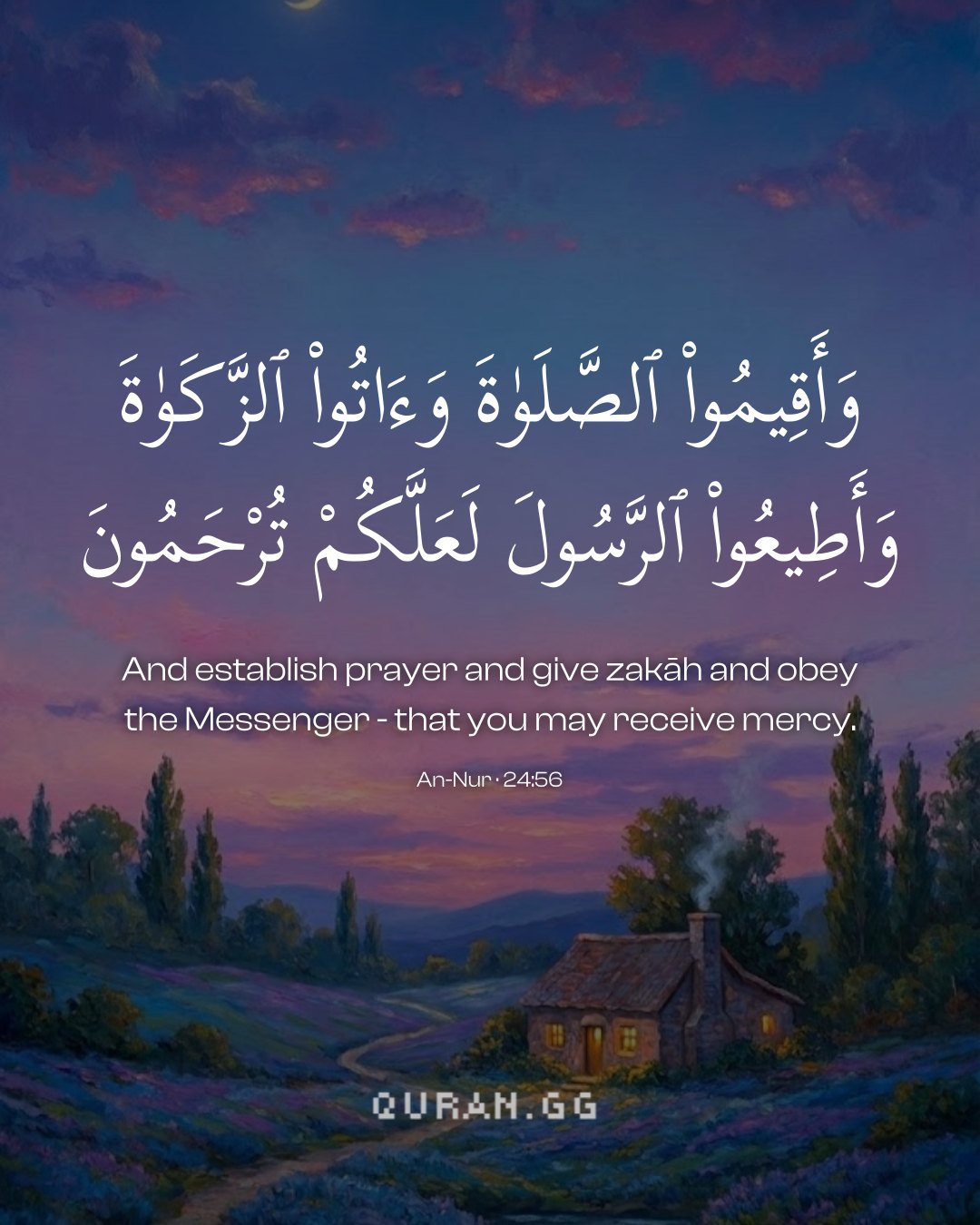
The Command to pray, give the Zakah and obey the Messenger ﷺ; the inability of the Disbelievers to escape, and the ultimate Destiny
Allah commands His believing servants to establish prayer, which means worshipping Allah Alone with no partner or associate; to pay the Zakah, which is an act of kindness towards His poor and weak creatures; and by doing so to obey the Messenger of Allah ﷺ, i.e., to do as he commands them and to avoid what he forbids them, so that Allah will have mercy on them for that. No doubt, whoever does that, Allah will have mercy on him, as Allah says in another Ayah:
أُوْلَـئِكَ سَيَرْحَمُهُمُ اللَّهُ
(Allah will have His mercy on them) 9:71
لاَ تَحْسَبَنَّ
(Consider not) means, `do not think, O Muhammad,' that:
الَّذِينَ كَفَرُواْ
(the disbelievers) meaning, those who opposed and denied you,
مُعْجِزِينَ فِى الاٌّرْضِ
(can escape in the land.) means, that they can flee from Allah. No, Allah is able to deal with them and He will punish them most severely for that. Allah says:
وَمَأْوَاهُمُ
(Their abode) meaning, in the Hereafter,
النَّارُ وَلَبِئْسَ الْمَصِيرُ
(shall be the Fire -- and worst indeed is that destination.) means, how terrible the consequences will be for the disbelievers, how evil a place to stay in and how awful a place to rest!
Commentary
Background of Revelation
Qurtubi has reported on authority of Abul ` Aliyah that the Holy Prophet ﷺ stayed in Makkah for ten years after commencement of revelation and declaration of prophethood, during which time there was a constant fear of the infidels and disbelievers. Then after the Hijrah to Madina also there was a ceaseless danger of attacks from the disbelievers. So, someone asked the Holy Prophet ﷺ "Would a time come to us when we will be able to live in peace without wearing our weaponry?' The Holy Prophet ﷺ replied ` Yes, the time is coming very soon'. On that occasion these verses were revealed. (Qurtubi and Bahr). Sayyidna ` Abdullah Ibn 'Abbas ؓ ، has said that these verses relate the promise of Allah Ta’ ala, which He had made with the Ummah of Muhammad ﷺ before their creation in the Torah and the Injil. (Bahr Muhit)
Continue reading the tafsir of ayahs 55–57 The promise of the grant of a dominant status applied initially to the Prophet Muhammad and his companions, but it also applies to the whole community of the believers. It is observed here that men of faith need not make the possession of power and dominance their target, for these are actually blessings of God, conferred upon deserving believers as a reward for their faith and good deeds. The purpose of granting this dominant status is to provide the believers with stability in this world, so that they may be able to live peacefully and in safety, lead their lives as the subjects of the One God and pray to Him freely, without fearing their enemies. The dominant status of the people of faith shall continue so long as they remain grateful to God and do not lose their fear of God (taqwa). Appointing a successor, khalifah, or ‘one who comes afterwards’, entails the conferring of dominant status and stability on one community in place of the community, which had earlier enjoyed this position. The dominant position is, in fact, a part of the divine trial. God gives this position to all communities, one after another, and thus puts them to the test. For people of faith, this position is a means of judging them.
Uthmani text of the Madinah mushaf (King Fahd Complex). Translation: Saheeh International. Tafsir via Quran.com.