Ibrahim's Emigration, the Test of the Sacrifice of Isma`il, and how Allah blessed Him
Allah tells us that after He helped His close friend Ibrahim, peace be upon him, against his people, and after Ibrahim gave up hoping that they would ever believe despite all the mighty signs that they had witnessed, he emigrated away from them, and said:
(Verily, I am going to my Lord. He will guide me! My Lord! Grant me (offspring) from the righteous.) meaning, obedient children, in compensation for his people and relatives whom he had left. Allah said:
فَبَشَّرْنَـهُ بِغُلَـمٍ حَلِيمٍ
(So We gave him the glad tidings of a forbearing boy.) This child was Isma`il, peace be upon him, for he was the first child of whom glad tidings were given to Ibrahim, peace be upon him, and he was older than Ishaq. The Muslims and the People of the Book agree, and indeed it is stated in their Book, that Isma`il, peace be upon him, was born when Ibrahim, peace be upon him, was eighty-six years old, and Ishaq was born when Ibrahim was ninety-nine years old. According to their Book, Allah commanded Ibrahim to sacrifice his only son, and in another text it says his firstborn son. But here they falsely inserted the name of Ishaq. This is not right because it goes against what their own Scripture says. They inserted the name of Ishaq because he is their ancestor, while Isma`il is the ancestor of the Arabs. They were jealous of them, so they added this idea and changed the meaning of the phrase "only son" to mean `the only son who is with you,' because Isma`il had been taken with his mother to Makkah. But this is a case of falsification and distortion, because the words "only son" cannot be said except in the case of one who has no other son. Furthermore, the firstborn son has a special status that is not shared by subsequent children, so the command to sacrifice him is a more exquisite test.
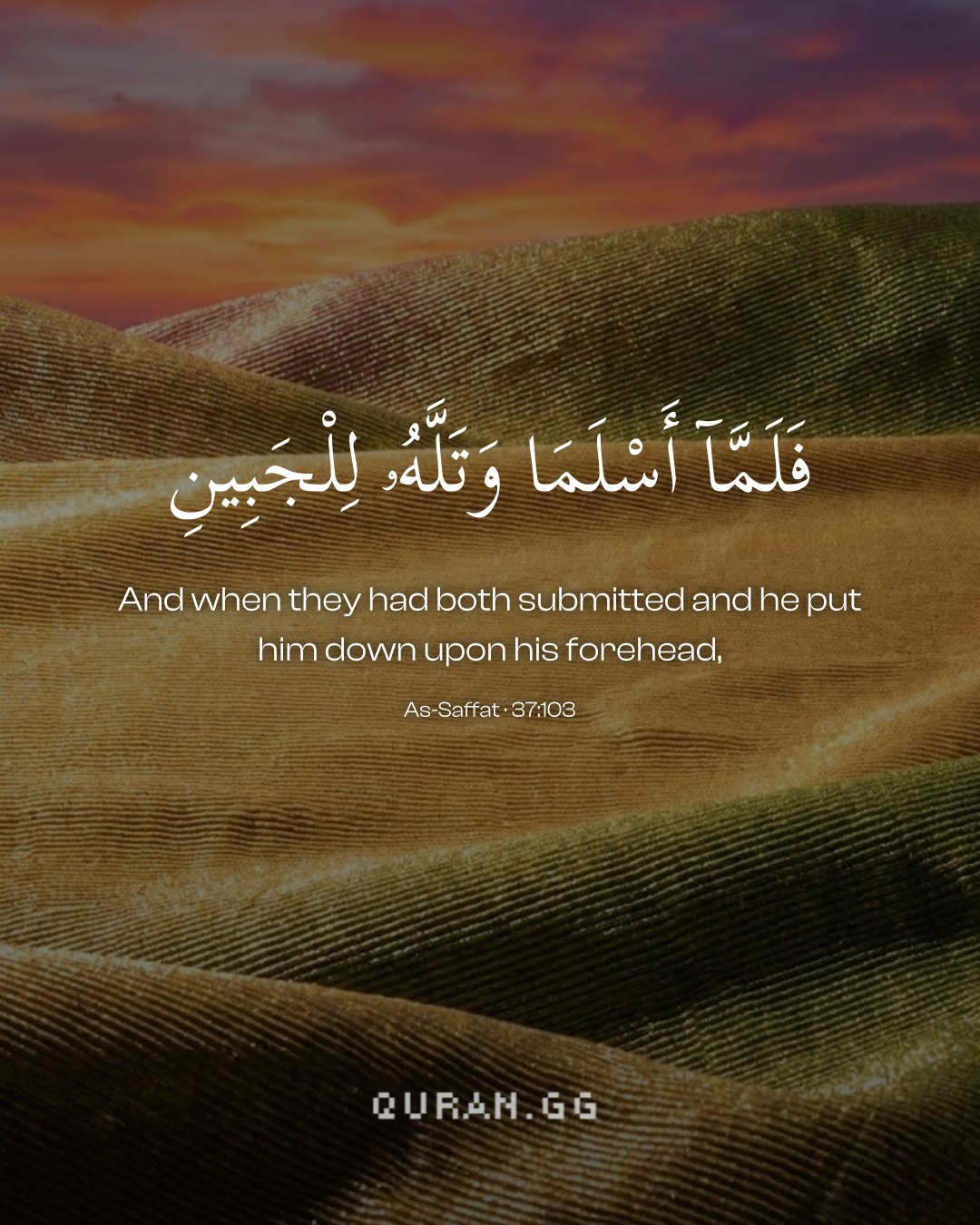
The word: اَسلَمَ (aslama: both of them submitted) in verse 103: فَلَمَّا أَسْلَمَا means to submit, bow down, become obedient, rendered ready to carry out the command. Hence, it releases the sense of having bowed down before the Divine command, that is, in plain words, the father resolved to slaughter the son and the son, to be slaughtered by him. At this place, the word used is: لَمَّا (lamma: when), but its apodosis or the complement of the condition has not been mentioned - in other words, it has not been said later on as to what happened when this thing came to pass. This releases a hint towards the uniqueness of this bold initiative of self-submission undertaken by the father and son - so unique that words just fail to convey a fuller description.
Some historical and exegetical reports tell us that the Shaitan tried to seduce Sayyidna Ibrahim (علیہ السلام) away from it three times and every time Sayyidna Ibrahim (علیہ السلام) pelted seven pebbles on him, and drove him away. Right through up to this day, on the three pillars of Mina, pebbles are thrown to commemorate this very endearing act. Finally, when both father and son reached the place of slaughter to offer this unique act of worship, Sayyidna Ismail (علیہ السلام) said to his father, "My dear father, tie me down well enough so that my body may not toss and turn too much; and also keep your dress protected, lest the drops of my blood spoil it which might reduce my reward with Allah, and moreover, if my mother were to see this blood, she will be virtually smitten with sorrow. And sharpen your knife, and run it fast over my throat, so that my last breath comes easy on me, for death is hard; and when you return to my mother, pay my respects to her and should you wish to take my shirt to her, you are welcome to do so, may be it would give her the comfort she needs." Hearing these words coming from the lips of the only son a father has, who can imagine what would have been going on in his heart. But, here was Sayyidna Ibrahim (علیہ السلام) Like a mountain of fortitude, he says to his son, "Son, what a good helper you are for me in this task assigned by Allah." Saying this, he kissed his son and, with wet eyes, he tied him. (Mazhari)
And then came the stage about which the text says: وَتَلَّهُ لِلْجَبِينِ (and he laid him on his forehead - 103). According to an explanation of this statement as reported from Sayyidna Ibn ` Abbas, 'he laid him down on his side in a manner that one edge of the forehead was touching the ground' (Mazhari). Lexically, this explanation is weightier for the reason that the word: جَبِينِ (jabin) is applied to the two curvatures of the forehead while the middle part of the forehead is called: جَبھَۃُ (jabhah). Therefore, Moulana Thanavi (رح) has translated it carrying the sense of 'laying down on the side.' But, other respected commentators have explained it as 'laid him down on the ground face down.' Whatever be the case, the reason given in historical accounts for this manner of laying him down is that, initially, Sayyidna Ibrahim (علیہ السلام) had laid him down face up. But, once he started moving the knife on his throat, it would not cut despite repeated efforts, because a copper plate had come as a barrier in between by the will of Allah. At that time, the son himself requested his father that he be laid down on the side face down for the reason that once he looked at him, his filial compassion unnerved his hand, and the throat is not cut as required. In addition to that, he said, when he looked at the knife, he too started feeling nervous. So Sayyidna Ibrahim (علیہ السلام) started using his knife in the manner he was told (Tafsir Mazhari). Allah knows best.
Tazkirul Quran
Maulana Wahiduddin KhanOn ayahs 101–112
The people of Abraham’s community were perhaps going out of town to participate in some festival. Members of his household invited him to accompany them, but he managed somehow to excuse himself. When all the people had left, he entered the temple during the night and broke the deities kept there. It is important to note here that Abraham did so after continuous logical persuasion had failed to yield any result. When his people did not realise or accept the falsity of the deities by means of rational pleadings, by breaking the deities Abraham demonstrated that they were just a sham. Had they been genuine deities, they would have saved themselves from being smashed. This infuriated the people of Abraham’s community so much that they decided to kill him and throw him into a fire. But God saved him from it. Thereafter, he left his native place, Mesopotamia (now called Iraq). At that time, he prayed, ‘O, God ! Bless me with a pious and righteous offspring so that, by teaching and training, I may make him a believer and a Muslim who, after me, will continue to perform the mission of preaching the oneness of God.’
Uthmani text of the Madinah mushaf (King Fahd Complex). Translation: Saheeh International. Tafsir via Quran.com.