Surah As-Saffat Ayah 104 (37:104) — Meaning & Tafsir | Quran.GG

Surah As-Saffat, Ayah 104

37:104 · Meaning and tafsir

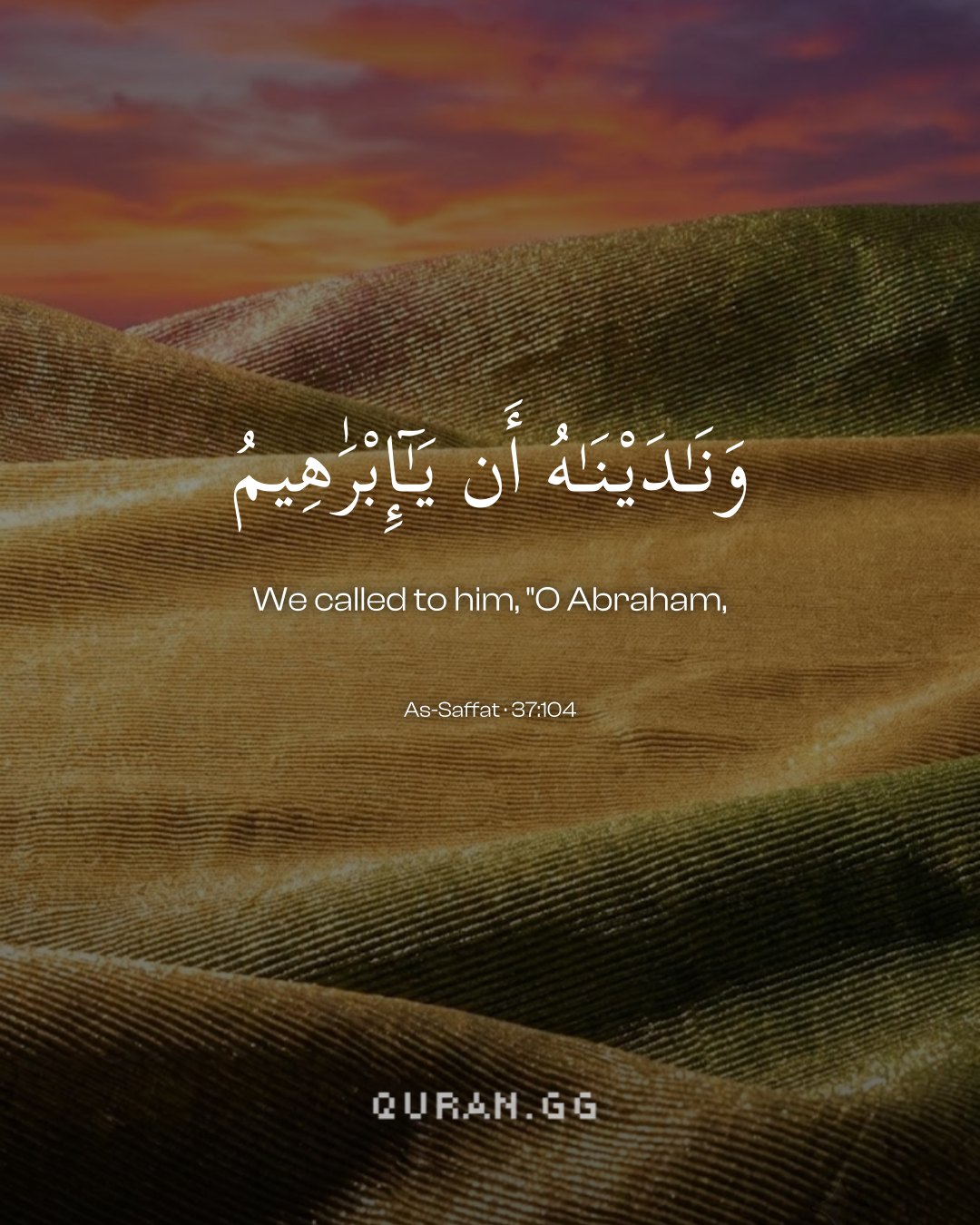
وَنَـٰدَيْنَـٰهُ أَن يَـٰٓإِبْرَٰهِيمُ ١٠٤

We called to him, "O Abraham,

Surah As-Saffat 37:104 in Arabic with its translation: “We called to him, "O Abraham,”

Make something with this ayah

Turn it into a video for Stories, Reels or TikTok, recited by the reciter you pick, or an image on a background you choose. Free, in your browser.

Download this image

Tafsir Ibn Kathir (abridged)

Ibrahim's Emigration, the Test of the Sacrifice of Isma`il, and how Allah blessed Him

Allah tells us that after He helped His close friend Ibrahim, peace be upon him, against his people, and after Ibrahim gave up hoping that they would ever believe despite all the mighty signs that they had witnessed, he emigrated away from them, and said:

وَقَالَ إِنِّى ذَاهِبٌ إِلَى رَبِّى سَيَهْدِينِ - رَبِّ هَبْ لِى مِنَ الصَّـلِحِينِ

(Verily, I am going to my Lord. He will guide me! My Lord! Grant me (offspring) from the righteous.) meaning, obedient children, in compensation for his people and relatives whom he had left. Allah said:

فَبَشَّرْنَـهُ بِغُلَـمٍ حَلِيمٍ

(So We gave him the glad tidings of a forbearing boy.) This child was Isma`il, peace be upon him, for he was the first child of whom glad tidings were given to Ibrahim, peace be upon him, and he was older than Ishaq. The Muslims and the People of the Book agree, and indeed it is stated in their Book, that Isma`il, peace be upon him, was born when Ibrahim, peace be upon him, was eighty-six years old, and Ishaq was born when Ibrahim was ninety-nine years old. According to their Book, Allah commanded Ibrahim to sacrifice his only son, and in another text it says his firstborn son. But here they falsely inserted the name of Ishaq. This is not right because it goes against what their own Scripture says. They inserted the name of Ishaq because he is their ancestor, while Isma`il is the ancestor of the Arabs. They were jealous of them, so they added this idea and changed the meaning of the phrase "only son" to mean `the only son who is with you,' because Isma`il had been taken with his mother to Makkah. But this is a case of falsification and distortion, because the words "only son" cannot be said except in the case of one who has no other son. Furthermore, the firstborn son has a special status that is not shared by subsequent children, so the command to sacrifice him is a more exquisite test.

Continue reading the tafsir of ayahs 99–113

Ma'arif al-Qur'an

In verse 104, 105, it was said: وَنَادَيْنَاهُ أَن يَا إِبْرَ‌اهِيمُ قَدْ صَدَّقْتَ الرُّ‌ؤْيَا (and then We called out to him, "0 Ibrahim, you did make the dream come true." ), that is, in accomplishing the task entrusted with him in obedience to the command of Allah, he left nothing undone, in fact, did it perfectly to the letter (more likely so because in the dream too, it was shown that Sayyidna Ibrahim (علیہ السلام) is simply moving his knife to slaughter his son). Now that test was over, so he should let him go.

Tazkirul Quran

The people of Abraham’s community were perhaps going out of town to participate in some festival. Members of his household invited him to accompany them, but he managed somehow to excuse himself. When all the people had left, he entered the temple during the night and broke the deities kept there. It is important to note here that Abraham did so after continuous logical persuasion had failed to yield any result. When his people did not realise or accept the falsity of the deities by means of rational pleadings, by breaking the deities Abraham demonstrated that they were just a sham. Had they been genuine deities, they would have saved themselves from being smashed. This infuriated the people of Abraham’s community so much that they decided to kill him and throw him into a fire. But God saved him from it. Thereafter, he left his native place, Mesopotamia (now called Iraq). At that time, he prayed, ‘O, God ! Bless me with a pious and righteous offspring so that, by teaching and training, I may make him a believer and a Muslim who, after me, will continue to perform the mission of preaching the oneness of God.’

Uthmani text of the Madinah mushaf (King Fahd Complex). Translation: Saheeh International. Tafsir via Quran.com.