Surah As-Saffat Ayah 75 (37:75) — Meaning & Tafsir | Quran.GG

Surah As-Saffat, Ayah 75

37:75 · Meaning and tafsir

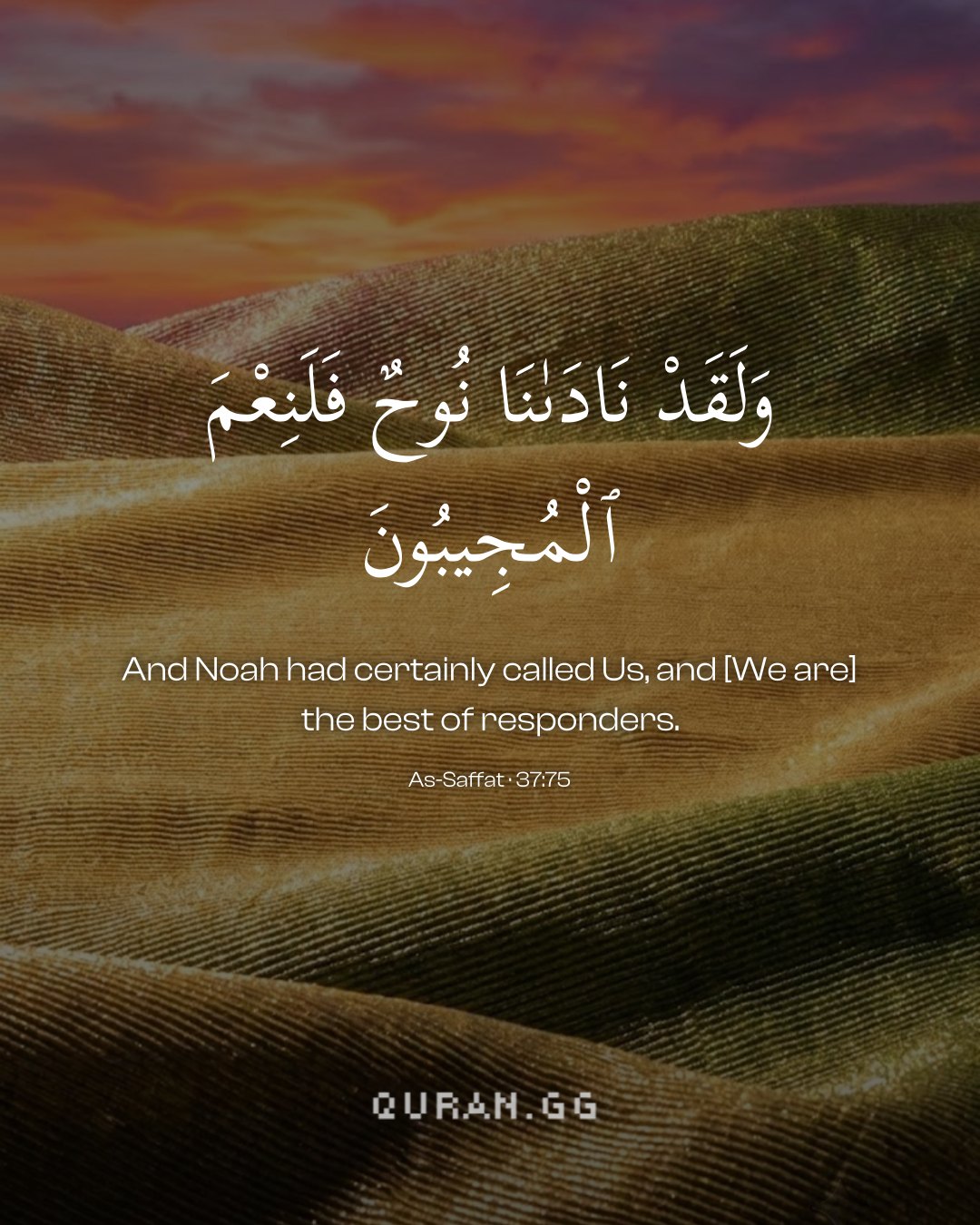
وَلَقَدْ نَادَىٰنَا نُوحٌ فَلَنِعْمَ ٱلْمُجِيبُونَ ٧٥

And Noah had certainly called Us, and [We are] the best of responders.

Surah As-Saffat 37:75 in Arabic with its translation: “And Noah had certainly called Us, and [We are] the best of responders.”

Make something with this ayah

Turn it into a video for Stories, Reels or TikTok, recited by the reciter you pick, or an image on a background you choose. Free, in your browser.

Download this image

Tafsir Ibn Kathir (abridged)

Nuh and His People

When Allah tells us about how most of the early people went astray from the path of salvation, He starts the detailed explanation of that with the story of Nuh and the rejection of his people. Only a few of Nuh's people believed in him, despite the long period of time he spent among them. He stayed among them for one thousand years less fifty, and after he stayed among them for so long and their disbelief became too much for him to bear -- for every time he called them, they turned away from him even more -- he prayed to his Lord saying, "I have been overcome, so help (me)!" So Allah became angry because Nuh was angry with them. He says:

وَلَقَدْ نَادَانَا نُوحٌ فَلَنِعْمَ الْمُجِيبُونَ

(And indeed Nuh invoked Us, and We are the best of those who answer.)

وَنَجَّيْنَـهُ وَأَهْلَهُ مِنَ الْكَرْبِ الْعَظِيمِ

(And We rescued him and his family from the great distress.) means, their disbelief and their insults.

وَجَعَلْنَا ذُرِّيَّتَهُ هُمُ الْبَـقِينَ

(And, his progeny, them We made the survivors.) `Ali bin Abi Talhah reported that Ibn `Abbas, may Allah be pleased with him, "There was no one left apart from the offspring of Nuh, peace be upon him." Sa`id bin Abi `Arubah said, narrating from Qatadah concerning the Ayah,

وَجَعَلْنَا ذُرِّيَّتَهُ هُمُ الْبَـقِينَ

(And, his progeny, them We made the survivors.) "All people descended from the offspring of Nuh, peace be upon him." At-Tirmidhi, Ibn Jarir and Ibn Abi Hatim narrated from Samurah, may Allah be pleased with him, that the Prophet said, concerning the Ayah,

وَجَعَلْنَا ذُرِّيَّتَهُ هُمُ الْبَـقِينَ

(And, his progeny, them We made the survivors):

«سَامُ، وَحَامُ، وَيَافِث»

(Sam, Ham and Yafith.) Imam Ahmad recorded from Samurah, may Allah be pleased with him, that the Messenger of Allah ﷺ said:

«سَامُ أَبُو الْعَرَبِ، وَحَامُ أَبُو الْحَبَشِ، وَيَافِثُ أَبُو الرُّوم»

(Sam was the father of the Arabs, Ham was the father of the Ethiopians and Yafith was the father of the Romans.)" This was also recorded by At-Tirmidhi. What is meant here by Romans is the original Romans, i.e., the Greeks who claimed descent from Ruma (Roma) the son of Liti, the son of Yunan, the son of Yafith, the son of Nuh, peace be upon him.

وَتَرَكْنَا عَلَيْهِ فِى الاٌّخِرِينَ

(And left for him among the later generations. ) Ibn `Abbas, may Allah be pleased with him, said, "He is remembered in a good way." Mujahid said this means "An honorable mention by all the Prophets." Qatadah and As-Suddi said, "Allah caused him to be praised constantly by others." Ad-Dahhak said it means "Salam and praise."

سَلَـمٌ عَلَى نُوحٍ فِى الْعَـلَمِينَ

(Salam (peace!) be upon Nuh among the all creatures!) This explains for us the extent of the honorable mention and praise, for he is greeted with peace by all groups and nations.

إِنَّا كَذَلِكَ نَجْزِى الْمُحْسِنِينَ

(Verily, thus We reward the gooddoers.) means, `This is how We reward those of Our servants who do deeds of obedience to Allah. We gave him an honorable mention so that after he died he is still remembered in a manner that befits his status.' Then Allah says:

إِنَّهُ مِنْ عِبَادِنَا الْمُؤْمِنِينَ

(Verily, he Nuh was one of Our believing servants.) meaning, one of the sincere believers in the Oneness of Allah, one of those who had certain faith.

ثُمَّ أَغْرَقْنَا الاٌّخَرِينَ

(Then We drowned the others. ) means, `We destroyed them, and there was no trace whatsoever left of them, and they are only known by this unfavorable description.'

Ma'arif al-Qur'an

Commentary

In the previous verses, it was said that Allah had sent messengers to warn the earlier communities as well, but most of the people did not listen to them, therefore, they met a very sad end. Now, from here details of that brief statement made earlier are being given. As a corollary, events relating to several noble prophets have been narrated. Mentioned first in these verses was Sayyidna Nuh (علیہ السلام) . The event relating to Sayyidna Nuh (علیہ السلام) has appeared in Surah Hud (11) with sufficient details. A few things connected with the explanation of these very verses particularly are being taken up here.

In verse 75, it was said: وَلَقَدْ نَادَانَا نُوحٌ (And Nuh did call Us). According to most commentators, it means either the prayer of Sayyidna Nuh (علیہ السلام) mentioned in Surah Nuh: رَّ‌بِّ لَا تَذَرْ‌ عَلَى الْأَرْ‌ضِ مِنَ الْكَافِرِ‌ينَ دَيَّارً‌ا (My Lord, do not leave on earth even a single inhabitant (surviving) from the disbelievers - 71:26), or that which appears in Surah Al-Qamar: أَنِّي مَغْلُوبٌ فَانتَصِرْ‌ (I am overpowered, so defend me - 54:10). Sayyidna Nuh , 41 had made this prayer at a time when his people had crossed all limits in being wicked and unruly to him and had gone as far as conspiring to kill him.

Tazkirul Quran

It is stated in the Quran that there will be a Zaqqum tree in hell and that its fruits will be eaten by the inmates of hell when they are overwhelmed by hunger. (See 56: 52). When this revelation was made in the Quran, the people of ancient Arabia started mocking it. One of the chiefs said, ‘How can a tree grow amidst the fire of hell?’ Another chief said, ‘Muhammad is terrifying us by talking of Zaqqum, when the fact is that dates and butter are called Zaqqum, in the Berber language.’ Abu Jahl took some people home and asked his maidservant to bring some dates and butter and when they were brought, he said to his companions, ‘Eat this. This is the Zaqqum with which you are being threatened by Muhammad.’ (Tafsir al-Mazhari). Such Quranic statements were misused by unbelievers to demonstrate the untrustworthiness of the Quran. God might well have refrained from using such a word as would give unbelievers the opportunity to raise unnecessary issues, but He did not do so. The reason is that this creates the very situation in which a man is meant to be tried. In order to achieve salvation, he has to prove that by avoiding unnecessary issues he has given his full attention to the truth; that, by carefully avoiding misunderstandings, he has managed to discover the real purpose of the argument; that he has concentrated entirely on facts, although there were many opportunities for his mind to be diverted from them. God’s selected few are those who rise above traditional religion and discover the real Truth; who rise above outward appearances and realise the real meaning of occurrences; who recognise God’s representative and become his supporters.

Continue reading the tafsir of ayahs 74–81

Uthmani text of the Madinah mushaf (King Fahd Complex). Translation: Saheeh International. Tafsir via Quran.com.