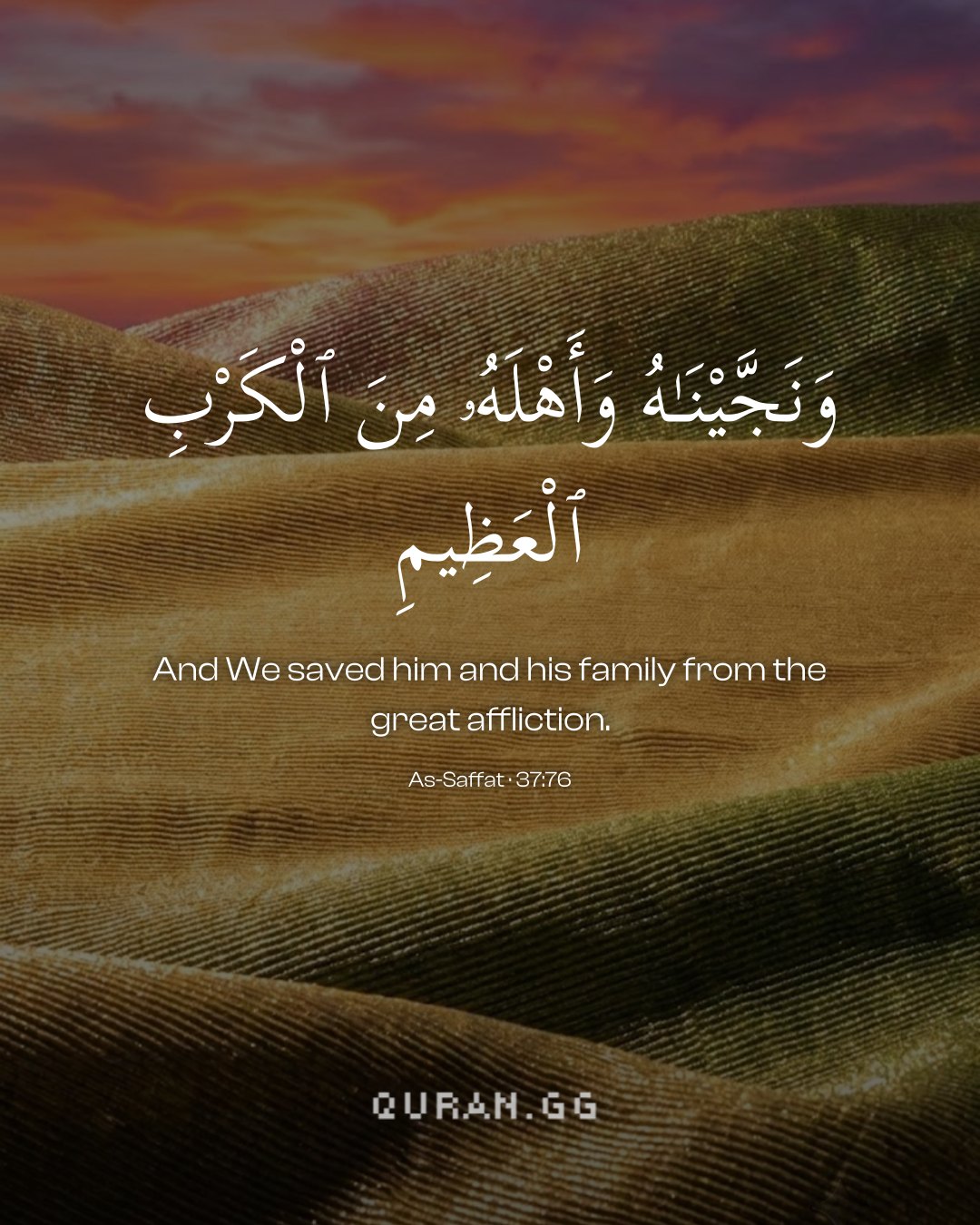
When Allah tells us about how most of the early people went astray from the path of salvation, He starts the detailed explanation of that with the story of Nuh and the rejection of his people. Only a few of Nuh's people believed in him, despite the long period of time he spent among them. He stayed among them for one thousand years less fifty, and after he stayed among them for so long and their disbelief became too much for him to bear -- for every time he called them, they turned away from him even more -- he prayed to his Lord saying, "I have been overcome, so help (me)!" So Allah became angry because Nuh was angry with them. He says:
In the previous verses, it was said that Allah had sent messengers to warn the earlier communities as well, but most of the people did not listen to them, therefore, they met a very sad end. Now, from here details of that brief statement made earlier are being given. As a corollary, events relating to several noble prophets have been narrated. Mentioned first in these verses was Sayyidna Nuh (علیہ السلام) . The event relating to Sayyidna Nuh (علیہ السلام) has appeared in Surah Hud (11) with sufficient details. A few things connected with the explanation of these very verses particularly are being taken up here.
In verse 75, it was said: وَلَقَدْ نَادَانَا نُوحٌ (And Nuh did call Us). According to most commentators, it means either the prayer of Sayyidna Nuh (علیہ السلام) mentioned in Surah Nuh: رَّبِّ لَا تَذَرْ عَلَى الْأَرْضِ مِنَ الْكَافِرِينَ دَيَّارًا (My Lord, do not leave on earth even a single inhabitant (surviving) from the disbelievers - 71:26), or that which appears in Surah Al-Qamar: أَنِّي مَغْلُوبٌ فَانتَصِرْ (I am overpowered, so defend me - 54:10). Sayyidna Nuh , 41 had made this prayer at a time when his people had crossed all limits in being wicked and unruly to him and had gone as far as conspiring to kill him.
Tazkirul Quran
Maulana Wahiduddin KhanOn ayahs 74–81
It is stated in the Quran that there will be a Zaqqum tree in hell and that its fruits will be eaten by the inmates of hell when they are overwhelmed by hunger. (See 56: 52). When this revelation was made in the Quran, the people of ancient Arabia started mocking it. One of the chiefs said, ‘How can a tree grow amidst the fire of hell?’ Another chief said, ‘Muhammad is terrifying us by talking of Zaqqum, when the fact is that dates and butter are called Zaqqum, in the Berber language.’ Abu Jahl took some people home and asked his maidservant to bring some dates and butter and when they were brought, he said to his companions, ‘Eat this. This is the Zaqqum with which you are being threatened by Muhammad.’ (Tafsir al-Mazhari). Such Quranic statements were misused by unbelievers to demonstrate the untrustworthiness of the Quran. God might well have refrained from using such a word as would give unbelievers the opportunity to raise unnecessary issues, but He did not do so. The reason is that this creates the very situation in which a man is meant to be tried. In order to achieve salvation, he has to prove that by avoiding unnecessary issues he has given his full attention to the truth; that, by carefully avoiding misunderstandings, he has managed to discover the real purpose of the argument; that he has concentrated entirely on facts, although there were many opportunities for his mind to be diverted from them. God’s selected few are those who rise above traditional religion and discover the real Truth; who rise above outward appearances and realise the real meaning of occurrences; who recognise God’s representative and become his supporters.