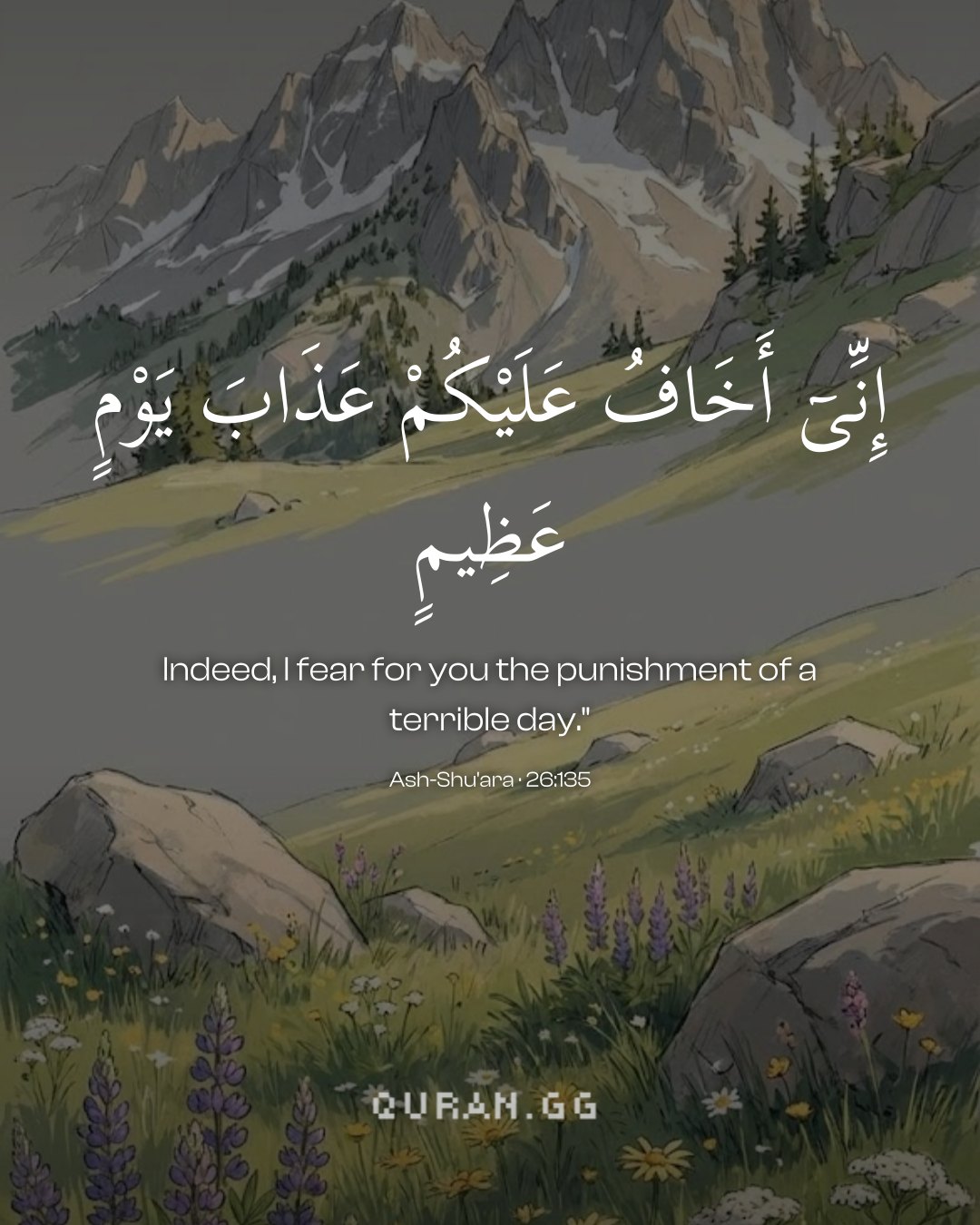
Here Allah tells us about His servant and Messenger Hud, when he called his people `Ad. His people used to live in the Ahqaf, curved sand-hills near Hadramawt, on the borders of Yemen. They lived after the time of Nuh, as Allah says in Surat Al-A`raf:
(And remember that He made you successors after the people of Nuh and increased you amply in stature) (7:69). This refers to the fact that they were physically strong and well-built, and very violent, and very tall; they had also been given a great deal of provisions, wealth, gardens, rivers, sons, crops and fruits. Yet despite all of that, they worshipped others besides Allah. So Allah sent Hud, one of their own, as a Messenger bringing them good news and delivering warnings. He called them to worship Allah alone, and he warned them of Allah's wrath and punishment if they were to go against him and treating him harshly. He said to them, as Nuh had said to his people:
Do you erect on every height a sign having no sound purpose, [ 128] and take the objects of architecture as if you are going to live forever, (26:128-129)
Ibn Jarir (رح) has related from Mujahid (رح) that the passage between two hills is called Ri (ریع). But Sayyidna Ibn ` Abbas ؓ and majority have taken the meaning of Ri (ریع) as a high place, and its derivative is ri`-un-na bat' (ریع البنات), which means growing and climbing vegetation. Literal meaning of 'Ayah (آیۃ) is symbol or sign, but here it means a high palace. تَعْبَثُونَ is derived from ` abath (عَبَث), which is something of no value and benefit neither in reality nor by implication. So, the meaning of the verse is that they used to make very high palaces of no benefit and which they did not need. It was just to fulfill their ego and pride. masani' (مَصَانِع) is the plural of Masna` (مَصنَع). Sayyidna Qatadah has taken masani' (مَصَانِع) for the water tank, whereas Hadrat Mujahid (رح) take it to mean strong palace.
The ‘Ad was a community which rose to prominence after Noah’s people were destroyed (see 7:69). Almighty God blessed this community with everything—health, prosperity, power, etc. Had they been grateful for these blessings, they would have developed a feeling of humility. But, instead, they became proud, thinking that the best use of their resources was to upgrade their standard of living and to elevate their name. They considered the erecting of stone icons their greatest task. If such people have any difference with or complaint against anyone, their pride makes them go beyond all limits. They consider any injustice perpetrated against one who is the object of their disapproval to be legitimate and proper. They simply want to crush him with all their might. Prosperity in the world makes them fearless of retribution in the Hereafter. Those who consider themselves safe from the ultimate reckoning can go to any extent to harm others. People who enjoy prosperity and dominance develop a high degree of false self-confidence. This false confidence prevents them from understanding the Truth when presented to them by people who do not belong to their group. They do not give importance to the advice of the admonisher, who may be most trustworthy, and even though he be God’s messenger. Such people accept the Truth only when they confront God’s punishment, but such acceptance will be of no avail.
Uthmani text of the Madinah mushaf (King Fahd Complex). Translation: Saheeh International. Tafsir via Quran.com.