The Response of Shu`ayb's People, Their Disbelief in Him and the coming of the Punishment upon Them
Allah tells us how his people responded, and how it was like the response of Thamud to their Messenger -- for they were of like mind -- when they said:
إِنَّمَآ أَنتَ مِنَ الْمُسَحَّرِينَ
(You are only one of those bewitched!) meaning, `you are one of those who are affected by witchcraft.'
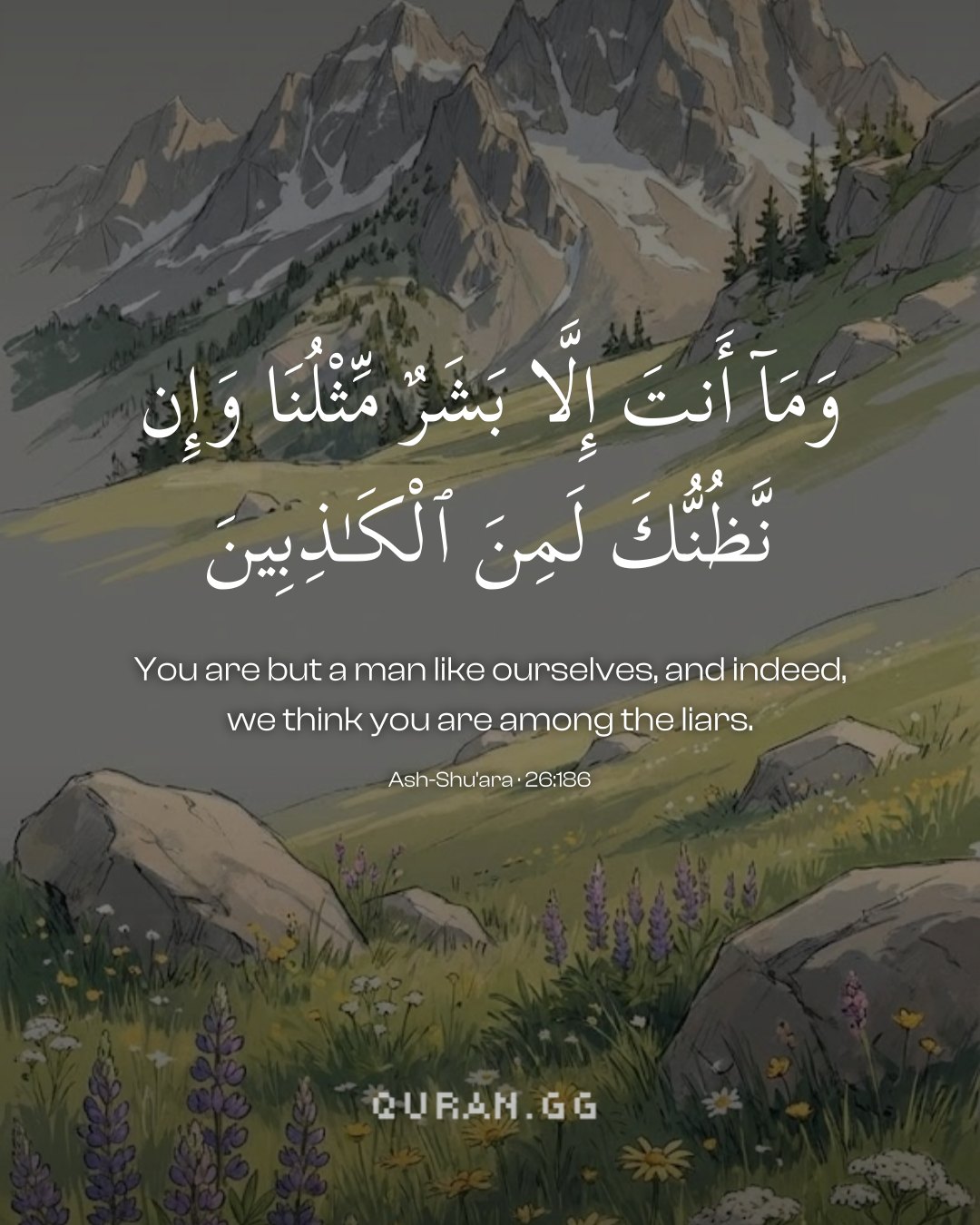
(You are but a human being like us and verily, we think that you are one of the liars!) means, `we think you are deliberately lying to us in what you say, and Allah has not sent you to us.'
فَأَسْقِطْ عَلَيْنَا كِسَفاً مِّنَ السَّمَآءِ
(So cause a piece of the heaven to fall on us,) Ad-Dahhak said: "One side of the heavens." Qatadah said: "A piece of the heaven." As-Suddi said: "A punishment from heaven." This is like what the Quraysh said, as Allah tells us:
And do not make people short of their things - 26:183
What it means is that it is unlawful to reduce any quantity or amount from that which has been contracted with anyone, whether it is a measurable thing or otherwise. Therefore, if a servant or a laborer does not work his full time at his workplace, he too is included in this warning. Imam Malik (رح) has reported a narration in his Muwatta' that Sayyidna ` Umar ؓ noticed that someone did not join in the ` Asr prayer. So, he enquired about the reason for that, to which he offered some excuse. Then Sayyidna ` Umar ؓ said, طَفَّفتَ ` You have reduced in measuring'. As prayer is not something to be measured, hence after quoting this hadith Imam Malik (رح) has said that this command is not restricted to measurable things. Rather, performing any obligation less than due is included in prohibition highlighted in this verse and in Surah "At-tatfif 84".
Tazkirul Quran
Maulana Wahiduddin KhanOn ayahs 184–190
Shu‘ayb’s community was the progeny of Abraham. The central city of the area which they inhabited was Tabuk. The old name of Tabuk was Ayka, which literally means ‘the forest.’ That is why, in the Quran, it is called Ashab al-Ayka (the dwellers of the forest). The root cause of all moral and social evils is setting double standards. Just conduct for a man is to give others their rightful due, and take for himself what rightfully belongs to him. This is the Divine ‘balance’. When this is upset, disturbance occurs in collective social life. The secret of maintaining this balance is the fear of God. If the fear of God goes out of the heart, nothing can make a man keep his moral equilibrium. All the prophets who had appeared on behalf of God had told their addressee communities: ‘I am a trustworthy Messenger to you.’ This shows that a preacher should necessarily have the quality of trustworthiness. One aspect of this trustworthiness is that he should not raise any material or economic issue with his addressee community, so that there should never be any doubt about the selflessness of his purpose. This trustworthiness is so important that it should be fostered at any cost, even if the preacher of truth has, voluntarily, to forego his material rights for its sake.
Uthmani text of the Madinah mushaf (King Fahd Complex). Translation: Saheeh International. Tafsir via Quran.com.