Surah At-Tawbah Ayah 105 (9:105) — Meaning & Tafsir | Quran.GG

Surah At-Tawbah, Ayah 105

9:105 · Meaning and tafsir

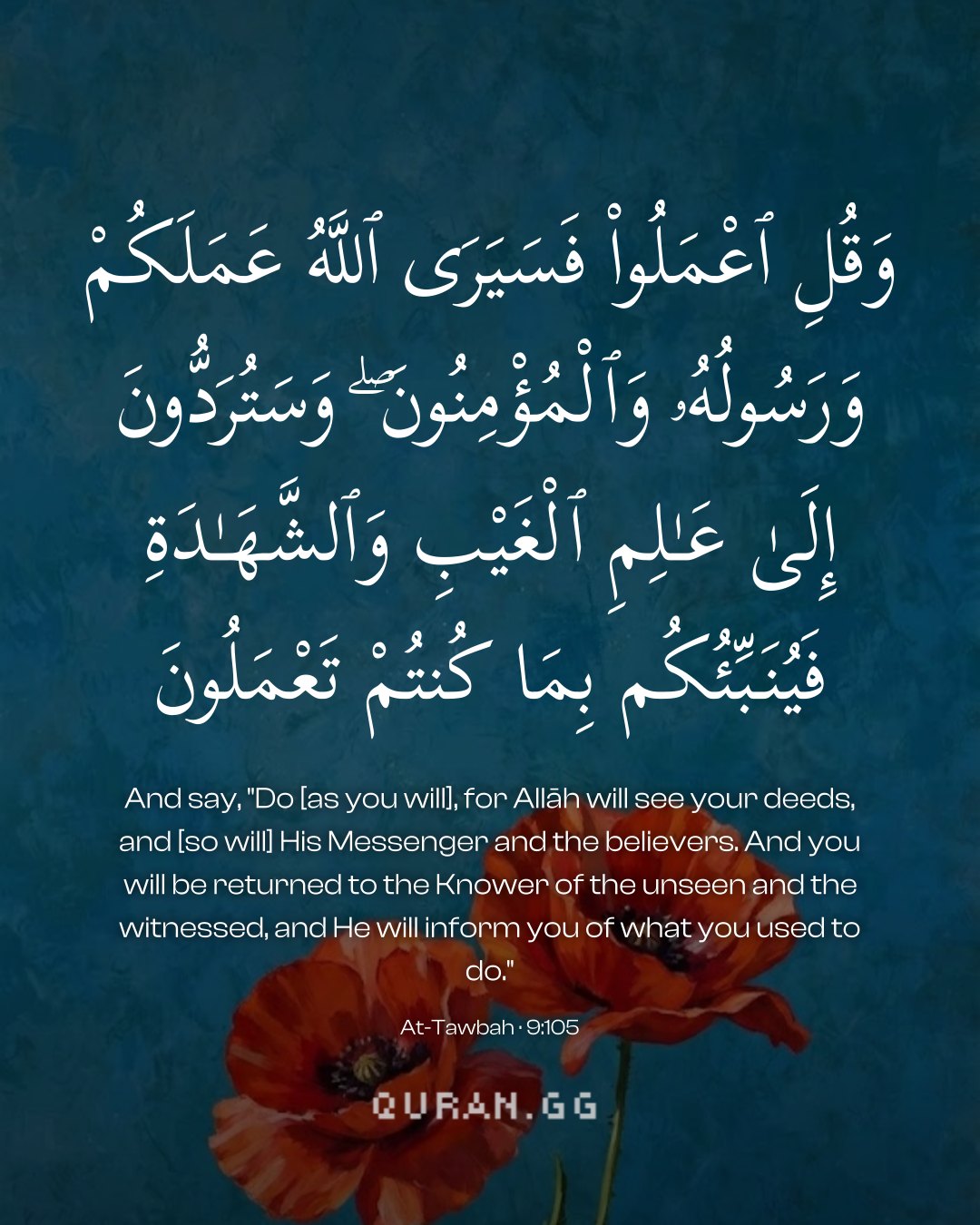
وَقُلِ ٱعْمَلُوا۟ فَسَيَرَى ٱللَّهُ عَمَلَكُمْ وَرَسُولُهُۥ وَٱلْمُؤْمِنُونَ ۖ وَسَتُرَدُّونَ إِلَىٰ عَـٰلِمِ ٱلْغَيْبِ وَٱلشَّهَـٰدَةِ فَيُنَبِّئُكُم بِمَا كُنتُمْ تَعْمَلُونَ ١٠٥

And say, "Do [as you will], for Allāh will see your deeds, and [so will] His Messenger and the believers. And you will be returned to the Knower of the unseen and the witnessed, and He will inform you of what you used to do."

Surah At-Tawbah 9:105 in Arabic with its translation: “And say, "Do [as you will], for Allāh will see your deeds, and [so will] His Messenger and the believers. And…”

Make something with this ayah

Turn it into a video for Stories, Reels or TikTok, recited by the reciter you pick, or an image on a background you choose. Free, in your browser.

Download this image

Tafsir Ibn Kathir (abridged)

Warning the Disobedient

Mujahid said that this Ayah carries a warning from Allah to those who defy His orders. Their deeds will be shown to Allah, Blessed and Most Honored, and to the Messenger and the believers. This will certainly occur on the Day of Resurrection, just as Allah said,

يَوْمَئِذٍ تُعْرَضُونَ لاَ تَخْفَى مِنكُمْ خَافِيَةٌ

(That Day shall you be brought to Judgement, not a secret of you will be hidden.) 69:18,

يَوْمَ تُبْلَى السَّرَآئِرُ

(The Day when all the secrets will be examined.)86:9, and,

وَحُصِّلَ مَا فِى الصُّدُورِ

(And that which is in the breasts (of men) shall be made known.)100:10 Allah might also expose some deeds to the people in this life. Al-Bukhari said that `Aishah said, "If the good deeds of a Muslim person please you, then say,

اعْمَلُواْ فَسَيَرَى اللَّهُ عَمَلَكُمْ وَرَسُولُهُ وَالْمُؤْمِنُونَ

(Do deeds! Allah will see your deeds, and (so will) His Messenger and the believers.)" There is a Hadith that carries a similar meaning. Imam Ahmad recorded that Anas said that the Messenger of Allah ﷺ said,

«لَا عَلَيْكُمْ أَنْ تُعْجَبُوا بِأَحَدٍ حَتَّى تَنْظُرُوا بِمَ يُخْتَمُ لَهُ،فَإِنَّ الْعَامِلَ يَعْمَلُ زَمَانًا مِنْ عُمْرِهِ أَوْ بَــرهَةً مِنْ دَهْرِهِ . بِعَمَلٍ صَالِحٍ لَوْ مَاتَ عَلَيْهِ دَخَلَ الْجَنَّةَ ثُمَّ يَتَحَوَّلُ فَيَعْمَلُ عَمَلًا سَيِّئًا، وَإِنَّ الْعَبْدَ لَيَعْمَلُ الْبُرْهَةَ مِنْ دَهْرِهِ بِعَمَلٍ سَيِّءٍ، لَوْ مَاتَ عَلَيْهِ دَخَلَ النَّارَ ثُمَّ يَتَحَوَّلُ فَيَعْمَلُ عَمَلًا صَالِحًا، وَإِذَا أَرَادَ اللهُ بِعَبْدِهِ خَيْرًا اسْتَعْمَلَهُ قَبْلَ مَوْتِه»

(Do not be pleased with someone's deeds until you see what his deeds in the end will be like. Verily, one might work for some time of his life with good deeds, so that if he dies while doing it, he will enter Paradise. However, he changes and commits evil deeds. one might commit evil deeds for some time in his life, so that if he dies while doing them he will enter the Fire. However, he changes and performs good deeds. If Allah wants the good of a servant He employs him before he dies.) He was asked, "How would Allah employ him, O Allah's Messenger" He said,

«يُوَفِّقُهُ لِعَمِلٍ صَالِحٍ ثُمَّ يَقْبِضُهُ عَلَيْه»

(He directs him to perform good deeds and takes his life in that condition.) Only Imam Ahmad collected this Hadith.

Ma'arif al-Qur'an

The imperative: خُذْ مِنْ أَمْوَالِهِمْ صَدَقَةً : "Take out of their wealth a Sadaqah (obligatory alms) " in the second verse (103) has its background. Some people, as mentioned a little earlier, had stayed back from the battle of Tabuk without a valid excuse. Then, out of remorse, they had tied themselves to the pillars of the Mosque. Then came the acceptance of their repentance as revealed in the previous verse (102) and. they were released from their self-imprisonment. When this happened, they presented their entire wealth as a token of their gratitude so that it could be given out as Sadaqah. The Holy Prophet ﷺ refused to accept it by saying that he did not have the authority to take it. There-upon, this verse (103): خُذْ مِنْ أَمْوَالِهِمْ صَدَقَةً. (Take out of their wealth a Sadaqah) was revealed and he accepted to take one third of it as Sadaqah. He did not take the entire wealth, rather, took a part of it - as indicated in the verse. The preposition, مِن (min: out of) proves it.

Continue reading the tafsir of ayahs 103–105

Tazkirul Quran

The proof of sincere repentance is a greater urge to serve the cause of religion. To absolve themselves of sin, they offered a part of their cherished property for the cause of God. On seeing such a positive response from them, the Prophet was asked not to reproach them but rather to give them psychological support, pray for them so that the burden (of guilt) in their hearts was lightened and their confidence in their faith restored. Doing wrong is not the real evil in the eyes of God; persistence in that wrong is the real evil. One who begins to justify his wrongs ruins himself, while one who admits his mistakes and tries his best to atone for them with good deeds is worthy of being pardoned by God.

Uthmani text of the Madinah mushaf (King Fahd Complex). Translation: Saheeh International. Tafsir via Quran.com.