Tafsir Ibn Kathir (abridged)
Ismail ibn Kathir
Delaying the Decision about the Three Companions Who stayed away from the Battle of Tabuk
Ibn `Abbas, Mujahid, `Ikrimah, Ad-Dahhak and several others said that those mentioned in the Ayah are the three who were made to wait to know if their repentance was accepted; Mararah bin Ar-Rabi`, Ka`b bin Malik and Hilal bin Umayyah. Some Companions stayed behind from the battle of Tabuk due to laziness, preferring comfort, ease, ripe fruits and shade. They did not lag behind because of hypocrisy or doubts. Some of them tied themselves to the pillars (of the Masjid) like Abu Lubabah and several of his friends did. Some of them did not do that, and they are the three mentioned here. Those who tied themselves received their pardon before these three men whose pardon was delayed, until this Ayah was revealed,
لَقَدْ تَابَ الله عَلَى النَّبِىِّ وَالْمُهَـجِرِينَ وَالاٌّنصَـرِ
(Allah has forgiven the Prophet, the Muhajirin and the Ansar...)
وَعَلَى الثَّلَـثَةِ الَّذِينَ خُلِّفُواْ حَتَّى إِذَا ضَاقَتْ عَلَيْهِمُ الأَرْضُ بِمَا رَحُبَتْ
(And the three who stayed behind, until for them the earth, vast as it is, was straitened...) We will mention the Hadith about this story from Ka`b bin Malik. Allah said,
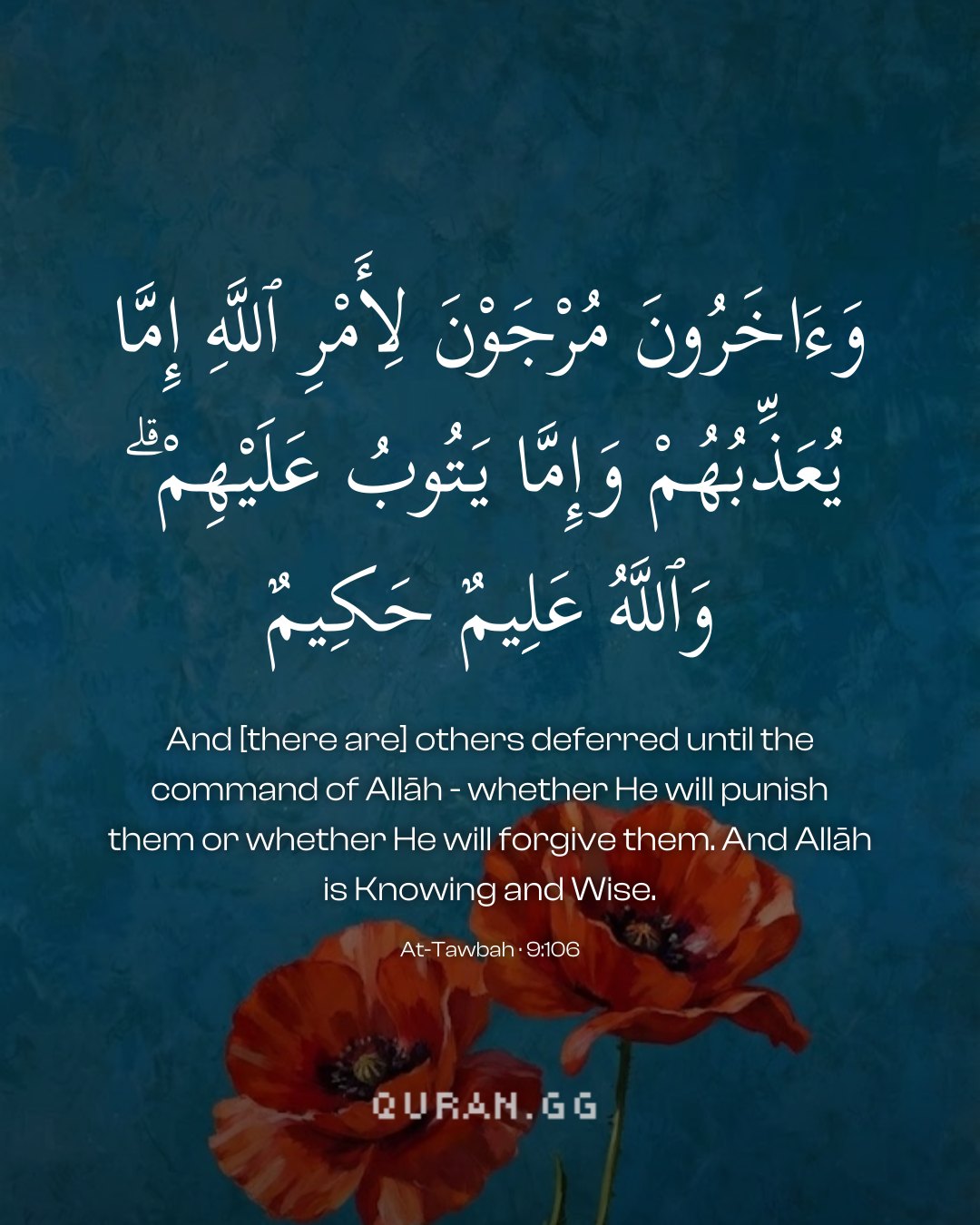
إِمَّا يُعَذِّبُهُمْ وَإِمَّا يَتُوبُ عَلَيْهِمْ
(whether He will punish them or will forgive them. ) meaning, they are at Allah's mercy, if He wills, He pardons them or punishes them. However, Allah's mercy comes before His anger,
وَاللَّهُ عَلِيمٌ حَكِيمٌ
(And Allah is All-Knowing, All-Wise.) 9:106 Allah knows those who deserve the punishment and those who deserve the pardon. He is All-Wise in His actions and statements, there is no deity worthy of worship nor Lord besides Him.
Ma'arif al-Qur'an
Mufti Muhammad Shafi
Let us now turn to the statement: وَآخَرُونَ مُرْجَوْنَ لِأَمْرِ اللَّـهِ (And there are others whose matter is deferred till the command of Allah - 106). We already know that seven of the ten believers, who had missed the battle of Tabuk without a valid excuse, had demonstrated their heartfelt remorse by tying themselves up to the pillars of the Prophet's Mosque. The injunction which covers them appeared in the first verse (102): آخَرُونَ اعْتَرَفُوا (And there are others who admitted their sins). Verse 106 is now referring to the other three gentlemen who had not done what the group of seven had done in the Masjid. Thus, they had not admitted their misconduct openly. In their case, the Holy Prophet ﷺ ordered his Companions ؓ to see that Muslims boycott them by not talking to them. When things reached those limits, they learnt their lesson, confessed to their misconduct and repented sincerely, following which orders were given for their pardon. (Sahib a1-Bukhari and Muslim)
After committing a wrong, the individual has two options: either to admit his mistake or shamelessly persist. One who admits his mistakes becomes increasingly modest and once again he becomes entitled to God’s grace and blessings. On the contrary, one who is emboldened by his persistence in his sinful ways invites the wrath of God. In order to prove that the path he has opted for is the right path, he invents false arguments in self-defence. In this way his attempt to falsely justify one mistake will lead him on to making more and more mistakes. This is why God’s grace awaits the former type of individual, while His wrath awaits the latter.
Uthmani text of the Madinah mushaf (King Fahd Complex). Translation: Saheeh International. Tafsir via Quran.com.